Capture vinyl chloride before it reaches the tap
VINYLSORB® is a targeted adsorption system using OrganoSorb® coconut-shell activated carbon for reducing vinyl chloride and selected volatile organic compounds in drinking water and process-water streams.
Vinyl chloride, also known as vinyl chloride monomer or chloroethene, is a volatile chlorinated organic compound primarily used to manufacture polyvinyl chloride. VINYLSORB® passes contaminated water through a high-surface-area bed of OrganoSorb® media, where vinyl chloride molecules are transferred from the water and retained within the carbon’s porous structure. The system can operate in upflow or downflow configurations and may be applied as a dedicated treatment stage or final polishing barrier.
Targeted VOC capture / High-surface-area carbon
Targeted adsorption.
Flexible water-treatment integration.
VINYLSORB® can be integrated into municipal, commercial and industrial treatment systems where vinyl chloride or other validated adsorbable VOCs require reduction.
Municipal Drinking Water
Advanced fixed-bed VOC reduction for community and public water systems.
PVC Distribution-System Polishing
Specialized polishing barrier for systems affected by monomer leaching or industrial trace organics.
Groundwater Remediation
Targeted treatment of contaminated aquifers and industrial spill sites.
Industrial Process Water
Removal of volatile chlorinated compounds from industrial utility and manufacturing waters.
Point-of-Entry Treatment
Whole-building adsorption systems for residential and commercial property protection.
VOC-Contaminated Water
Flexible adsorption configurations for complex volatile organic contaminant streams.
Four adsorption functions engineered into one system
Targeted vinyl chloride adsorption (VINYL-CAPTURE™)
OrganoSorb® provides an extensive porous carbon surface for transferring dissolved vinyl chloride from water into the adsorption media.
High internal adsorption area (MICROPORE-SORB™)
The coconut-shell carbon media provides a published total surface area of approximately 1,500–1,600 m²/g, creating abundant internal sites for adsorbable organic molecules.
Flexible hydraulic configuration (DUAL-FLOW™)
VINYLSORB® systems can be configured for either upflow or downflow operation, subject to correct vessel design, bed retention, backwashing and hydraulic distribution.
Final organic-contaminant polishing (VOC-POLISH™)
In addition to vinyl chloride, the carbon base may adsorb other volatile organic compounds. Each additional VOC requires compound-specific capacity and breakthrough validation.
Porous carbon engineered for vinyl chloride capture
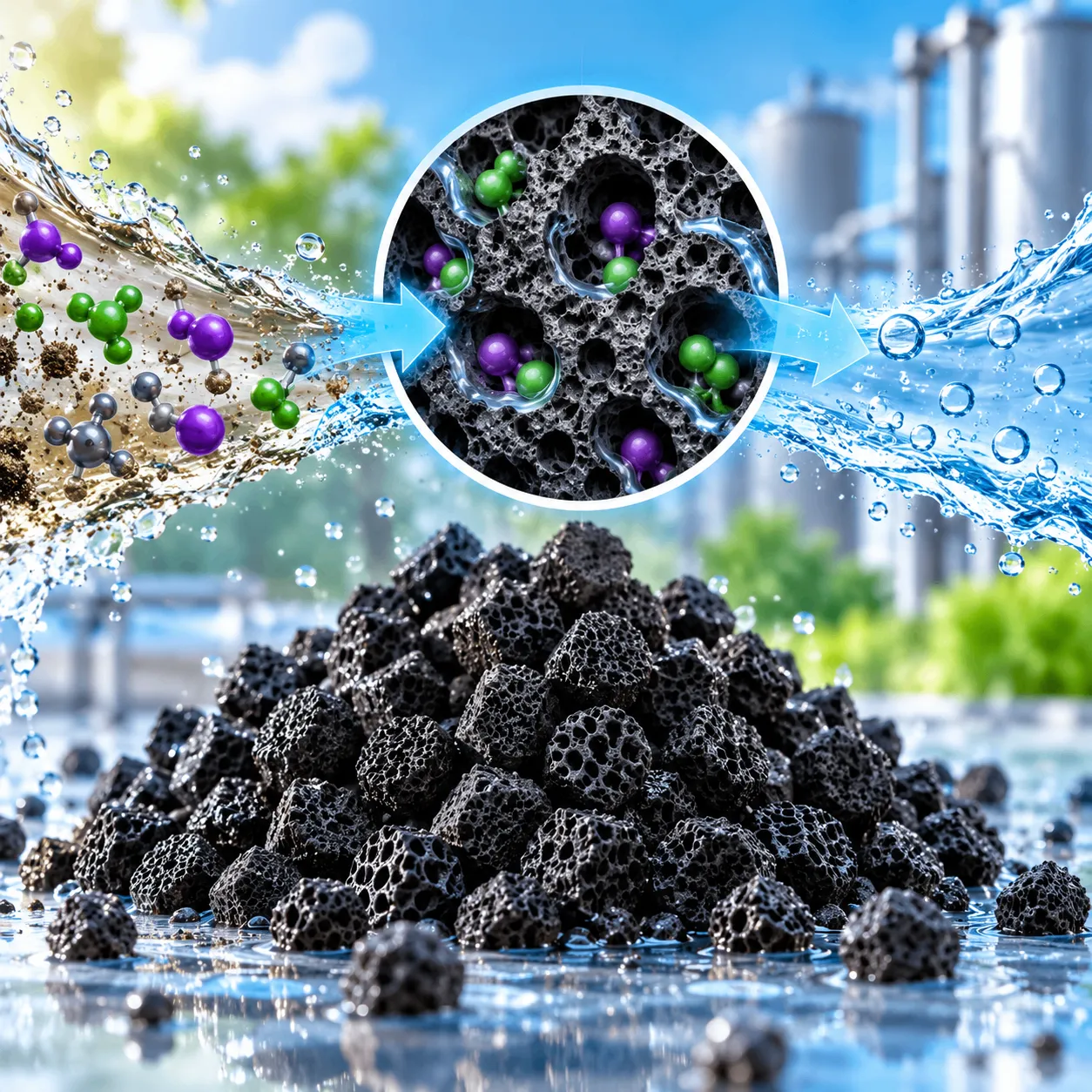
VINYLSORB® uses the internal pore structure of coconut-shell activated carbon to remove dissolved vinyl chloride through physical adsorption.
- Liquid-to-Solid Mass Transfer – Vinyl chloride molecules move from the bulk water to the external surface of the OrganoSorb® granules.
- Internal Pore Diffusion – The molecules diffuse into the carbon’s internal pore structure, where most of the available adsorption area is located.
- Surface Retention – Weak intermolecular forces retain adsorbable organic molecules on the internal carbon surface.
- Breakthrough-Controlled Operation – As adsorption sites become occupied, the outlet concentration gradually increases. Regular analytical monitoring identifies when the media requires replacement or validated regeneration.
Technical Data
Key properties, operating parameters, and specifications for OrganoSorb® media used in VINYLSORB®.
OrganoSorb® Media Properties & Operating Parameters
| Parameter / Property | Published Specification |
|---|---|
| Base material | Coconut-shell activated carbon |
| Appearance | Black, coarse granules |
| Particle size | 0.6–2.4 mm (U.S. mesh size: 8 × 30) |
| Total surface area | Approximately 1,500–1,600 m²/g |
| Moisture content | Maximum 5% |
| Bulk density | Approximately 630–640 kg/m³ |
| Media character | Described as acidic |
| Expected service life | Up to five years, condition-dependent |
| Flow direction | Upflow or downflow |
| System freeboard | 25–35% |
| Filtration rate | 10–20 BV/h (Brochure-text max: 40 BV/h) |
| Backwash velocity | 10–20 m/h |
| Bed depth | 80–100 cm (Max: 120 cm) |
| Minimum stated EBCT | 90 seconds |
| Standard packaging | 30 litres / approx. 19.2 kg (40 bags per pallet) |
Vinyl Chloride Regulatory Reference
- U.S. EPA Drinking-Water MCL: 0.002 mg/L (2 µg/L or 2 ppb) — enforceable standard.
- U.S. EPA MCLG: 0 mg/L — non-enforceable public health goal.
Download VINYLSORB® documents
Explore VINYLSORB®
adsorption technology


Frequently
Asked Questions
Essential information about vinyl chloride, OrganoSorb® and VINYLSORB® system operation.
Contact SupportBuild your VINYLSORB® treatment solution
It starts with accurate VOC analysis.
Send us your water-quality data, vinyl chloride concentration, flow requirements and discharge or tap objectives. Our specialists will help evaluate VINYLSORB® for your application and recommend the necessary treatment configuration.