Dissolve mineral deposits. Restore heat transfer. Recover system performance.
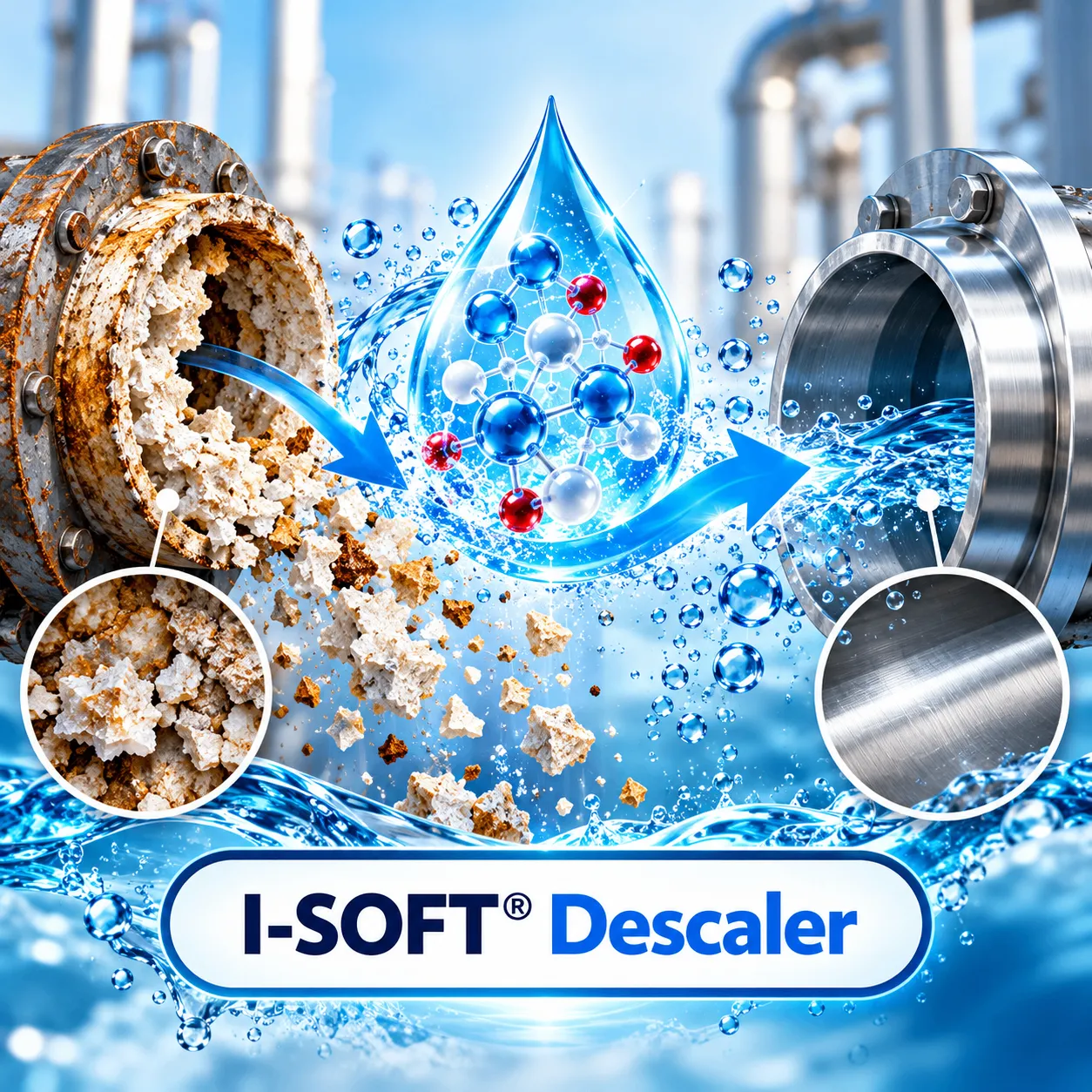
I-SOFT® Descaler is a concentrated acidic cleaning powder developed to dissolve carbonate scale, corrosion deposits and selected mixed mineral fouling from industrial water systems.
Scale and corrosion products restrict flow, reduce heat-transfer efficiency and increase energy consumption across boilers, cooling systems, heat exchangers and process equipment. I-SOFT® Descaler combines acidic cleaning chemistry with complexing, wetting and corrosion-inhibiting components. Once dissolved in water, the working solution penetrates mineral deposits, reacts with carbonate scale and helps retain released calcium, magnesium and metal ions in solution. A colour indicator is described on the existing webpage to show whether useful acid-cleaning capacity remains. The system is then drained, neutralised where required and thoroughly rinsed before returning to service.
Acid cleaning with metal-ion control / Visual activity indication
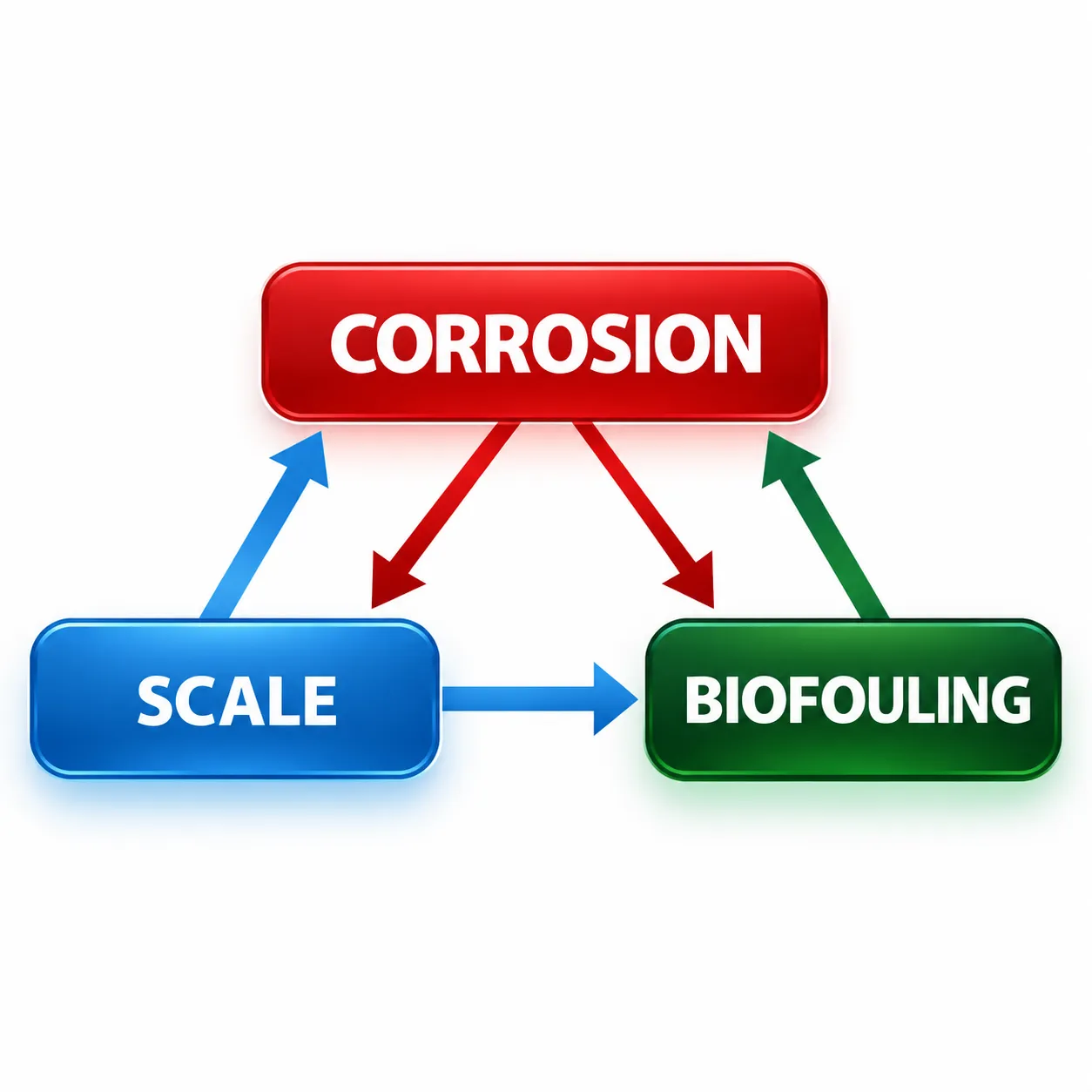
One concentrated cleaner.
Multiple descaling applications.
I-SOFT® Descaler can be applied through controlled circulation, soaking or equipment-specific cleaning procedures after confirming material compatibility.
Heat Exchangers
Dissolving carbonate scale and restoring thermal transfer efficiency in plate and shell exchangers.
Cooling Towers and Condensers
Removing scale and mineral fouling from evaporative condensers and recirculating loops.
Boilers and Heating Systems
Cleaning low- and high-pressure boiler components and closed heating loops.
Chillers and HVAC Equipment
Clearing mineral deposits from water chillers, air-conditioning units and cooling circuits.
Pipes and Water Circuits
Restoring flow through restricted process-water pipelines, valves and fittings.
Coffee and Beverage Equipment
Targeted descaling for commercial and industrial beverage service equipment.
Four cleaning actions / Inside one instant powder
Carbonate-scale dissolution (SCALE-DISSOLVE)
Acidic components react with calcium carbonate, converting solid scale into soluble or dispersed species while releasing carbon dioxide.
Released-metal complexing (ION-BIND)
Complexing components help keep dissolved calcium, magnesium and selected metals from immediately redepositing during cleaning.
Corrosion-inhibited cleaning (SURFACE-GUARD)
Formulation inhibitors are intended to reduce acid attack on compatible base metals when concentration, temperature and contact time remain within validated limits.
Visual activity indication (COLOR-ACTIVE)
The existing page describes an active pink or red solution that changes toward yellow as cleaning capacity becomes depleted.
Acid dissolution supported by complexing and dispersion
I-SOFT® Descaler removes deposits through chemical dissolution. The reaction products remain in the spent cleaning solution and must be safely drained, characterised and managed.
- Calcium Carbonate Dissolution – Carbonate scale reacts with hydrogen ions ($CaCO_{3(s)} + 2H^+ \rightarrow Ca^{2+} + CO_{2(g)} + H_2O$), generating carbon dioxide that requires ventilation and pressure relief.
- Magnesium Carbonate Dissolution – Magnesium carbonate deposits react similarly ($MgCO_{3(s)} + 2H^+ \rightarrow Mg^{2+} + CO_{2(g)} + H_2O$).
- Metal-Oxide Dissolution – Acid dissolves compatible oxide deposits, illustrated conceptually for ferric oxide ($Fe_2O_3(s) + 6H^+ \rightarrow 2Fe^{3+} + 3H_2O$).
- Metal-Ion Complexing – Complexing agents bind released ions ($M^{n+} + L \rightleftharpoons ML^{n+}$), reducing immediate reprecipitation.
Download I-SOFT® Descaler documents
Explore I-SOFT® Descaler Posters


Frequently
Asked Questions
Essential information about I-SOFT® Descaler preparation, compatibility, monitoring and disposal.
Contact SupportGet an industrial descaling solution
Safe cleaning begins with deposit analysis and material compatibility.
Send us your equipment type (heat exchanger, boiler, cooling tower), scale composition, system volume and cleaning objectives. Our specialists will help evaluate I-SOFT® Descaler for your maintenance procedure.
