Capture carbon dioxide / Convert it into stable carbonate products
CarboFix® is a family of liquid, powder, granular and bead-form absorbents proposed for capturing carbon dioxide from suitable air and process-gas streams.
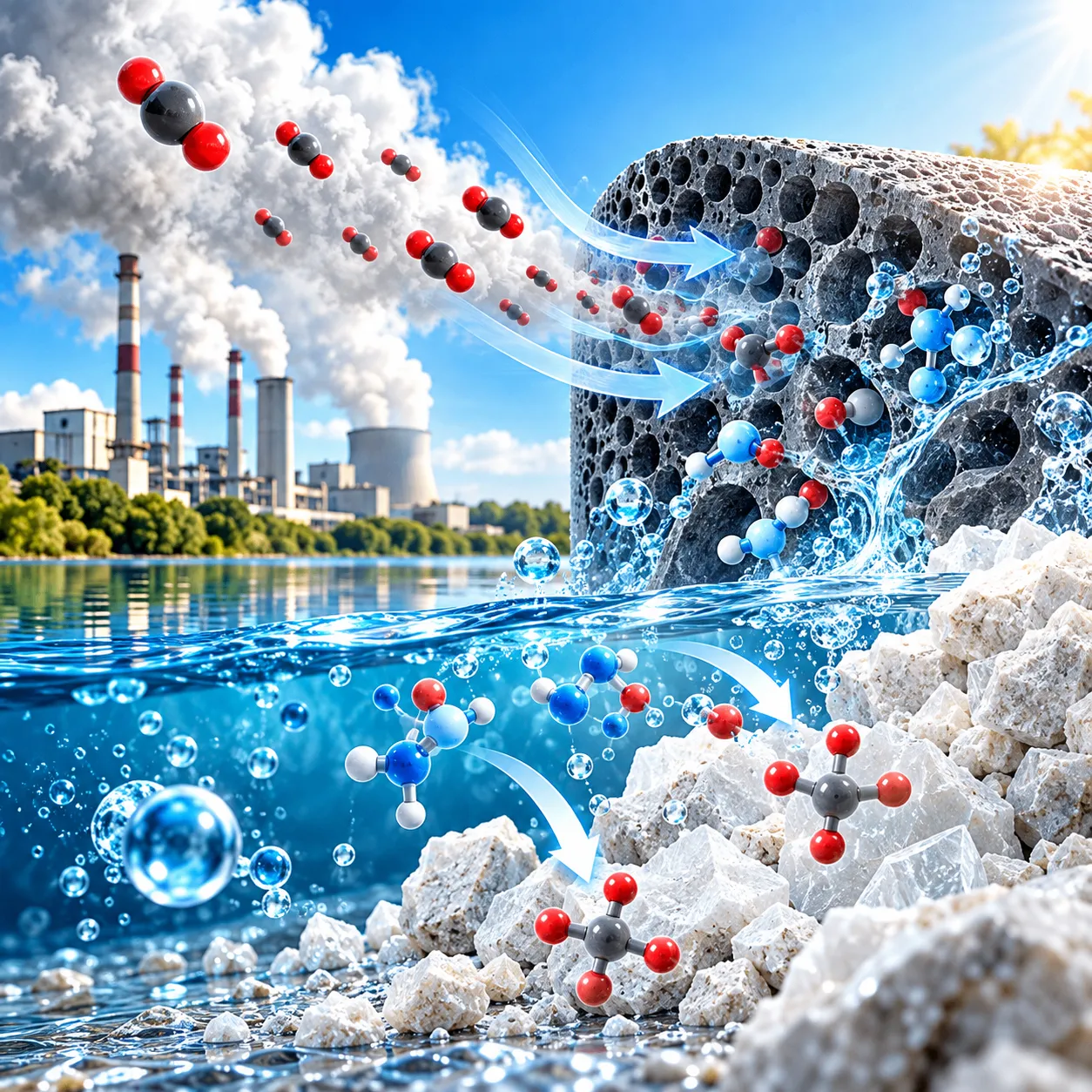
Developed under the Watch Air® platform, CarboFix® is presented as an alkaline carbon-capture technology incorporating porous absorbent structures and metal-based active components. Carbon dioxide contacts the alkaline phase and is converted through hydration, ionic reactions and mineralization into dissolved bicarbonate or solid carbonate products. Depending on the selected product form and process configuration, CarboFix® may be integrated with air scrubbers, gas-contact columns or controlled mineralization reactors. Every commercial installation requires gas characterization, mass-transfer testing, capacity validation, emission monitoring and safe management of the captured carbonate product.
From gaseous CO₂ / To manageable carbonate

One carbon-capture platform.
Multiple emission sources.
CarboFix® product forms can be evaluated for different gas-treatment and carbon-mineralization applications. Final suitability depends on CO₂ concentration, flow, moisture, temperature and competing contaminants.
Industrial Flue-Gas Treatment
Carbon-dioxide capture from characterized industrial exhaust streams after appropriate particulate and contaminant pretreatment.
Boilers and Combustion Systems
Treatment of combustion exhaust from suitable fuel-fired equipment using engineered gas-contact systems.
Biogas and Renewable-Gas Upgrading
Potential separation of carbon dioxide from methane-rich gas after controlling hydrogen sulfide, moisture and trace impurities.
Indoor and Enclosed-Space Air
CO₂ reduction in controlled recirculating-air systems with adequate ventilation and continuous monitoring.
Direct-Air-Capture Research
Evaluation of porous alkaline media for capturing low-concentration atmospheric carbon dioxide.
Carbonate Production and Utilization
Conversion of captured carbon into carbonate-containing products for approved storage or industrial utilization routes.
Four delivery formats for application-specific gas treatment
Liquid absorption chemistry (CARBOFIX-L)
A liquid formulation intended for gas–liquid contact systems where CO₂ is absorbed, hydrated and converted into dissolved carbonate or bicarbonate species.
Powdered reactive absorbent (CARBOFIX-P)
Fine-particle absorbent offering high accessible surface area for controlled dry, semi-dry or slurry-based carbon-capture processes.
Granular fixed-bed media (CARBOFIX-G)
Granular material intended for packed columns, gas scrubbers and other engineered contact systems requiring practical flow distribution.
Structured absorbent beads (CARBOFIX-B)
Mechanically structured beads designed for controlled gas flow, accessible porosity and potential recovery or washing of accumulated carbonate products.
Core functional features of CarboFix® technology
Mass Transfer & Absorption
Optimized gas-phase mass transfer ensures efficient transport of CO₂ from exhaust or air into the alkaline active sites.
Alkaline Conversion
Active metal components consume acidity, driving chemical equilibria toward stable bicarbonate and carbonate species.
Mineralization & Precipitation
Reacts with available divalent ions like calcium or magnesium to form solid, stable mineral carbonates for permanent sequestration.
Modular System Integration
Designed for flexible deployment in packed columns, wet scrubbers, fixed beds or slurry-based capture reactors.
From carbon dioxide to carbonate chemistry
CarboFix® is based on gas absorption followed by aqueous carbonate chemistry and, where suitable metal ions are available, precipitation as solid mineral carbonate.
- Gas-Phase Mass Transfer – CO₂ moves from gas stream to liquid/solid surface; performance depends on contact area, residence time, temperature, moisture and partial pressure.
- Carbonic-Acid & Bicarbonate Formation – Dissolved $CO_2$ establishes equilibria with carbonic acid, bicarbonate and carbonate ($CO_2 + H_2O \rightleftharpoons H_2CO_3 \rightleftharpoons H^+ + HCO_3^- \rightleftharpoons 2H^+ + CO_3^{2-}$).
- Alkaline CO₂ Capture – Alkaline components consume acidity, shifting equilibrium toward usable bicarbonate and carbonate capacity.
- Carbonate Mineralization – Divalent calcium or magnesium ions react with carbonate to form solid minerals ($Ca^{2+} + CO_3^{2-} \rightarrow CaCO_{3(s)}$ and $Mg^{2+} + CO_3^{2-} \rightarrow MgCO_{3(s)}$).
Download CarboFix® documents
Explore CarboFix® Posters


Frequently
Asked Questions
Essential information about CarboFix®, CO₂ absorption, carbonate mineralization and process integration.
Contact SupportBuild a verified carbon-capture solution
Effective carbon management starts with the gas source, process conditions and measurable performance.
Send us your gas stream composition (CO₂ concentration, flow rates, temperature, moisture) and carbon capture objectives. Our specialists will help evaluate CarboFix® (Liquid, Powder, Granular, or Bead) for your industrial application.
