
twomit.com

NitroTrapp®

Selective, regenerable nitrate-removal media for drinking water and industrial applications

Advanced Nitrate Removal

Selective nitrate capture. Reliable water quality. Repeatable regeneration.

NitroTrapp® is a nitrate-selective, regenerable anion-exchange media engineered to reduce nitrate concentrations in residential, commercial, municipal and industrial water-treatment systems.

Nitrate contamination commonly originates from agricultural fertilisers, livestock operations, septic systems, landfill leachate and industrial discharges. Because nitrate is highly soluble, it can migrate through soil and accumulate in groundwater over time. NitroTrapp® uses functionalised spherical beads supplied in the chloride form to selectively capture nitrate ions while allowing treated water to pass through the media bed. Once the available capacity is exhausted, the media can be regenerated using a controlled brine cycle and returned to service. Proper system sizing must consider nitrate loading, sulfate competition, flow rate, target concentration, regeneration efficiency and applicable water-quality limits.

High nitrate selectivity / Regenerable long-term performance
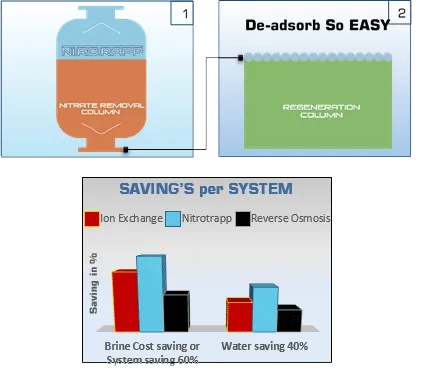
NitroTrapp Introduction

One selective media.
From household wells to municipal plants.

NitroTrapp® systems can be configured for point-of-use cartridges, point-of-entry vessels and large automated treatment plants using either upflow or downflow service arrangements.

Municipal Drinking Water

Large-scale automated treatment systems ensuring compliance with municipal drinking-water nitrate standards.

Groundwater and Rural Wells

Reliable reduction of agricultural and runoff-derived nitrate in private and community well supplies.

Point-of-Entry Systems

Whole-house pressure vessels configured for continuous residential and commercial nitrate protection.

Food and Beverage Processing

Consistent water quality for food production, ingredient blending and beverage manufacturing.

Agricultural and Aquaculture Water

Optimising water safety for fish farming, irrigation and livestock operations.

Industrial and Wastewater Treatment

Handling nitrate-rich process water, runoff and industrial discharge streams.

Four intelligent functions / Built into one nitrate-removal technology

Selective nitrate capture (SELECT-NO₃)

Functional groups on the NitroTrapp® beads preferentially capture nitrate ions from the water and release chloride ions during the service cycle.

Efficient media-bed utilisation (HIGH-CAPACITY)

Uniform spherical beads, controlled hydraulic distribution and an appropriate bed depth help promote consistent contact and minimise premature breakthrough.

Repeatable six-stage regeneration (REGEN-6)

A controlled backwash, brine, displacement-rinse and final-rinse sequence removes captured nitrate and restores the media for another service cycle.

Scalable system engineering (SCALE-FLEX)

NitroTrapp® can be installed in compact residential vessels or custom-engineered treatment trains for commercial and municipal flow rates.

The chemistry behind selective nitrate removal

NitroTrapp® operates through reversible anion exchange. Nitrate is captured during service and displaced into a concentrated regenerant stream during regeneration.

  • Nitrate Capture – Supplied in chloride form; nitrate ions displace chloride ions from positively charged functional sites ($R–N^+Cl^- + NO_3^- \rightleftharpoons R–N^+NO_3^- + Cl^-$).
  • Selectivity and Competition – Nitrate-selective resin chemistry improves capture in competing waters, though sulfate, bicarbonate, chloride, phosphate and organics still affect operating capacity.
  • Regeneration – A concentrated chloride solution reverses the loading reaction ($R–N^+NO_3^- + Cl^- \rightleftharpoons R–N^+Cl^- + NO_3^-$), transferring nitrate into spent regenerant.
  • Breakdown Management – Systems regenerate before applicable nitrate limits are exceeded, using influent loading, throughput or online monitoring.
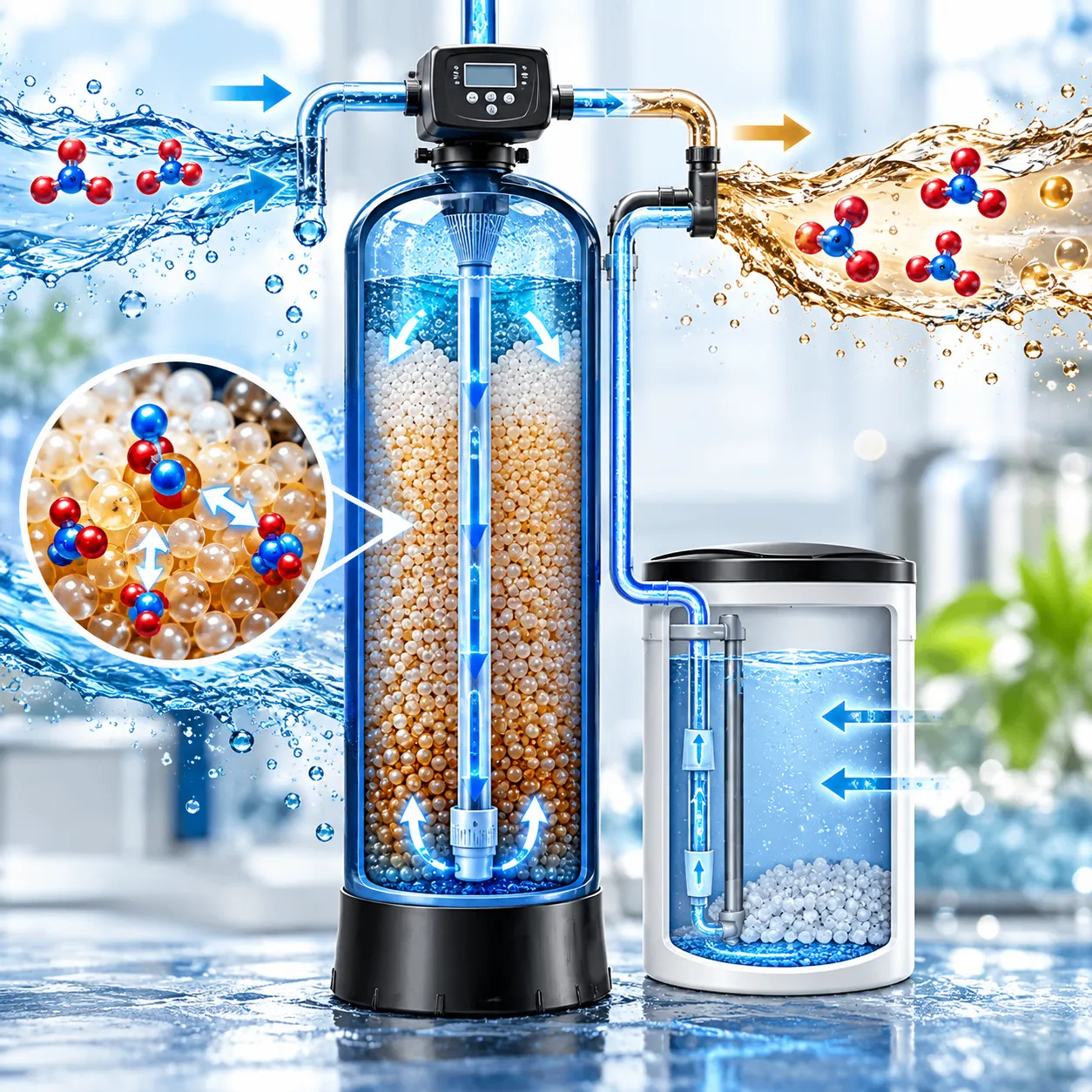
NitroTrapp Science and Technology

Explore nitrate removal science and applications

Loading Poster Library…
Understanding Nitrate Contamination
July 2019

Understanding Nitrate Contamination

How fertilisers, livestock operations and wastewater contribute to nitrate accumulation in groundwater.

Selective Nitrate Capture
July 2019

Selective Nitrate Capture

A visual explanation of how NitroTrapp® functional sites capture nitrate and release chloride.

The NitroTrapp Treatment Cycle
July 2019

The NitroTrapp® Treatment Cycle

Follow the complete process from raw-water distribution to nitrate-reduced water.

Six-Stage Regeneration
July 2019

Six-Stage Regeneration

Service, backwash, brine draw, slow rinse, fast rinse and return-to-service stages.

Nitrate Treatment for Rural Wells
July 2019

Nitrate Treatment for Rural Wells

Protecting private and community groundwater supplies affected by agricultural nitrate.

Municipal Nitrate Removal
July 2019

Municipal Nitrate Removal

Scalable pressure-vessel systems for continuous municipal drinking-water treatment.

Managing Regeneration Brine
July 2019

Managing Regeneration Brine

Responsible collection, analysis, treatment and potential recovery of nitrate-rich regenerant.

Monitoring Nitrate Breakthrough
July 2019

Monitoring Nitrate Breakthrough

Using water analysis and operating data to determine the correct regeneration endpoint.

Frequently
Asked Questions

Important information about NitroTrapp® operation, regeneration, applications and water-quality monitoring.

Contact Support
What is NitroTrapp®?
NitroTrapp® is a selective, regenerable anion-exchange media designed to reduce nitrate concentrations in drinking water, groundwater, process water and suitable wastewater applications.
How does NitroTrapp® remove nitrate?
Positively charged functional groups on the media capture nitrate ions and release chloride ions. During regeneration, concentrated chloride displaces the captured nitrate and restores the media.
Why is nitrate removal important?
Excessive nitrate can make drinking water non-compliant and poses a serious risk to infants, particularly through methemoglobinemia. Nitrate also contributes to nutrient pollution in receiving waters.
Is NitroTrapp® different from standard anion-exchange resin?
It is still an anion-exchange technology, but its resin chemistry is designed to provide improved nitrate selectivity. Comparative capacity must be demonstrated under the same water conditions.
Does sulfate affect nitrate removal?
Nitrate-selective media can reduce sulfate interference compared with conventional strong-base anion resins, but sulfate and other competing anions can still influence usable capacity and breakthrough.
Which regenerant should be used?
The current brochure identifies sodium chloride as the standard regenerant. Potassium or magnesium-based alternatives are mentioned for selected applications but require technical validation.
Can spent regenerant be used as fertiliser?
Potential agricultural reuse depends on its complete chemical composition, salinity, contaminants and local fertiliser, waste and groundwater regulations. It must not be applied directly without analysis and regulatory approval.
Can NitroTrapp® be used in POU and POE systems?
Yes. It can be used in appropriately sized point-of-use cartridges and point-of-entry pressure vessels, provided flow, capacity, regeneration and hygienic requirements are satisfied.
How frequently is regeneration required?
Frequency depends on influent nitrate, competing ions, media volume, flow, target concentration and usable operating capacity. It must be based on site-specific loading and breakthrough data.
What is the expected media life?
Media life depends on regeneration conditions, oxidant exposure, organic fouling, suspended solids and mechanical stress. A universal two-to-five-year lifespan should not be guaranteed without operating evidence.
Is NitroTrapp® suitable for drinking water?
It may be used only when the supplied media and complete system meet applicable potable-water material, purity, microbiological and certification requirements.
What parameters should be monitored?
Monitor nitrate as both NO₃⁻ and nitrate-nitrogen where required, together with sulfate, chloride, bicarbonate, pH, conductivity, organic matter, turbidity, flow, treated volume and regenerant strength.

Get a nitrate-removal solution

It starts with complete water analysis.

Send us your water characteristics (nitrate levels, sulfate, flow rates, target compliance limit) and system requirements. Our specialists will help evaluate NitroTrapp® for your facility.

Selective Nitrate Capture for Safer Water

Water treatment facility overview