One advanced adsorber / A wider contaminant spectrum
HYDROSORB® is a high-performance adsorber combining activated carbon with Watch Water®’s proprietary FerroPhos surface treatment and framework-based adsorption technology.
HYDROSORB® is designed to capture selected organic compounds, metals, taste-and-odor substances and emerging contaminants from drinking water, industrial water and wastewater. Its granular activated-carbon base provides an extensive network of micro-, meso- and macropores. The FerroPhos coating and described COF/MOF functionality introduce additional adsorption, complexation and redox-active sites. This multi-mechanism structure enables HYDROSORB® to target a broader range of contaminants than standard activated carbon alone. It can be installed in point-of-use, point-of-entry, commercial, municipal and industrial pressure-vessel systems using either upflow or downflow service.
Activated carbon + functional coating / Advanced adsorption performance
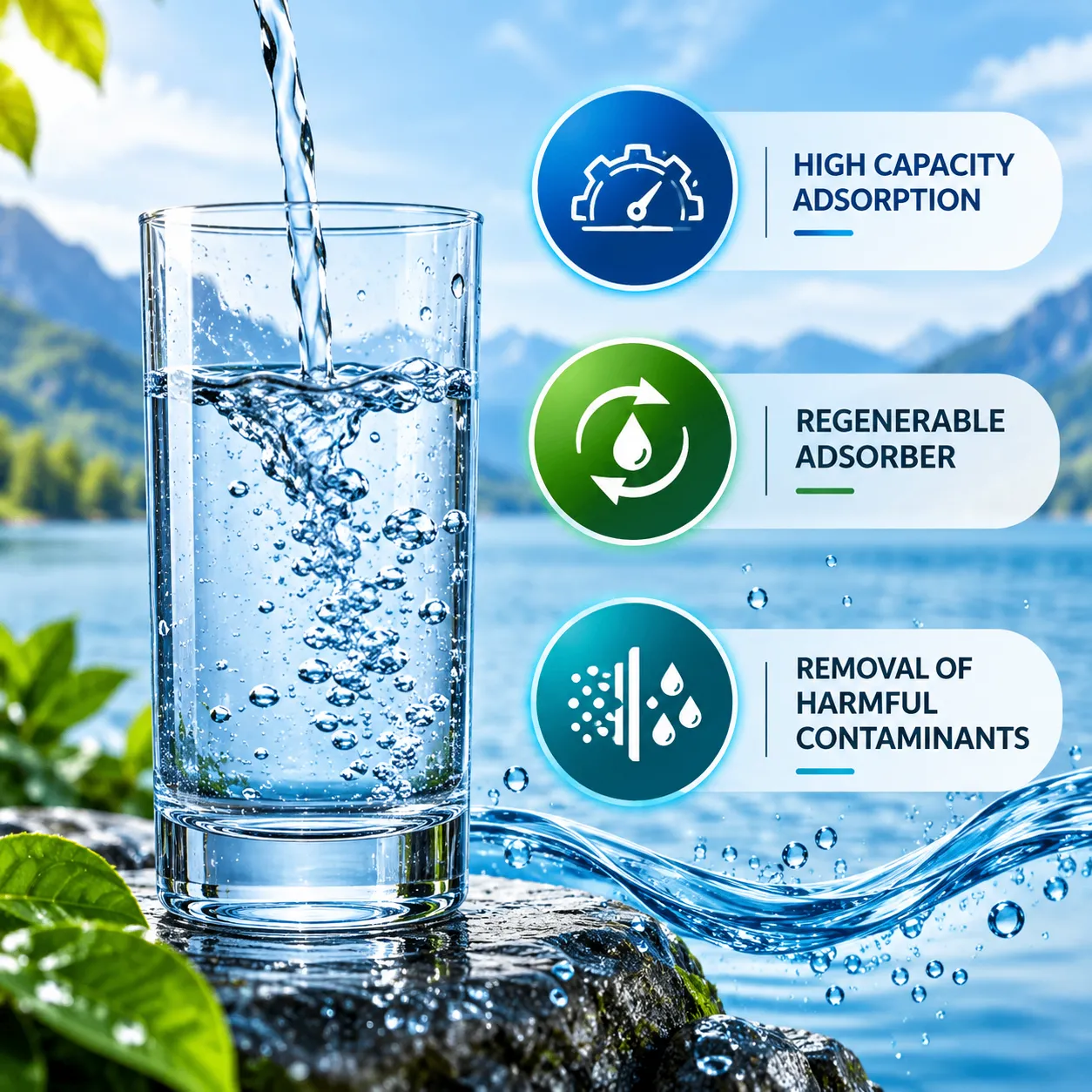
One adsorber.
Multiple water-treatment challenges.
HYDROSORB® can be integrated into residential, commercial, municipal and industrial treatment systems. Contaminant-specific testing is required to establish capacity, breakthrough behavior and regeneration suitability.
Drinking-Water Treatment
Point-of-use, point-of-entry, commercial and municipal adsorption systems.
PFAS and Emerging Contaminants
Adsorption treatment for selected PFAS, pharmaceuticals and personal-care compounds.
Industrial Wastewater Treatment
Treatment of selected organics, metals, solvents and industrial process contaminants.
Taste, Odor and VOC Control
Reduction of MIB, hydrogen sulfide, solvents and odor-causing organic compounds.
Heavy-Metal Treatment
Adsorption, complexation and redox-assisted capture of selected dissolved metals.
Environmental Remediation
Treatment of contaminated groundwater, landfill-impacted water and remediation streams.
Four treatment mechanisms engineered into one media
Multi-scale pore adsorption
The activated-carbon base provides micro-, meso- and macropores for capturing organic compounds of different molecular sizes.
Iron-assisted contaminant capture
Iron-containing surface sites can support electrostatic attraction, complexation, adsorption and redox reactions with selected metals and organic contaminants.
Phosphorus-functionalized binding sites
The described FerroPhos treatment introduces functional sites intended to improve affinity for selected metals, nutrients and radioactive contaminants.
COF/MOF-inspired surface functionality
The brochure describes covalent-organic and metal-organic framework functionality that creates tunable adsorption sites for selected emerging contaminants.
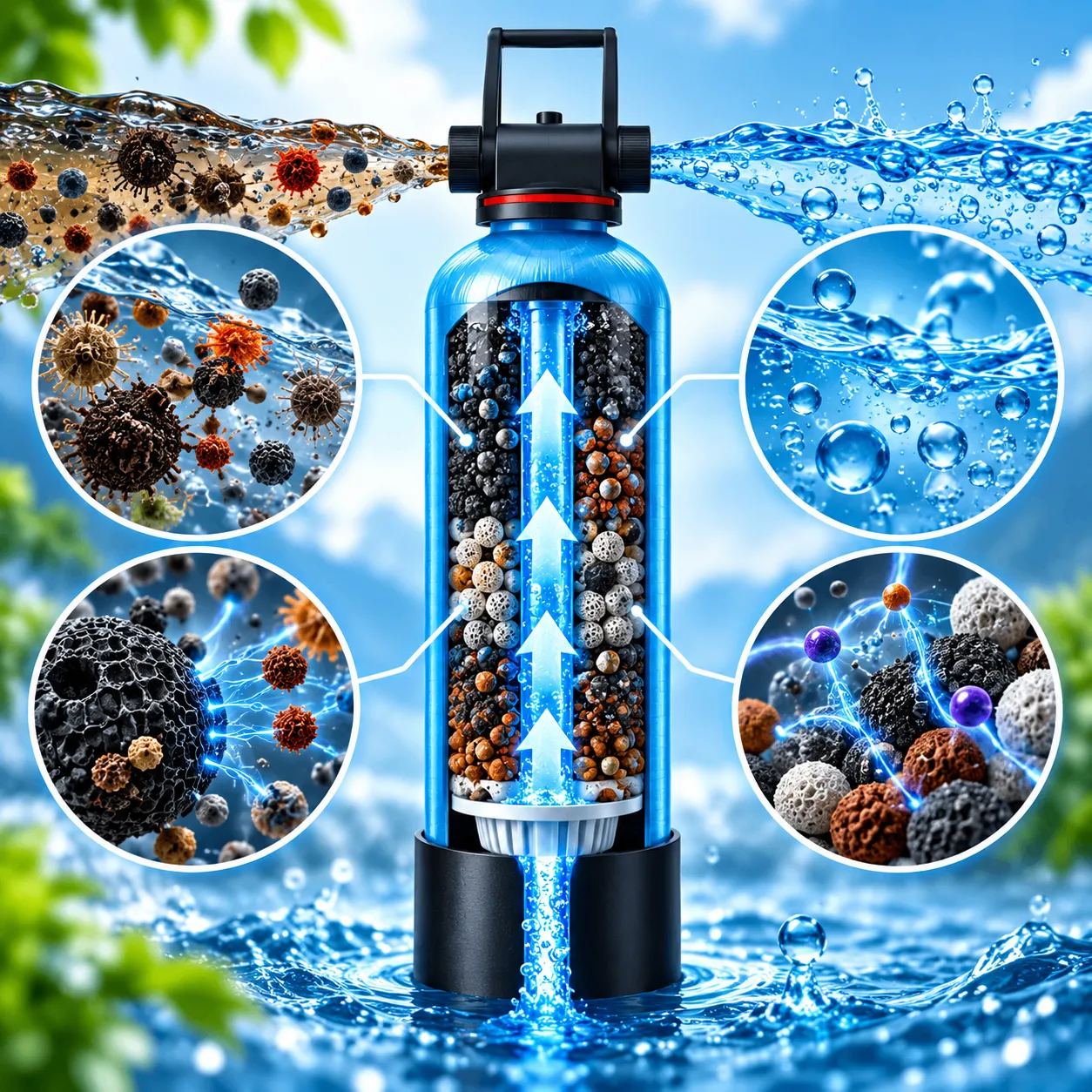
Multi-mechanism surface chemistry for advanced adsorption
HYDROSORB® combines physical adsorption, electrostatic attraction, surface complexation and redox-active interactions within one granular medium.
- Physical Adsorption – Organic molecules are retained within the activated-carbon pore network through dispersion forces and surface interactions.
- Electrostatic Attraction – Positively or negatively charged surface regions may attract oppositely charged contaminant species.
- Surface Complexation – Iron- and phosphorus-containing functional sites can form surface complexes with selected dissolved metals.
- Redox-Assisted Treatment – Zero-valent or ferrous iron sites may transform selected contaminants into less mobile or more readily adsorbed forms.
Regeneration Process & Steps
HYDROSORB® is designed to be regenerable using a 10% Instant Oxydes® solution following proper countercurrent contact protocols.
Step 1: Initial Rinse
Rinse the media with clean water to remove loose solids and prepare the bed for regeneration.
Step 2: Prepare Regenerant
Prepare Instant Oxydes® solution in a dedicated chemical-resistant tank using current product instructions and SDS.
Step 3: Countercurrent Contact
Introduce the regenerant opposite to the normal service-flow direction to improve media contact and reduce channeling.
Step 4: Contact Period
Allow approximately one hour for general applications or two hours for emerging contaminants.
Step 5: Final Rinse
Rinse thoroughly to remove residual oxidant, released contaminants and transformation by-products.
Step 6: Verify Before Service
Confirm acceptable pH, oxidant residual, turbidity, TOC and target concentrations before returning to service.
Download our latest HYDROSORB® documents
Explore the HYDROSORB®
technology library


Frequently
Asked Questions
Learn about HYDROSORB® composition, applications, PFAS treatment, regeneration and system operation.
Contact SupportGet an advanced adsorption solution
It all starts with identifying your target contaminants.
Send us your complete water analysis, target-contaminant concentrations, required treated-water limits and flow conditions. Our specialists will evaluate whether HYDROSORB® is appropriate and recommend the necessary pilot testing and treatment configuration.