Carbon adsorption enhanced by iron-based surface chemistry
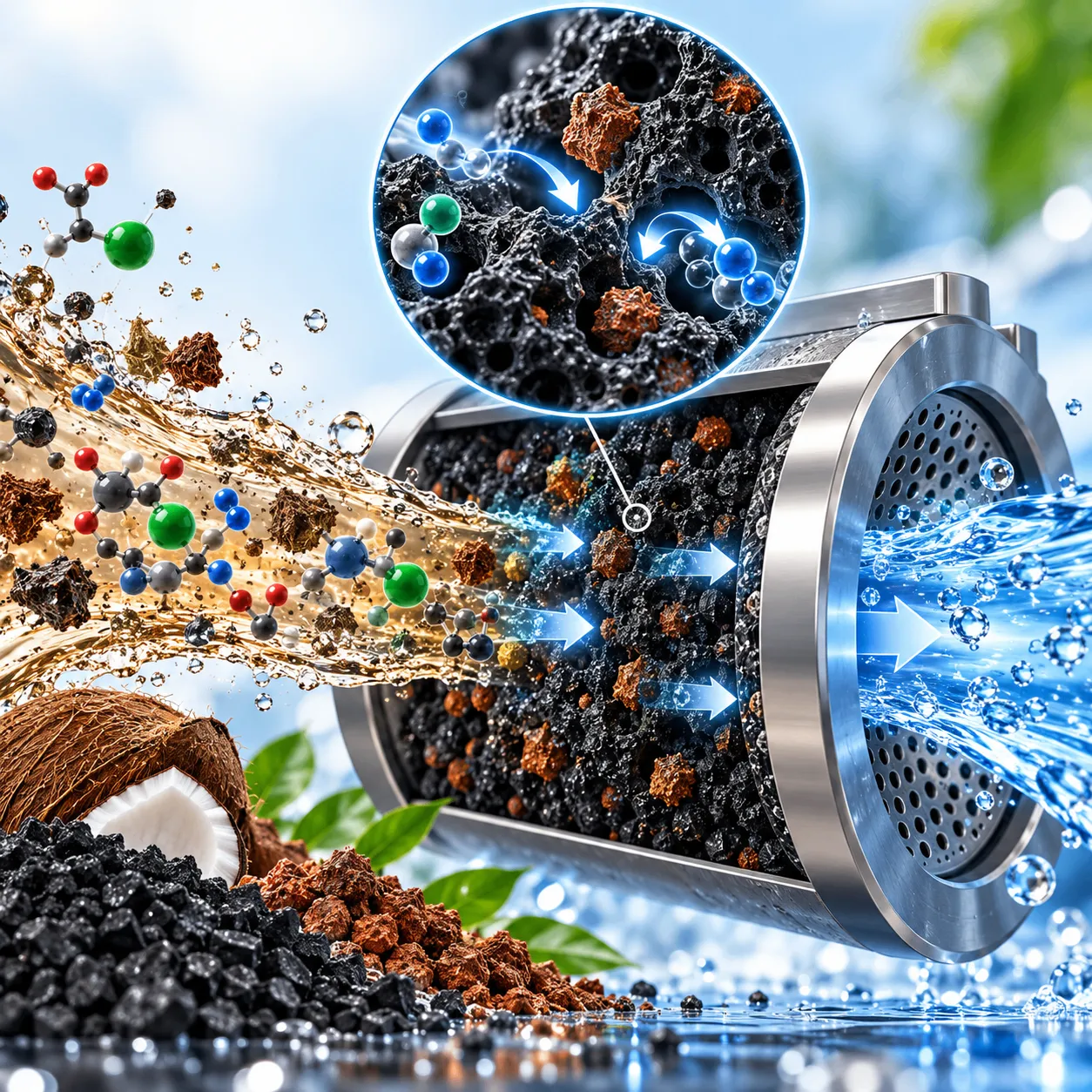
CATALYTIC CARBON® is an iron-enhanced coconut-shell granular activated carbon developed for chloramine reduction, natural organic matter adsorption and selected inorganic-contaminant treatment.
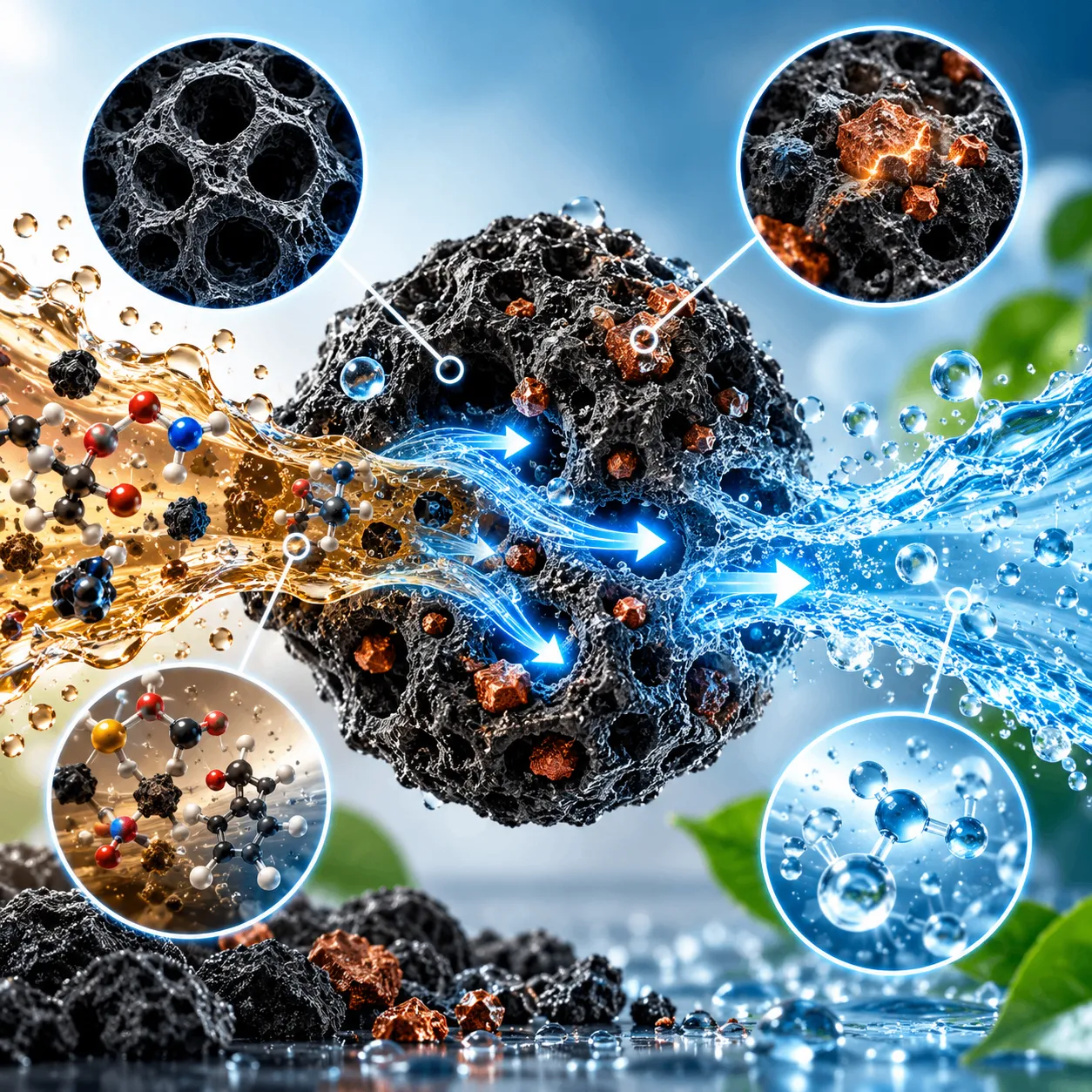
The media combines the high internal surface area and organic adsorption characteristics of coconut-shell activated carbon with an iron oxide or iron oxyhydroxide surface treatment. This hybrid structure provides physical adsorption sites for dissolved organic compounds, catalytic sites for chloramine reduction and positively charged iron-based surfaces that may improve the retention of selected negatively charged contaminants.
Catalytic reduction / High-capacity adsorption
One catalytic carbon.
Multiple water-treatment objectives.
CATALYTIC CARBON® can operate as a primary adsorption stage, catalytic dechlorination barrier or final polishing media. Performance must be validated against the actual water chemistry and target contaminant.
Municipal Drinking Water
Advanced fixed-bed filtration and organic reduction for public water systems.
Chloramine and Chlorine Reduction
Catalytic surface reduction of disinfectant residuals in municipal and industrial supplies.
Taste, Odor and Color Control
Removal of tannins, humic substances, phenols and aesthetic taste-causing compounds.
Food and Beverage Water
Polishing and dechlorination for food processing, bottling and beverage production.
Industrial Wastewater and Reuse
Organic pollutant reduction and polishing in industrial water-reuse circuits.
RO and Ion-Exchange Protection
Pretreatment barrier removing oxidants and organics to protect downstream membranes and resins.
Four treatment functions within one granular media
High-surface-area organic adsorption (ORGANIC-SORB™)
The porous coconut-shell carbon structure captures humic substances, tannins, lignin, phenols, taste-and-odor compounds and other adsorbable organics.
Catalytic disinfectant reduction (CHLORAMINE-CAT™)
Surface catalytic sites accelerate the reduction of chlorine and chloramine species compared with adsorption alone, subject to sufficient contact time and water conditions.
Iron-based surface attraction (IRON-AFFINITY™)
Iron oxide or oxyhydroxide sites provide pH-dependent affinity for selected negatively charged substances, including some natural organic matter and certain oxyanions.
Application-specific oxidative cleaning (OXY-RENEW™)
The brochure presents OXYDES-P® treatment as a method for cleaning or regenerating loaded media. Capacity recovery must be confirmed for the actual contaminants and number of treatment cycles.
Porous carbon modified with iron-based catalytic sites
CATALYTIC CARBON® combines physical adsorption, catalytic surface reactions and pH-dependent iron-surface interactions.
- Coconut-Shell Carbon Structure – A network of micro- and mesopores provides extensive internal surface for adsorbing dissolved organic molecules.
- Iron-Based Surface Modification – Iron-based particles approximately 20–50 nm in size are distributed across external and internal carbon surfaces.
- Catalytic Chloramine Reduction – Catalytic surface sites support chemical reduction of disinfectant residuals, with reaction products and breakthrough depending on pH, temperature, contact time and disinfectant concentration.
- Electrostatic Surface Interaction – Iron hydroxide surface charge changes with pH, potentially improving adsorption of negatively charged humic substances and certain inorganic species.
Technical Data
Key properties, operating parameters, and specifications for CATALYTIC CARBON® media.
Physical & Operating Properties
| Property | Published Value |
|---|---|
| Base material | Coconut-shell granular activated carbon |
| Surface treatment | Iron oxide / iron oxyhydroxide |
| Website-listed FeOOH content | Approximately 10% |
| Appearance | Red-black coarse granules |
| Particle size | 0.6–2.4 mm (U.S. mesh size: 8 × 30) |
| BET surface area | 2,000–2,500 m²/g |
| Bulk density | 630–640 kg/m³ |
| Moisture content | Maximum 5% |
| Ball-pan hardness | Minimum 98% |
| Published extract pH value | 9.5 |
| Expected service life | Approximately 2–5 years, condition-dependent |
| Flow direction | Upflow packed bed or downflow |
| Downflow freeboard | 25–35% |
| Service rate | 10–30 BV/h (Max: 40 BV/h) |
| Backwash velocity | 10–20 m/h |
| Bed depth | 80–100 cm (Max: 120 cm) |
| Minimum stated EBCT | 90 seconds |
Packaging Information
- Standard bag: 30 litres (~16 kg) | Pallet: 40 bags (~665 kg gross)
- Bulk bag: 1,000 litres (~535 kg) | Bulk-pallet gross weight: ~560 kg
Download CATALYTIC CARBON® documents
Explore CATALYTIC CARBON®
treatment technology


Frequently
Asked Questions
Essential information about CATALYTIC CARBON® selection, operation and regeneration.
Contact SupportCalculate Your CATALYTIC CARBON® System
Determine the required media volume and empty-bed contact time (EBCT) based on your design flow rate.
Sizing Recommendation
Build your catalytic carbon treatment system
It starts with your complete water analysis.
Send us your chloramine, chlorine, organic loading, pH, temperature and flow requirements. Our specialists will help evaluate CATALYTIC CARBON® for your application and recommend the necessary treatment configuration.