Remove dissolved oxygen / Protect water infrastructure
OXYLOCK® is a granular adsorption-redox treatment medium developed to reduce dissolved oxygen in industrial water systems without continuous dosing of conventional oxygen-scavenger chemicals.
Dissolved oxygen is a major contributor to corrosion in boilers, pipelines, heat exchangers, condensate systems and industrial process-water equipment. When oxygen reaches susceptible metal surfaces, it participates in electrochemical reactions that can cause localized attack, pitting and premature equipment failure. OXYLOCK® uses a proprietary framework matrix containing adsorption sites and electrochemically active structures. Water passes through a packed media bed where dissolved oxygen is captured or chemically transformed within the active framework. The technology is intended to reduce dependence on hydrazine, sulfite, carbohydrazide, DEHA and other conventional oxygen-scavenger programs. OXYLOCK® can be integrated into upflow or downflow pressure-vessel systems for continuous industrial operation.
No continuous scavenger dosing / Advanced dissolved-oxygen control
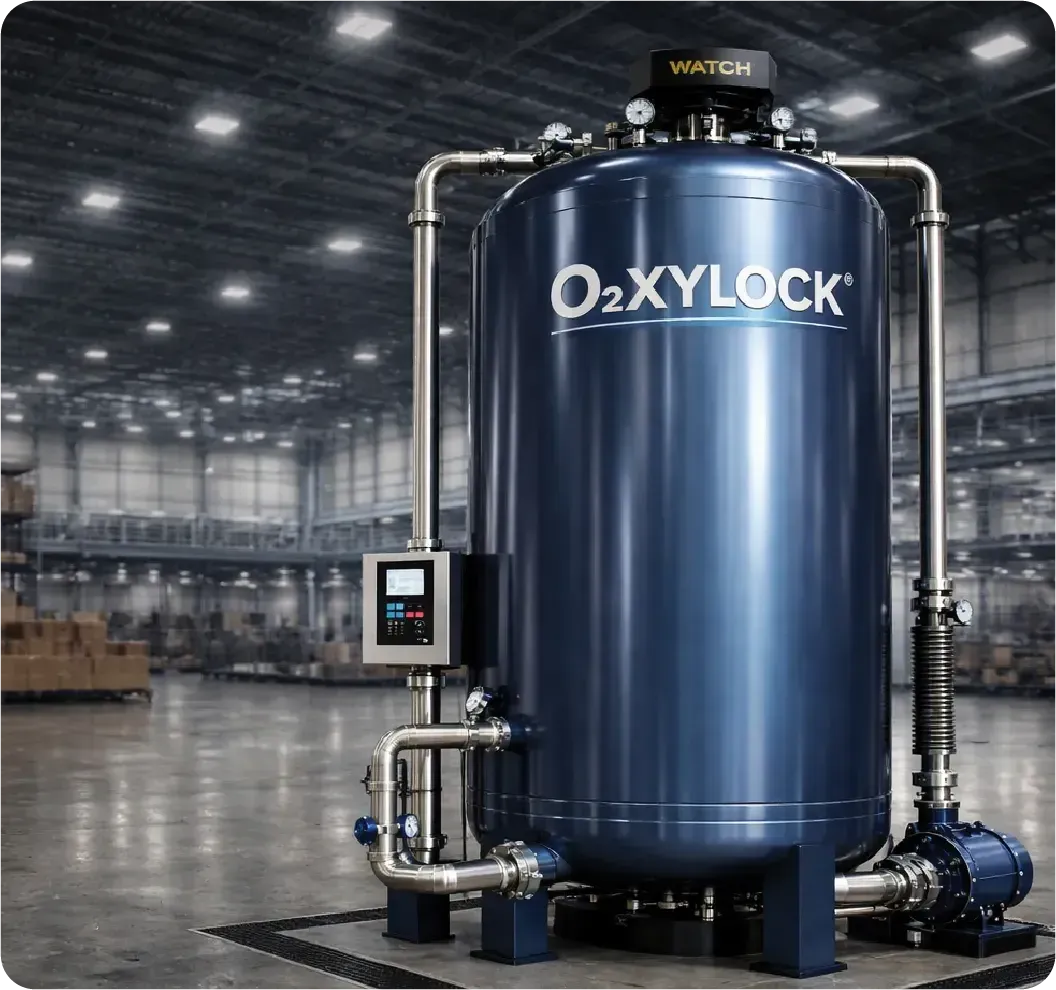
One oxygen-control media.
Multiple critical applications.
OXYLOCK® is intended for systems where dissolved oxygen contributes to corrosion, oxidation or process instability. Application suitability must be confirmed using feed-water chemistry, temperature, pressure and target dissolved-oxygen concentration.
Steam Boilers
Dissolved-oxygen reduction in boiler makeup and feedwater treatment.
Power Plants
Protection of steam-cycle, condensate and auxiliary water equipment.
Industrial Process Water
Oxygen control for pipelines, tanks, heat exchangers and process-water circuits.
Oil and Gas Injection Systems
Reduction of oxygen-related corrosion and microbiological risk in injection water.
Heating and Cooling Systems
Oxygen reduction in closed-loop heating, district-energy and cooling circuits.
Semiconductor Manufacturing
Dissolved-oxygen control for sensitive process and high-purity water applications.
Four oxygen-control mechanisms inside one media
High-surface-area oxygen adsorption
The framework matrix provides extensive internal surface area and multiple active sites for contacting and retaining dissolved oxygen from the water phase.
Internal electrochemical activity
Anodic and cathodic functional regions are intended to support electron-transfer reactions that transform captured oxygen into more stable bound species.
Oxygen stabilization within the media
Captured oxygen is retained or reacted within the active framework to limit its return to the treated-water stream before media breakthrough.
Low-oxygen corrosion protection
Reducing dissolved oxygen decreases the cathodic oxygen-reduction reaction responsible for many forms of corrosion in susceptible water systems.
Advanced framework technology for dissolved-oxygen reduction
OXYLOCK® combines molecular adsorption with electrochemical functionality in a packed-bed treatment medium designed to reduce dissolved oxygen without continuous chemical injection.
- Framework-Based Adsorption – Microporous structures provide internal surface area for dissolved-oxygen capture.
- Anodic and Cathodic Sites – Functional regions within the media are described as creating an internal electrochemical environment.
- Oxygen Transformation – Captured oxygen may participate in reduction reactions and become incorporated into stable surface or framework-bound species.
- External Power Not Required – The media is described as operating through its internal chemical and electrochemical potential rather than an externally powered electrode system.
Download our latest OXYLOCK® documents
Explore the OXYLOCK®
technology library


Frequently
Asked Questions
Learn about OXYLOCK® technology, dissolved-oxygen control, applications, operation and monitoring.
Contact SupportGet an advanced oxygen-control solution
It all starts with your water and operating conditions.
Send us your influent and target dissolved-oxygen levels, flow rate, temperature, pressure, pH, conductivity and application details. Our specialists will evaluate whether OXYLOCK® is suitable for your system.