
twomit.com

FILTERSORB® SP3

Advanced Salt-Free Scale Prevention Based on NAC Technology

Salt-Free Scale Prevention

Transform hardness. Prevent scale. Preserve essential minerals.

FILTERSORB® SP3 is an advanced scale-prevention media based on Nucleation Assisted Crystallization technology. It helps prevent limescale without salt, chemical dosing, ion exchange or regeneration.

Developed by Watch Water® Germany, FILTERSORB® SP3 transforms dissolved carbonate hardness into stable, non-adhering calcium-carbonate microcrystals. Calcium and magnesium remain in the treated water, while their scale-forming behavior is altered. Unlike conventional sodium-based softeners, the process does not replace hardness minerals with sodium and requires no brine-producing regeneration cycle. The technology is suitable for residential, commercial, food-service and industrial applications where scale prevention—not hardness removal—is the primary objective[cite: 3].

No salt. No chemicals. No regeneration. No wastewater.

Scale prevention without removing calcium and magnesium.
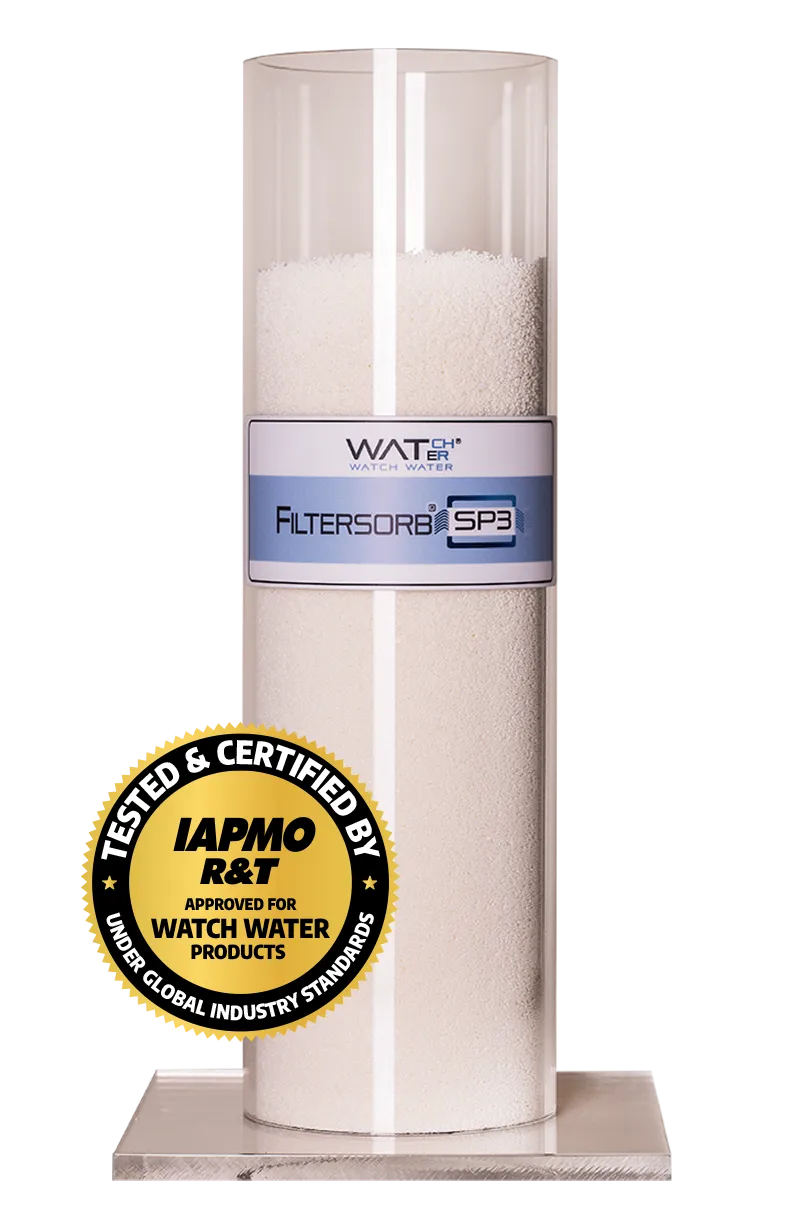
FILTERSORB SP3 Introduction

One media.
Comprehensive scale protection.

FILTERSORB® SP3 can be integrated into point-of-use, point-of-entry, commercial and industrial systems. It is particularly suitable for equipment where carbonate-scale accumulation reduces efficiency, restricts flow or increases maintenance.

Residential and Whole-House Water

Suitable for faucets, pipelines, showers, toilets, dishwashers, washing machines, water heaters and whole-house systems.

Hotels, Restaurants and Food Service

Protects catering equipment, coffee machines, tea makers, ice makers, vending machines and commercial water heaters.

Boilers and Heating Systems

Helps protect hot-water boilers, combination boilers, central heating, pool heaters and heat-transfer surfaces.

Cooling Towers and Heat Exchangers

Suitable for open- and closed-circuit cooling towers, heat exchangers, air-conditioning equipment and water coolers.

Food, Beverage and Process Water

Supports wineries, dairy processing, breweries, beverage production, coffee preparation and other mineral-sensitive applications.

Industrial and Special Applications

Suitable for manufacturing, injection moulding, irrigation, nurseries, car washing, swimming pools, spas and reverse-osmosis pretreatment.

Four advantages engineered into one scale-prevention media

Nucleation Assisted Crystallization

Catalytic nucleation sites transform dissolved carbonate hardness into stable calcium-carbonate microcrystals instead of allowing hard scale to develop on equipment surfaces.

Calcium and Magnesium Remain in the Water

FILTERSORB® SP3 does not operate through ion exchange. It retains calcium and magnesium and does not replace them with sodium.

Protection Across Hot- and Cold-Water Systems

Stable microcrystals are designed to remain suspended instead of attaching to pipes, heating elements, boilers, heat exchangers and other connected equipment.

No Salt, Regeneration or Brine Discharge

The system requires no regeneration chemicals, dosing pumps, electrical connection or drain connection for normal NAC operation.

Science &
Technology

FILTERSORB® SP3 uses a directed crystallization process that changes the physical behavior of carbonate hardness without removing the hardness minerals from the water.

  • Catalytic Nucleation – Hard water flows across the active surface of the media beads, where nucleation sites initiate calcium-carbonate crystal formation.
  • Microcrystal Growth – Calcium-carbonate crystals develop on the media surface and grow into stable submicron structures. The existing page states that the observed reaction time is normally around five seconds.
  • Crystal Detachment – After reaching a certain size, the microcrystals detach from the media and continue through the water in a suspended, neutral form.
  • Non-Adhering Hardness – The transformed crystals are intended to have a lower tendency to adhere to pipes, heating elements and other surfaces, including hot-water applications.
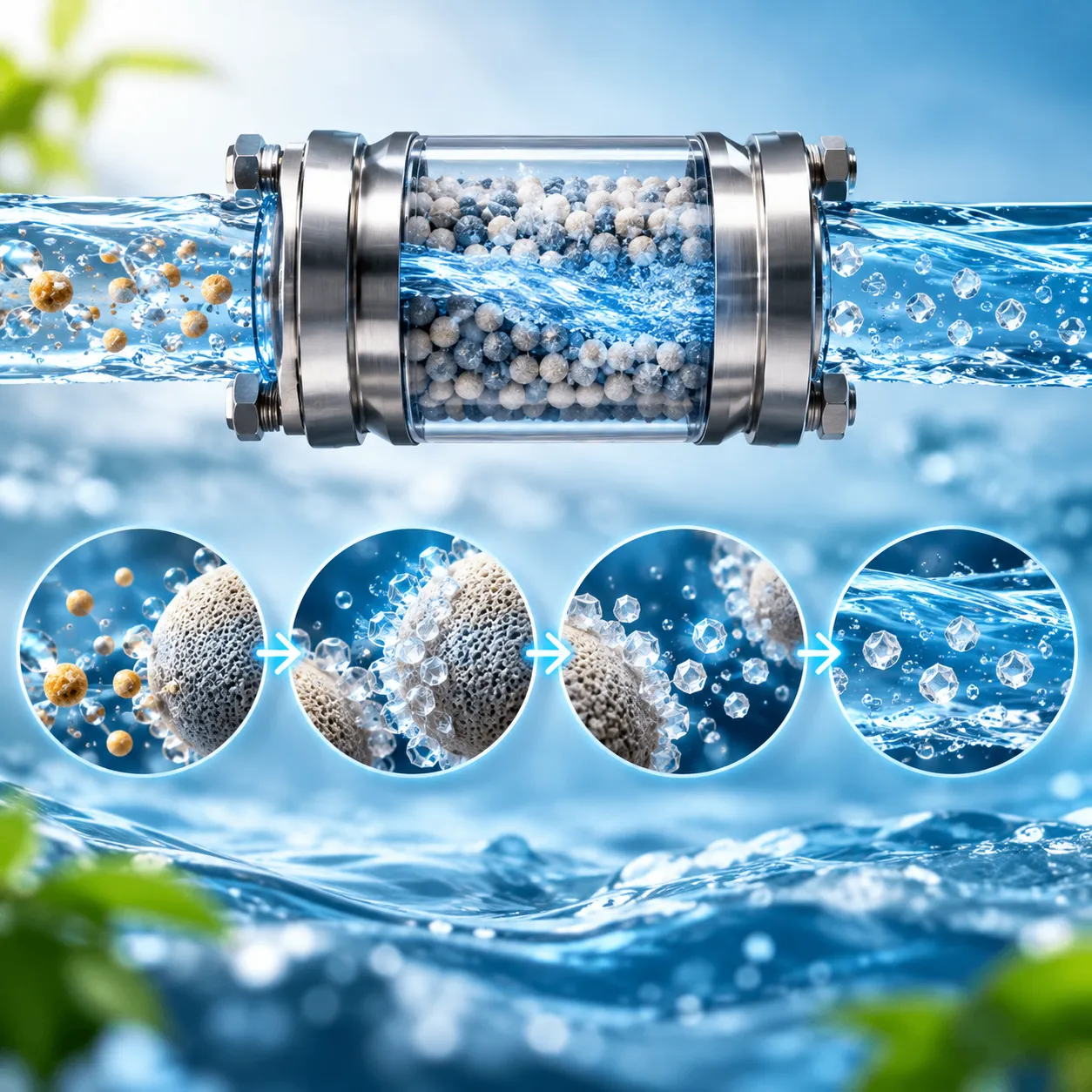
FILTERSORB SP3 Science and Technology

Explore the FILTERSORB® SP3
Poster Library

Loading Poster Library…
Salt-Free Scale Prevention
2026

Salt-Free Scale Prevention

Prevent carbonate scale without salt, chemicals, regeneration or brine discharge.

How NAC Technology Works
2026

How NAC Technology Works

See how dissolved hardness is transformed into stable, non-adhering microcrystals.

Preserve Essential Minerals
2026

Preserve Essential Minerals

Retain calcium and magnesium without adding sodium to the treated water.

FILTERSORB SP3 vs. Water Softening
2026

FILTERSORB® SP3 vs. Water Softening

Compare NAC scale prevention with conventional salt-based ion exchange.

Boiler and Heating Protection
2026

Boiler and Heating Protection

Protect boilers, water heaters and heat-transfer surfaces from carbonate-scale accumulation.

Cooling-Tower Scale Prevention
2026

Cooling-Tower Scale Prevention

Scale-management technology for open- and closed-circuit cooling applications.

Coffee and Beverage Water
2026

Coffee and Beverage Water

Maintain natural mineral content while protecting coffee, tea and beverage equipment.

Whole-House Equipment Protection
2026

Whole-House Equipment Protection

Protect pipes, showers, water heaters, dishwashers and household appliances.

Frequently
Asked Questions

Find answers about FILTERSORB® SP3, NAC technology, installation, maintenance and operating requirements.

Contact Support
What is FILTERSORB® SP3?
FILTERSORB® SP3 is a catalytic scale-prevention media that uses Nucleation Assisted Crystallization to transform dissolved carbonate hardness into stable calcium-carbonate microcrystals.
What is Nucleation Assisted Crystallization?
NAC is a directed crystallization process that changes dissolved hardness into microscopic crystals with a reduced tendency to adhere to pipes, appliances and heat-transfer surfaces.
How does FILTERSORB® SP3 work?
Hard water flows across catalytic nucleation sites on the media. Calcium-carbonate crystals form, grow and detach from the media before continuing through the system in suspended form.
Is FILTERSORB® SP3 a water softener?
No. It is a scale-prevention technology. It does not remove hardness ions or produce conventionally softened water.
Does it remove calcium and magnesium?
No. Calcium and magnesium remain in the water. The technology changes the scale-forming behavior of carbonate hardness.
Does it add sodium?
No. FILTERSORB® SP3 does not use sodium-based ion exchange and does not intentionally add sodium to the treated water.
Does it change TDS?
The NAC process does not significantly remove dissolved hardness minerals, so a meaningful TDS reduction should not be expected.
Does it change the water’s pH?
Under suitable operating conditions, the system is intended to maintain relatively stable pH. Actual influent and treated-water values should be verified through testing.
What are its main benefits?
It helps prevent scale, retains calcium and magnesium, requires no salt regeneration, produces no regeneration brine and reduces routine maintenance.
Is FILTERSORB® SP3 certified for drinking-water use?
The existing page states that relevant products are tested or certified to NSF/ANSI/CAN 61 and NSF/ANSI/CAN 372 and references IAPMO and other evaluations. Confirm the applicable certification and listed model before making a project-specific claim.
How long does the media last?
The existing page states a typical service life of approximately 5–7 years. Actual life depends on water chemistry, flow, operating conditions and system sizing.
Does the system require backwashing?
A properly designed SP3 scale-prevention system generally does not require routine regeneration backwashing. Pretreatment filters may have separate backwashing requirements.
Does it require electricity?
The NAC reaction itself does not require electricity. Auxiliary pumps, monitoring equipment or other treatment stages may require power.
Does it produce wastewater?
FILTERSORB® SP3 does not require a salt-regeneration cycle and therefore does not generate regeneration brine.
Is it effective for every hardness level?
The page states a maximum carbonate hardness of approximately 1,400 mg/L. Suitability should nevertheless be confirmed using a complete water analysis and correct system sizing.
Does NAC-treated water feel different?
It normally retains the feel of mineral-containing water because calcium and magnesium are not removed. It does not produce the slippery feel associated with sodium-softened water.
Can it help reduce existing scale?
The existing page states that treated water may gradually support the reduction of existing carbonate-scale deposits. The result depends on deposit composition, water chemistry, temperature and operating time.
Does FILTERSORB® SP3 eliminate bacteria?
No. The current brochure disclaimer explicitly states that the media does not eliminate bacteria. Appropriate disinfection is required for microbiologically unsafe or unknown-quality water.
Can it be combined with other treatment systems?
Yes. It may be combined with sediment filtration, catalytic carbon, iron and manganese pretreatment, UV disinfection and other treatment stages.
Where should it be installed?
Installation location depends on the treatment train. It is commonly installed after contaminant-removal pretreatment and before equipment requiring scale protection.
Is professional installation recommended?
Yes. Professional sizing and installation help ensure suitable flow, contact time, vessel configuration and integration with pretreatment equipment.
What happens if iron or manganese is too high?
Elevated metals can foul or discolor the media and reduce its service life. Iron and manganese pretreatment may therefore be required.
Can it treat water containing hydrogen sulfide or oil?
No. The existing operational limits specify that oil and hydrogen sulfide should be absent before the water enters the SP3 system.
Can media color change during operation?
Yes. Iron, copper, manganese, lead, zinc or color leaching from some polyethylene vessels may discolor the media. Unexpected color changes should be investigated with a detailed water analysis.
Is FILTERSORB® SP3 suitable for hot water?
It is designed for hot-water scale-prevention applications within the approved operating-temperature range.
Is a drain connection required?
A basic non-backwashing SP3 installation generally does not require a regeneration drain. Other filtration stages may require one.
How is the correct system size calculated?
Sizing should consider peak flow, daily demand, vessel diameter, media quantity, water hardness, temperature and the quality of pretreatment.
System Sizing Tool

Calculate Your FILTERSORB® SP3 System

Determine the recommended media volume and tank size based on your peak flow rate and water hardness parameters.

Sizing Recommendation

Get a Salt-Free Scale-Prevention Solution

It all starts with your water analysis.

Send us your water chemistry, peak flow and application requirements. Our technical team can help determine the correct FILTERSORB® SP3 media volume, vessel size and pretreatment configuration.

Protecting Water Systems Through Advanced NAC Technology

Water treatment facility overview