
twomit.com

RED-OXY® Treatment

Oxidation, Adsorption and Filtration in One Integrated Process

Advanced Oxidation Treatment

Oxidize. Adsorb. Filter. Restore.

RED-OXY® is an integrated water and wastewater treatment process combining ferrate-based oxidation, contaminant adsorption, solids separation and final polishing.

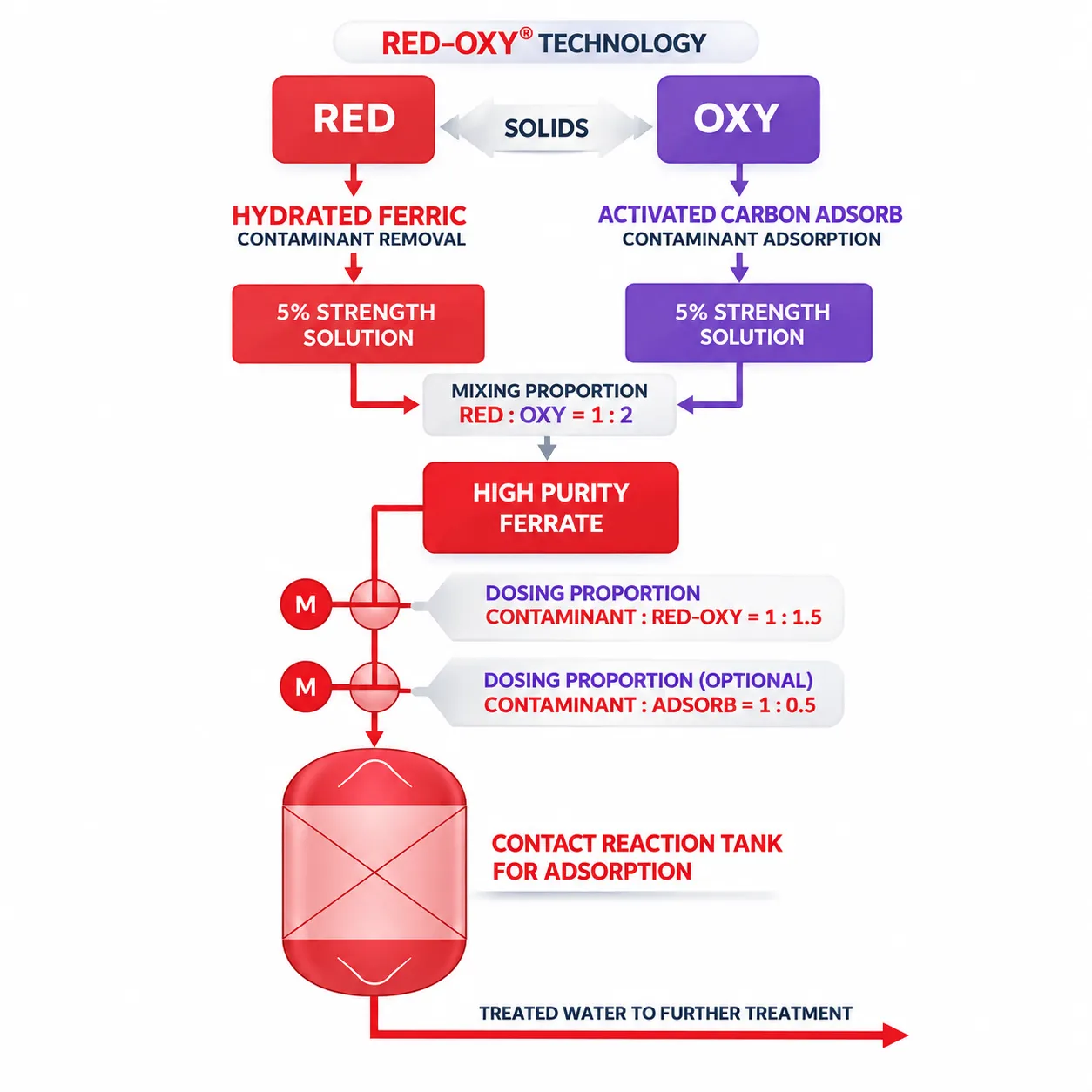
Developed by Watch Water® Germany, the RED-OXY® process uses REDx and OXYx components to generate active ferrate chemistry at the treatment site. The oxidation stage transforms selected organic and inorganic contaminants and simultaneously produces ferric hydroxide, which supports coagulation and adsorption. Optional ADSORBx improves floc formation and contaminant capture. The resulting solids are then removed through KATALOX-LIGHT® filtration, with CATALYTIC CARBON® available for final water polishing[cite: 3].

One treatment train for complex water conditions.

On-site oxidation. Rapid adsorption. Reliable filtration.

Download RED-OXY® Brochure
RED-OXY Treatment Introduction

One process.
Multiple water-treatment applications.

RED-OXY® is designed for contaminated water streams requiring oxidation, adsorption, coagulation, disinfection support and solids filtration within one coordinated treatment train.

Drinking-Water Treatment

Supports oxidation, coagulation and filtration of selected organic, inorganic and trace contaminants.

Municipal and Industrial Wastewater

Designed to reduce color, odor, turbidity, organic loading and selected industrial contaminants before reuse or discharge.

Water Reuse and Irrigation

Supports the treatment of reclaimed water intended for process reuse, agricultural irrigation or other approved applications.

Mining and Heavy-Metal Water

Ferrate oxidation and ferric-hydroxide adsorption support the removal of arsenic and selected dissolved metals.

Oil, Gas and Produced Water

Designed for produced water, flowback water and streams affected by hydrogen sulfide, metals, scale and biofouling.

Soil, Pulp and Process Industries

Applicable to contaminated-soil treatment, paper and pulp operations, fracking water and specialized process-water applications.

Four coordinated treatment systems working as one process

On-Site Ferrate Generation

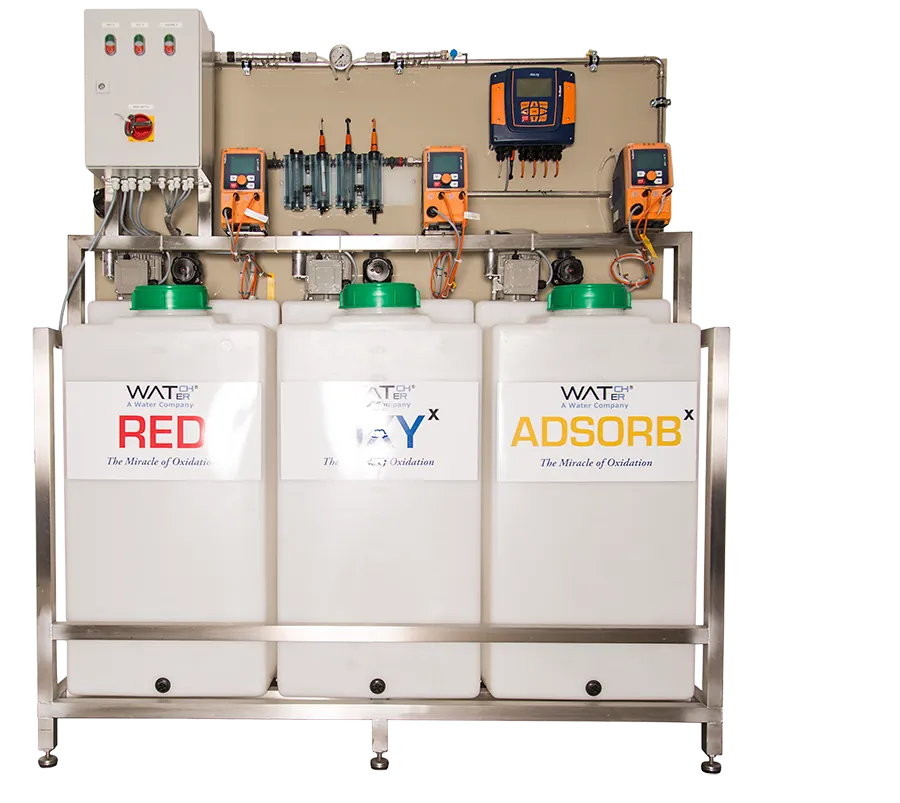
Prepared REDx and OXYx solutions are dosed simultaneously to generate active ferrate chemistry. This stage supports rapid oxidation of selected organic and inorganic contaminants.

Contaminant Capture and Floc Formation

Ferrate reduction produces ferric-hydroxide solids with adsorption and coagulation properties. Optional ADSORBx supports additional binding, floc formation and contaminant separation.

Removal of Precipitated Contaminants

Following the reaction and contact stage, KATALOX-LIGHT® filtration removes precipitated solids, ferric floc and associated contaminants from the treated water.

Taste, Odor and Trace-Contaminant Polishing

An optional CATALYTIC CARBON® stage provides final polishing for residual organics, taste, odor and selected trace contaminants.

The Science Behind
RED-OXY® Treatment

RED-OXY® uses ferrate-based oxidation together with in-situ ferric-hydroxide formation. This creates a combined process in which oxidation, coagulation and adsorption occur before physical filtration.

  • Ferrate(VI) Oxidation – Ferrate, commonly represented as FeO₄²⁻, is a strong oxidizing species capable of reacting with various organic and inorganic contaminants. Its oxidation performance depends strongly on pH, dose and water chemistry.
  • In-Situ Ferric-Hydroxide Formation – As ferrate is reduced, iron(III)-based hydroxide solids form. These solids can support coagulation, coprecipitation and adsorption of dissolved or suspended contaminants.
  • Rapid Contact Reaction – The brochure recommends a reaction-tank contact time of approximately 3–5 minutes. Actual requirements must be confirmed through water testing and pilot trials.
  • Filtration and Final Polishing – Precipitated contaminants and ferric solids are removed using KATALOX-LIGHT®, followed where necessary by CATALYTIC CARBON® for final polishing.
RED-OXY Science and Technology

Explore the RED-OXY®
Poster Library

Loading Poster Library…
Oxidation, Adsorption and Filtration
2024

Oxidation, Adsorption and Filtration

Discover the complete RED-OXY® treatment process from chemical dosing to final polishing.

The Science of Ferrate
2024

The Science of Ferrate

Learn how ferrate chemistry combines contaminant oxidation with ferric-hydroxide formation.

On-Site Oxidant Generation
2024

On-Site Oxidant Generation

Explore the coordinated preparation and dosing of REDx, OXYx and optional ADSORBx.

Industrial Wastewater Treatment
2024

Industrial Wastewater Treatment

An integrated process for color, odor, turbidity, organic loading and selected industrial contaminants.

Arsenic Oxidation and Removal
2024

Arsenic Oxidation and Removal

Oxidation of arsenite followed by adsorption and filtration for improved arsenic control.

Oilfield and Produced Water
2024

Oilfield and Produced Water

Treatment support for hydrogen sulfide, metals, scaling compounds and produced-water reuse.

KATALOX-LIGHT® Filtration
2024

KATALOX-LIGHT® Filtration

Efficient separation of ferric solids, precipitates and adsorbed contaminants.

RED-OXY® Mobile Laboratory
2024

RED-OXY® Mobile Laboratory

Conduct on-site treatability testing before designing a full-scale treatment system.

Frequently
Asked Questions

Learn how RED-OXY® works, how its treatment components are applied and why pilot testing is essential.

Contact Support
What is RED-OXY®?
RED-OXY® is an integrated oxidation, adsorption and filtration process for treating drinking water, process water, wastewater and other contaminated water streams.
Is RED-OXY® a single chemical?
No. The treatment uses REDx and OXYx to generate the active oxidation chemistry. ADSORBx may be added to improve adsorption and floc formation, followed by physical filtration.
What is ferrate?
Ferrate(VI), represented as FeO₄²⁻, is an iron-based oxidizing species. During treatment, it reacts with contaminants and is reduced to iron(III)-based solids.
What happens after ferrate oxidation?
Ferric-hydroxide solids form and support coagulation, coprecipitation and adsorption. These solids must then be removed by sedimentation and filtration.
What is the function of REDx?
REDx supplies the iron-based component required for generating the active ferrate chemistry.
What is the function of OXYx?
OXYx supplies the oxidizing component used in combination with REDx. Its preparation and dosing instructions must be followed carefully.
What is the function of ADSORBx?
ADSORBx is an optional component intended to improve adsorption, floc formation and capture of selected dissolved and suspended contaminants.
Why is a reaction tank required?
The reaction tank provides time for oxidation, precipitation, adsorption and floc formation before the water enters the filtration stage.
What contact time is recommended?
The brochure recommends approximately 3–5 minutes. The correct contact time should be verified through treatability testing.
Why is KATALOX-LIGHT® used?
KATALOX-LIGHT® removes ferric solids, precipitated contaminants and suspended material generated during the reaction stage.
Is CATALYTIC CARBON® mandatory?
No. It is an optional polishing stage recommended when additional reduction of taste, odor, organics or trace contaminants is required.
Can RED-OXY® treat arsenic?
The process is designed to oxidize arsenic(III) toward arsenic(V), which can then be captured through iron-based adsorption and filtration. Performance depends on pH, competing ions and system design.
Can it treat hydrogen sulfide?
RED-OXY® is presented for oxidation of hydrogen sulfide in groundwater, wastewater and oilfield-produced water. The required dose must be determined from the actual sulfide load.
Can it reduce BOD and COD?
The process may reduce oxidizable components contributing to BOD and COD. It should not be claimed to reduce every water to zero BOD or COD without application-specific test evidence.
Can it remove heavy metals?
Ferric-hydroxide adsorption and coprecipitation can support removal of selected metals, including arsenic, copper, lead and chromium. Performance varies by oxidation state, pH and competing chemistry.
Does RED-OXY® disinfect water?
Ferrate-based oxidation may inactivate microorganisms under controlled conditions. Drinking-water disinfection claims require validated dose-contact-time data and compliance with local regulations.
Does RED-OXY® create disinfection by-products?
The brochure positions the process as reducing conventional chlorinated by-product concerns. However, actual by-products depend on the complete formulation and source-water chemistry and should be analytically verified.
How is the dosage determined?
Dosage depends on contaminant concentration, oxidation demand, pH, TDS and treatment objectives. Laboratory or pilot testing is strongly recommended.
What dilution strength does the brochure recommend?
The brochure shows 5% prepared solutions for REDx, OXYx and ADSORBx. Current technical and safety instructions should take precedence.
Can existing dosing equipment be used?
Existing tanks and metering pumps may be suitable if their materials, capacity and controls are compatible. A technical review is required before reuse.
Can REDx and OXYx be mixed in the storage tank?
They should be prepared and stored separately and dosed at the designated reaction point. Never combine concentrated components unless expressly required by the current operating instructions.
Can salt be added to the OXYx tank?
No. The brochure specifically warns against adding sodium chloride to the OXYx preparation tank.
Is on-site testing available?
Yes. The RED-OXY® Mobile Lab is presented as a method for conducting comparative treatability tests before full-scale system design.
What packaging is available?
The brochure lists REDx, OXYx and ADSORBx in boxes containing four 5 kg bags of each respective solid product.

Get an Advanced Water-Treatment Solution

It all starts with a water analysis.

Send us your water-quality data and treatment objectives. Our technical team can evaluate the contamination profile, conduct treatability testing and recommend an appropriate RED-OXY® process configuration.

Transforming Complex Water Through Oxidation, Adsorption and Filtration

Water treatment facility overview