Powerful two-component oxidation for difficult leachate contaminants
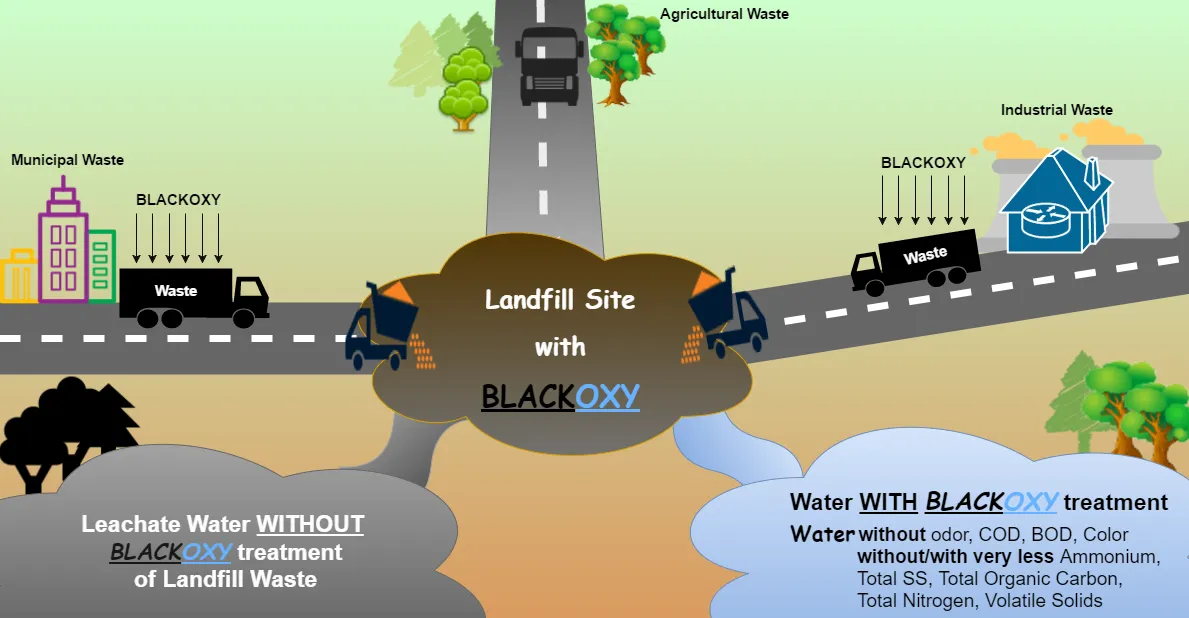
BlackOxy™ is a two-component treatment technology developed to support the oxidation of difficult organic contaminants in landfill leachate, wastewater, sludge and contaminated water.
BlackOxy™ combines a proprietary “Black” activator with an “Oxy” oxidizing component. When the components are introduced under controlled conditions, the activator is designed to accelerate oxidant decomposition and promote the formation of reactive sulfate radicals. These highly reactive species attack susceptible organic compounds, helping reduce colour, odour and difficult COD fractions while preparing the water for biological treatment, filtration or adsorption. Because landfill leachate composition changes with landfill age, waste composition, climate and operating conditions, every BlackOxy™ installation requires complete leachate analysis, laboratory treatability testing and site-specific process design.
Activate oxidation / Transform persistent pollution
Advanced oxidation for challenging leachate and wastewater
BlackOxy™ can be incorporated into multistage treatment systems as an oxidation, pretreatment or remediation step before biological treatment, clarification, filtration, adsorption or membranes.
Landfill Leachate Treatment
Targets colour, odour and oxidisable organic contaminants in young, intermediate and mature landfill leachate.
In-Situ Landfill Treatment
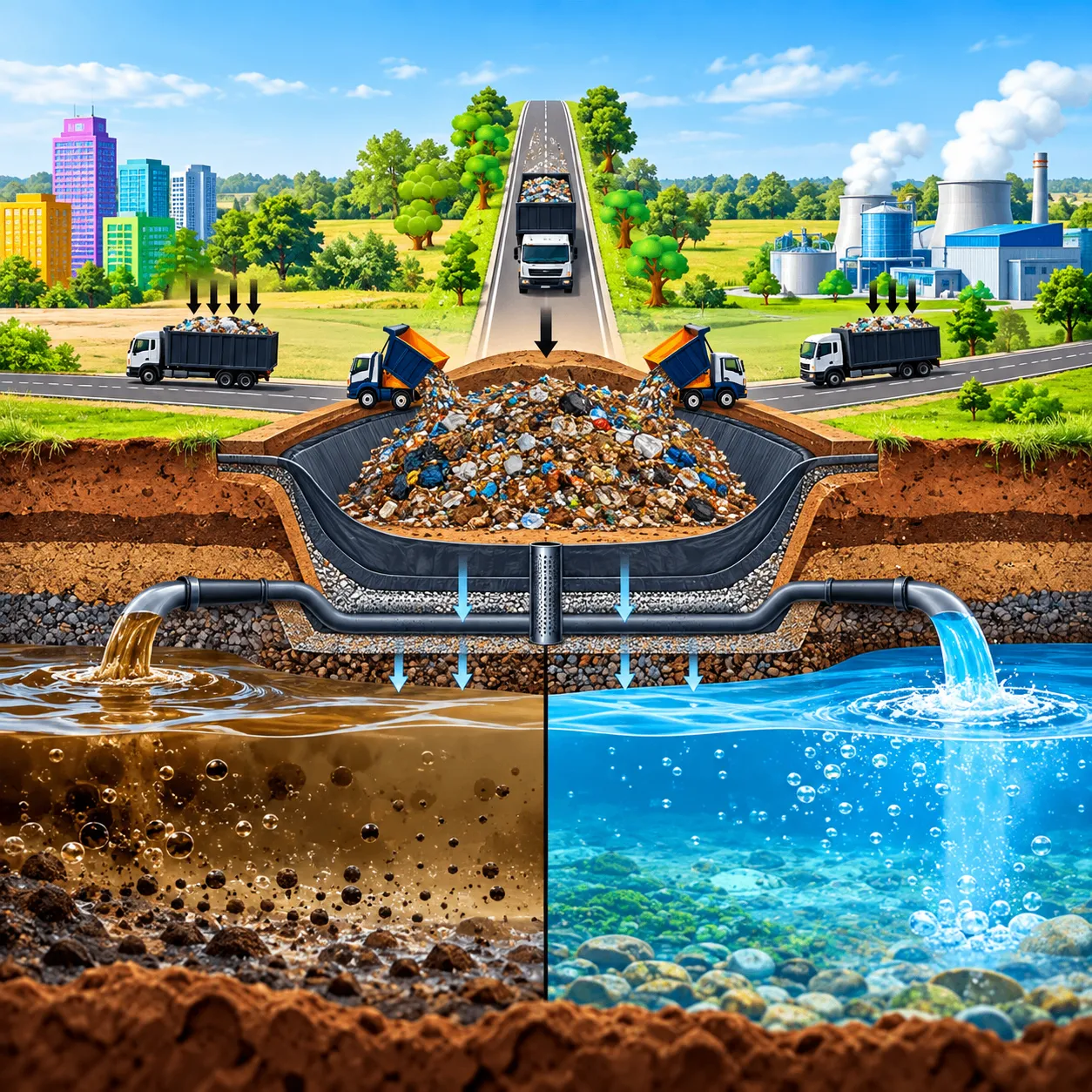
Proposed for professionally controlled treatment of landfill waste, contaminated surfaces or collected leachate at its source.
Industrial Wastewater
Supports the oxidation of selected organic contaminants in complex industrial wastewater after compatibility testing.
High-COD Wastewater
Can transform selected refractory organic compounds and potentially improve the biodegradability of difficult wastewater.
Hydrogen Sulphide & Odour
Oxidises hydrogen sulphide and other susceptible odour-causing compounds under properly controlled reaction conditions.
Sludge, Soil & Contaminated Water
Proposed for selected remediation projects where direct application and oxidation have been validated through field trials.
Recommended Treatment Sequence
Step-by-step process guide from leachate characterisation and treatability testing to biological polishing and verification.
BlackOxy™ Treatment Stages
| Stage | Process Description |
|---|---|
| Stage 1 — Characterisation | Analyse COD, BOD, TOC, pH, alkalinity, ammonium, conductivity, chloride, metals, sulphide and site-specific contaminants. |
| Stage 2 — Treatability Testing | Determine oxidant demand, component ratio, reaction time and potential transformation products through laboratory testing. |
| Stage 3 — Controlled Activation | Introduce the Black and Oxy components using an approved sequence, suitable mixing and compatible dosing equipment. |
| Stage 4 — Reaction & Monitoring | Monitor pH, temperature, oxidation-reduction potential, residual oxidant, colour, COD and gas formation. |
| Stage 5 — Biological Treatment | Where appropriate, use biological treatment for biodegradable oxidation products, ammonium conversion and nitrogen removal. |
| Stage 6 — Solids Separation & Polishing | Remove precipitated or suspended solids and apply filtration, adsorption or membrane treatment where required. |
| Stage 7 — Final Verification | Confirm compliance through accredited analysis before discharge, reuse or environmental release. |
Four complementary stages / For difficult leachate treatment
Proprietary Oxidizer Activation (BLACK-ACTIVATION)
The Black component is described as a formulation containing activated carbon, metal-based activating components and alkaline chemistry that initiates the oxidation reaction.
Sulfate-Radical Generation (OXY-OXIDATION)
The Oxy component is activated to generate reactive sulfate-radical species capable of attacking susceptible organic contaminants.
Improved Downstream Biodegradation (BIOLOGICAL-SUPPORT)
Controlled partial oxidation may convert selected persistent organic compounds into smaller, more biodegradable intermediates for downstream biological treatment.
Filtration and Adsorption (FINAL-POLISHING)
Clarification, filtration or adsorption can remove suspended reaction products, precipitated contaminants and residual organic pollution following oxidation.
Science & Technology
BlackOxy™ is based on activated oxidation chemistry designed to produce sulfate radicals with higher selectivity and longer effective lifetimes than hydroxyl radicals under certain water conditions.
- Activator and Oxidizer Combination – The Black component is added according to an approved sequence to activate the Oxy component (reaction speed depends on component ratio, temperature, pH and leachate composition).
- Sulfate-Radical Formation – Activation of a suitable persulfate-based oxidizer produces the sulfate radical ($S_2O_8^{2-} \rightarrow 2SO_4^{\bullet-}$).
- Organic-Contaminant Transformation – Sulfate radicals react with susceptible organic molecules through electron transfer, hydrogen abstraction and addition reactions, fragmenting complex contaminants.
- Integrated Treatment – Oxidation alone may not remove every contaminant; downstream biological treatment, precipitation, clarification, filtration or adsorption is required to achieve final objectives.
Technical Data & Safety Handling
Potential treatment benefits, technical information requirements, and safety guidance for BlackOxy™.
Potential Treatment Benefits
- Reduction of selected COD and BOD fractions, colour and odour improvement
- Oxidation of hydrogen sulphide and transformation of selected persistent organics
- Potential improvement in downstream biodegradability and reduced load on downstream units
- Flexible integration into existing treatment plants with a comparatively compact chemical footprint
Safety & Handling Guidelines
- Consult current SDS for both Black and Oxy components; store components separately unless premixing is authorized.
- Keep oxidizers away from heat, combustible material, reducing agents and incompatible chemicals.
- Wear suitable gloves, chemical goggles, protective clothing and respiratory protection where required.
- Use controlled mechanical dosing; monitor reaction temperature and pressure; never discharge untreated leachate based on appearance alone.
Explore the BlackOxy™
Poster Library


Frequently
Asked Questions
Technical information about BlackOxy™ chemistry, landfill-leachate applications, system integration and safe operation.
Contact SupportGet an advanced leachate treatment solution
It all starts with representative leachate analysis.
Send us your landfill leachate characteristics (COD, BOD, colour, heavy metals, flow rates) and treatment objectives. Our specialists will help evaluate BlackOxy™ for your facility.
