Clean the carbon in place. Recover useful performance. Reduce premature replacement.
CarbonOxy® R is a highly soluble oxidative regenerant developed for the in-situ cleaning and partial reactivation of activated carbon and compatible filtration media.
Activated carbon gradually loses performance as organic contaminants, sulfur compounds, colour bodies and other substances occupy its accessible pore structure. Conventional thermal reactivation requires the spent carbon to be removed, transported and processed at high temperature. CarbonOxy® R provides an alternative in-vessel treatment using a freshly prepared oxidising solution. During the regeneration cycle, the solution contacts the exhausted media and oxidises susceptible surface contaminants into smaller compounds, helping clean accessible pores and catalytic sites. The vessel is then thoroughly backwashed and rinsed before returning to service. The degree of capacity recovery depends on the carbon type, contaminant loading, pore accessibility and number of previous regeneration cycles.
No off-site transport / Regeneration inside the treatment vessel
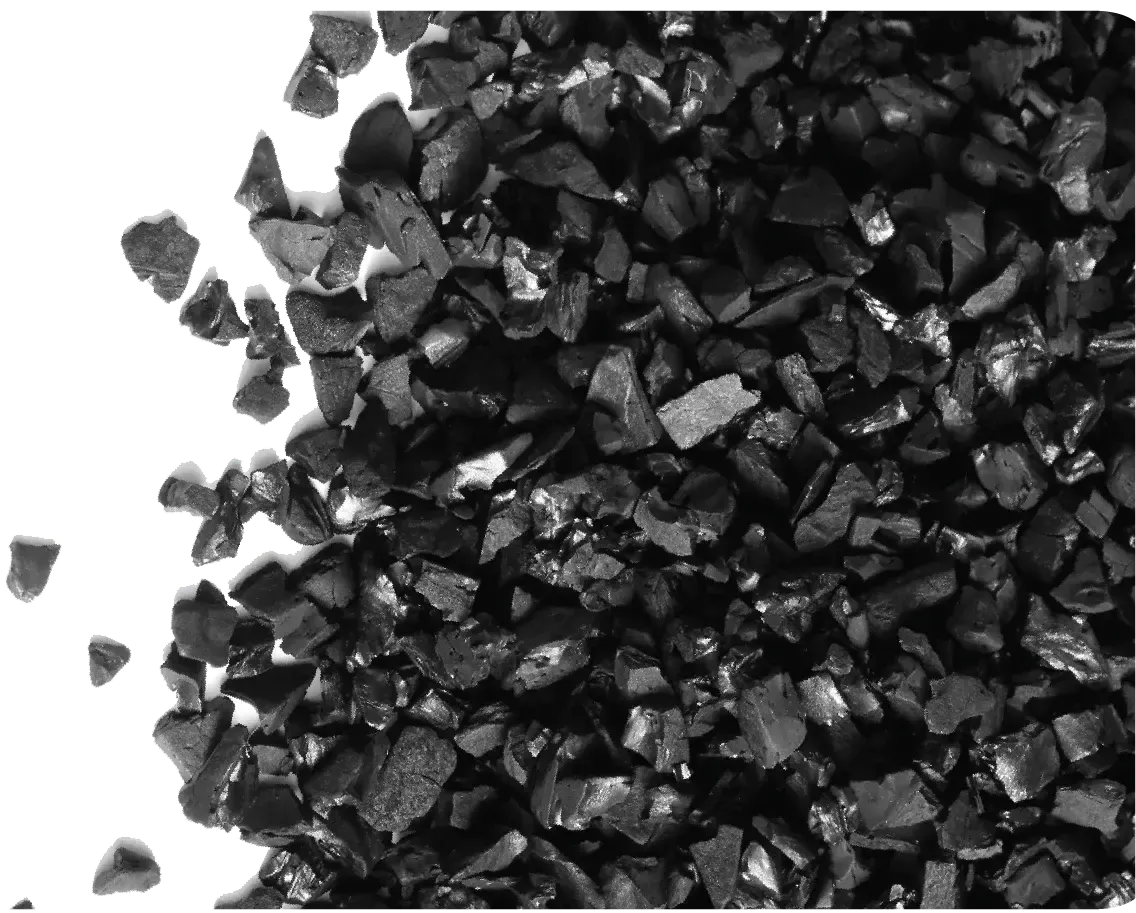
One in-situ regenerant.
Multiple carbon-treatment applications.
CarbonOxy® R can be evaluated for compatible granular, pelletised and bead-form activated carbons used across residential, commercial, municipal and industrial systems.
Municipal and Industrial Water
In-situ reactivation of granular activated carbon in central water treatment facilities.
Wastewater Treatment
Restoring carbon bed capacity in municipal and industrial wastewater polishing units.
Sulfur and Odour Removal
Cleaning sulfur-loaded carbon filters used in air and water odour control.
Food and Pharmaceutical Processing
Periodic chemical cleaning of carbon beds handling organic-rich food and pharma streams.
Biogas Purification
Reactivating carbon media used for siloxane and contaminant removal in biogas plants.
Colour and Organic Removal
Treating carbon exhausted by humic substances, dyes and dissolved organics.
Four regeneration functions / Integrated into one process
Regeneration inside the vessel (IN-SITU-R)
CarbonOxy® R can be applied without unloading and transporting the carbon to an off-site thermal-reactivation facility.
Oxidative contaminant treatment (OXY-CLEAN)
The prepared solution oxidises susceptible organic deposits and reduced compounds on accessible carbon surfaces.
Accessible-pore cleaning (PORE-RESET)
Backwashing and rinsing remove loosened deposits and soluble oxidation products, potentially reopening a portion of the carbon’s pore structure.
Automated regeneration sequence (AUTO-CYCLE)
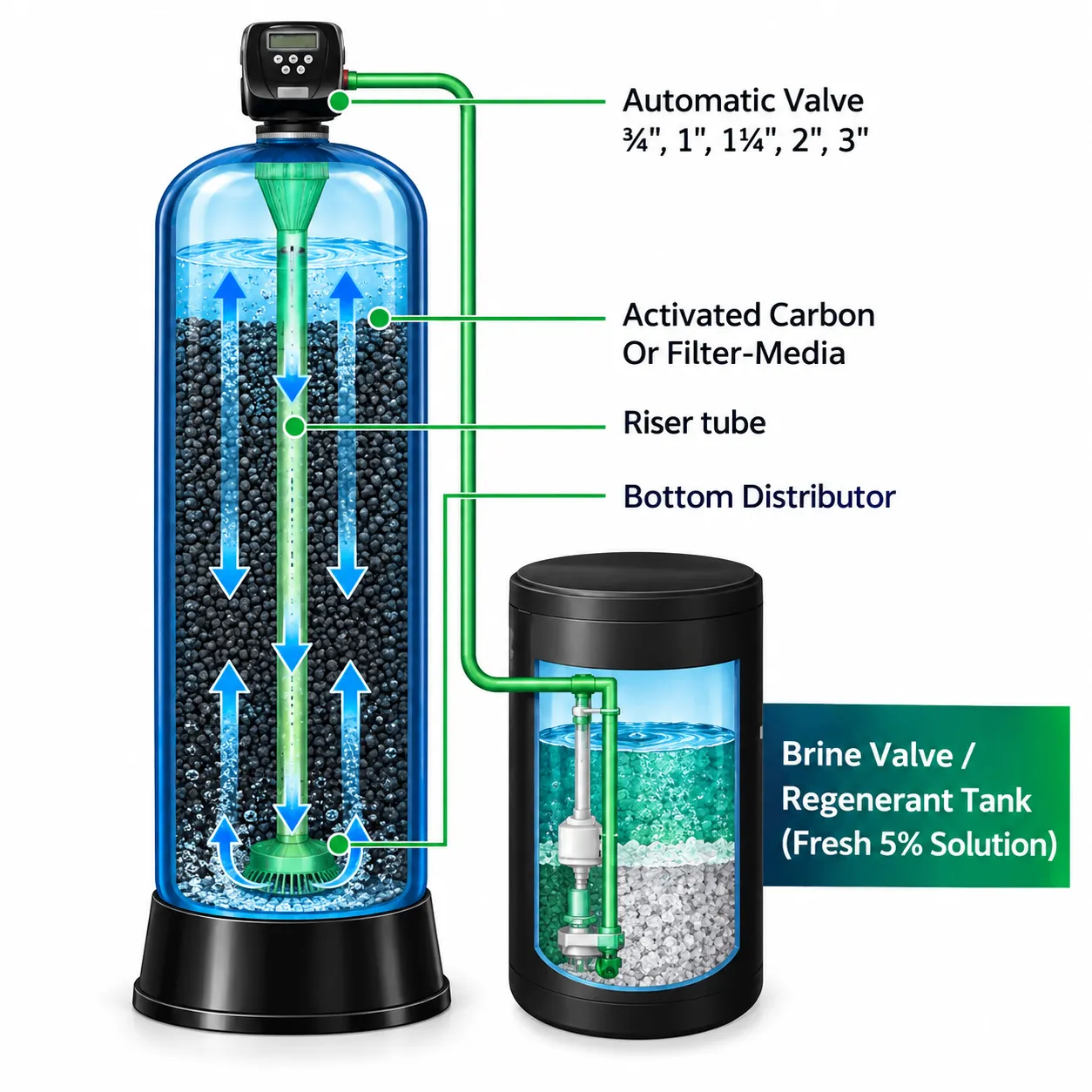
Standard multi-cycle valves and a regenerant tank can automate backwash, solution draw, reaction, rinse and return-to-service stages.
Oxidise adsorbed contaminants without high-temperature treatment
CarbonOxy® R uses chemical oxidation rather than thermal energy. Its effectiveness depends on whether the regenerant can reach and react with the compounds responsible for carbon exhaustion.
- Activated-Carbon Exhaustion – Adsorption transfers contaminants onto carbon surfaces ($Contaminant_{(aq/g)} \rightleftharpoons Contaminant_{(adsorbed)}$); as accessible sites fill, breakthrough increases.
- Oxidative Transformation – Supplies oxidising species transforming susceptible compounds ($Organic~contaminant + oxidant \rightarrow intermediates \rightarrow CO_2 + H_2O + mineral~ions$).
- Pore and Surface Cleaning – Oxidation reduces surface deposits while backwashing removes soluble products; compounds in deep micropores are harder to reach.
- Capacity Recovery – Quantified by comparing virgin, exhausted and regenerated carbon using breakthrough, iodine number, molasses number or surface area testing.
Download CarbonOxy® R documents
Explore CarbonOxy® R Posters


Frequently
Asked Questions
Essential information about CarbonOxy® R compatibility, regeneration performance, automation and waste management.
Contact SupportGet an in-situ carbon-regeneration solution
Successful regeneration starts with carbon and contaminant compatibility testing.
Send us your carbon media volume, bed dimensions, contaminant loading and regeneration objectives. Our specialists will help evaluate CarbonOxy® R for your vessel arrangement.
