Capture micropollutants. Activate degradation. Deliver cleaner water.
MicroTrapp® is a hybrid carbon-block technology combining powdered activated carbon with immobilised Titansorb-P photocatalytic media.
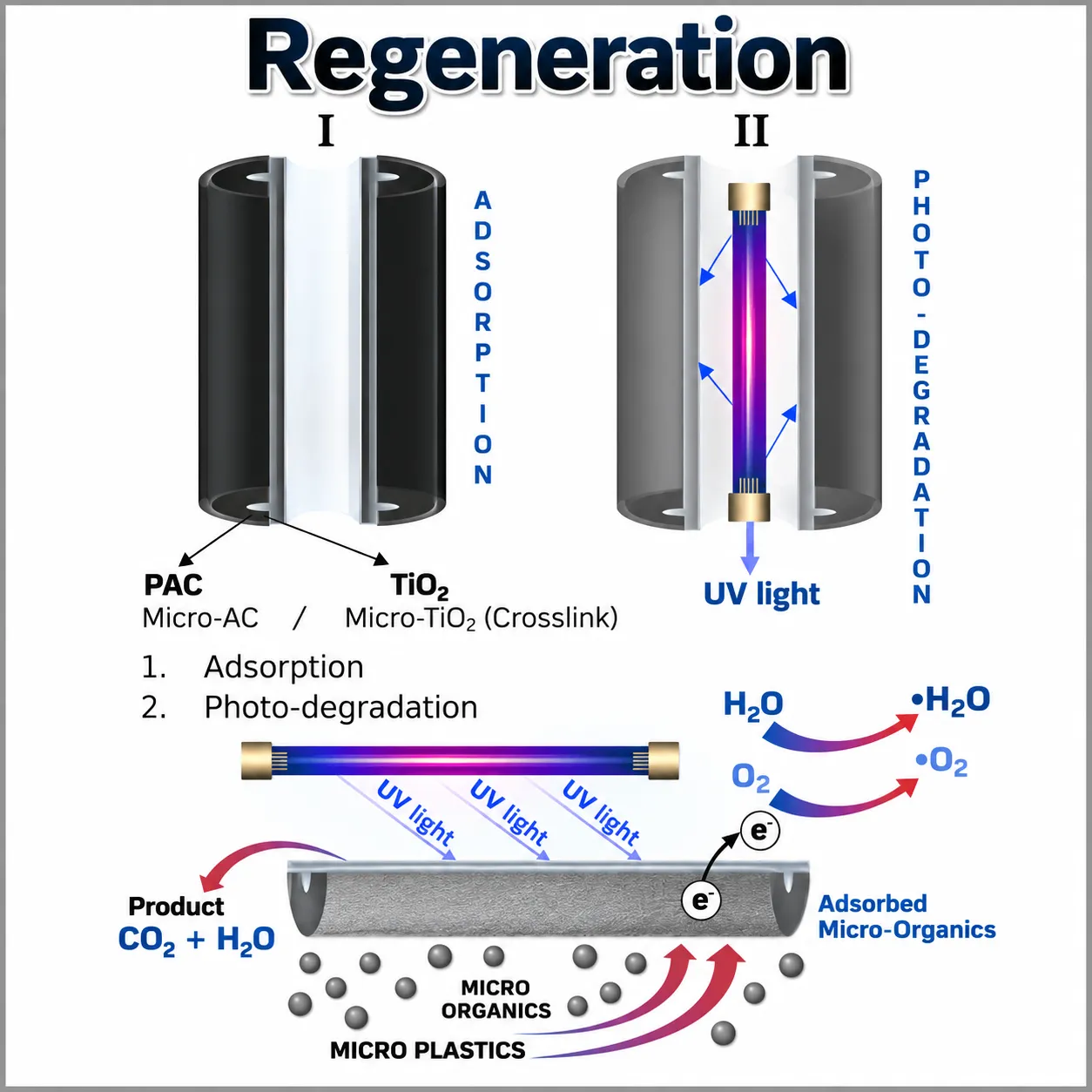
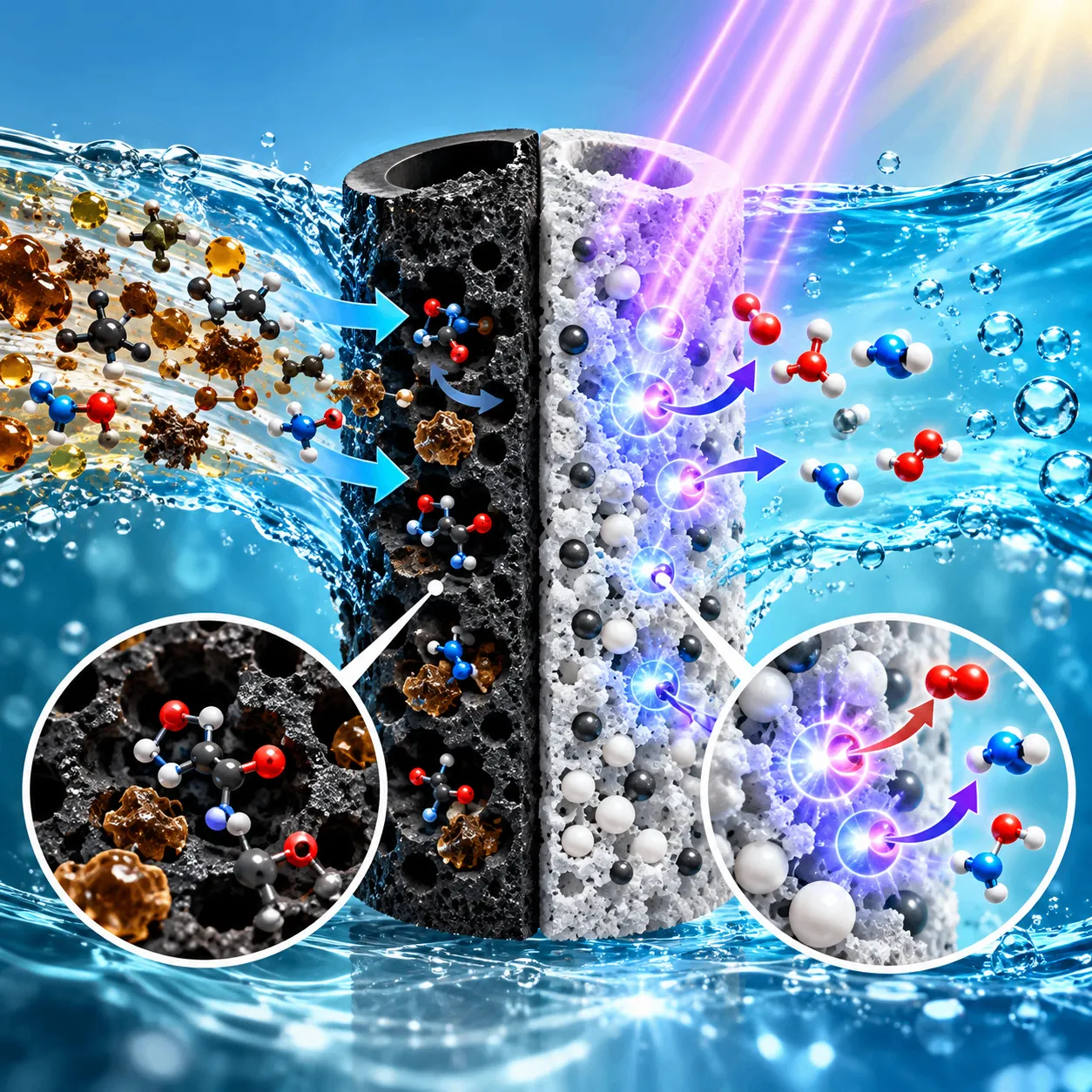
Conventional activated-carbon blocks are effective for many organic contaminants, chlorine, taste and odour, but their performance varies considerably for hydrophilic compounds, metals and emerging micropollutants. MicroTrapp® combines the adsorption capacity of powdered activated carbon with the reactive surface properties of Titansorb-P. Contaminants are first concentrated near the photocatalytic material through adsorption. Under suitable ultraviolet irradiation, the Titansorb-P component generates reactive oxygen species that may degrade selected organic contaminants. The compressed block also provides mechanical particle filtration. Actual reduction performance depends on contaminant chemistry, UV dose, flow, contact time, water clarity and cartridge condition.
Adsorption plus photocatalysis / One hybrid carbon block
One hybrid carbon block.
Multiple water-treatment applications.
MicroTrapp® can be configured for point-of-use, point-of-entry and specialised industrial treatment where both adsorption and photocatalytic oxidation are beneficial.
Point-of-Use Drinking Water
Advanced filtration and micropollutant reduction for residential and commercial tap systems.
Point-of-Entry Treatment
Whole-house carbon-block filtration for chlorine, organics and general water polishing.
Hospitals and Healthcare
Polishing water to target pharmaceutical residues, antibiotics and trace organic pollutants.
Industrial Process Water
High-purity water polishing for manufacturing, electronics and chemical processing.
Micropollutant Polishing
Targeting persistent trace organics, pesticides and endocrine disruptors.
Water-Reuse Treatment
Polishing reclaimed wastewater streams for safe non-potable or industrial reuse.
Four treatment functions / Engineered into one carbon block
High-surface-area adsorption (PAC-CAPTURE)
Powdered activated carbon provides a porous surface for capturing chlorine, taste-and-odour compounds and many compatible dissolved organic contaminants.
UV-activated photocatalysis (TITAN-ACTIVE)
Titansorb-P is designed to generate electron–hole pairs and reactive oxygen species when exposed to ultraviolet light of sufficient energy.
Fine-particle retention (MICRO-BLOCK)
The cross-linked block structure provides mechanical filtration for turbidity, sediment and suspended particles according to the cartridge’s independently validated rating.
Photocatalytic surface reactivation (UV-REACT)
Controlled UV exposure may degrade selected adsorbed organics and refresh photocatalytic sites. Complete recovery of activated-carbon capacity must be verified experimentally.
Adsorption brings pollutants close. Photocatalysis drives oxidation.
MicroTrapp® brings activated carbon and titanium-based photocatalytic surfaces into close contact, increasing the opportunity for adsorbed organic molecules to reach reactive sites.
- Activated-Carbon Adsorption – Organic molecules diffuse into activated-carbon pores and are retained through physical and chemical interactions ($Contaminant_{(aq)} \rightleftharpoons Contaminant_{(adsorbed)}$).
- Photocatalyst Activation – When Titansorb-P absorbs photons with energy $\ge$ band gap, electron–hole pairs are generated ($TiO_2 + h\nu \rightarrow e^- + h^+$). Band gap near 3.2 eV requires UV wavelengths shorter than ~388 nm.
- Reactive Oxygen Species – Photogenerated holes and electrons react with water and oxygen ($h^+ + H_2O \rightarrow \bullet OH + H^+$ and $e^- + O_2 \rightarrow O_2^{\bullet-}$), generating hydroxyl and superoxide radicals.
- Contaminant Degradation – Transforms organic contaminants into smaller intermediates and potentially $CO_2$, water and mineral ions (complete mineralisation requires carbon-balance testing).
Download MicroTrapp® documents
Explore MicroTrapp® adsorption and photocatalysis


Frequently
Asked Questions
Essential information about MicroTrapp® adsorption, photocatalysis, operation and cartridge replacement.
Contact SupportGet an advanced micropollutant solution
Effective treatment begins with contaminant-specific water analysis.
Send us your water characteristics (micropollutants, TOC, flow rates, UV transmittance) and treatment objectives. Our specialists will help evaluate MicroTrapp® for your hybrid adsorption and photocatalytic application.
