Powerful coagulation and clarification—in a convenient dry granulate
FERRIC-SG is a concentrated, granulated ferric sulphate coagulant designed to improve particle removal, floc formation, phosphorus precipitation and wastewater clarification.
FERRIC-SG supplies trivalent ferric iron (Fe³⁺), which hydrolyses in water to form iron-hydroxide flocs. These flocs destabilise suspended and colloidal material and capture contaminants so they can be removed by sedimentation, flotation or filtration. Its dry, free-flowing format simplifies transportation and storage compared with bulk liquid coagulants. The product can be dissolved into a controlled-strength solution and accurately metered into the treatment process. Final dosage, solution strength and operating pH must be established through jar testing and site-specific validation.
Concentrated dry chemistry / Fast, dense floc formation
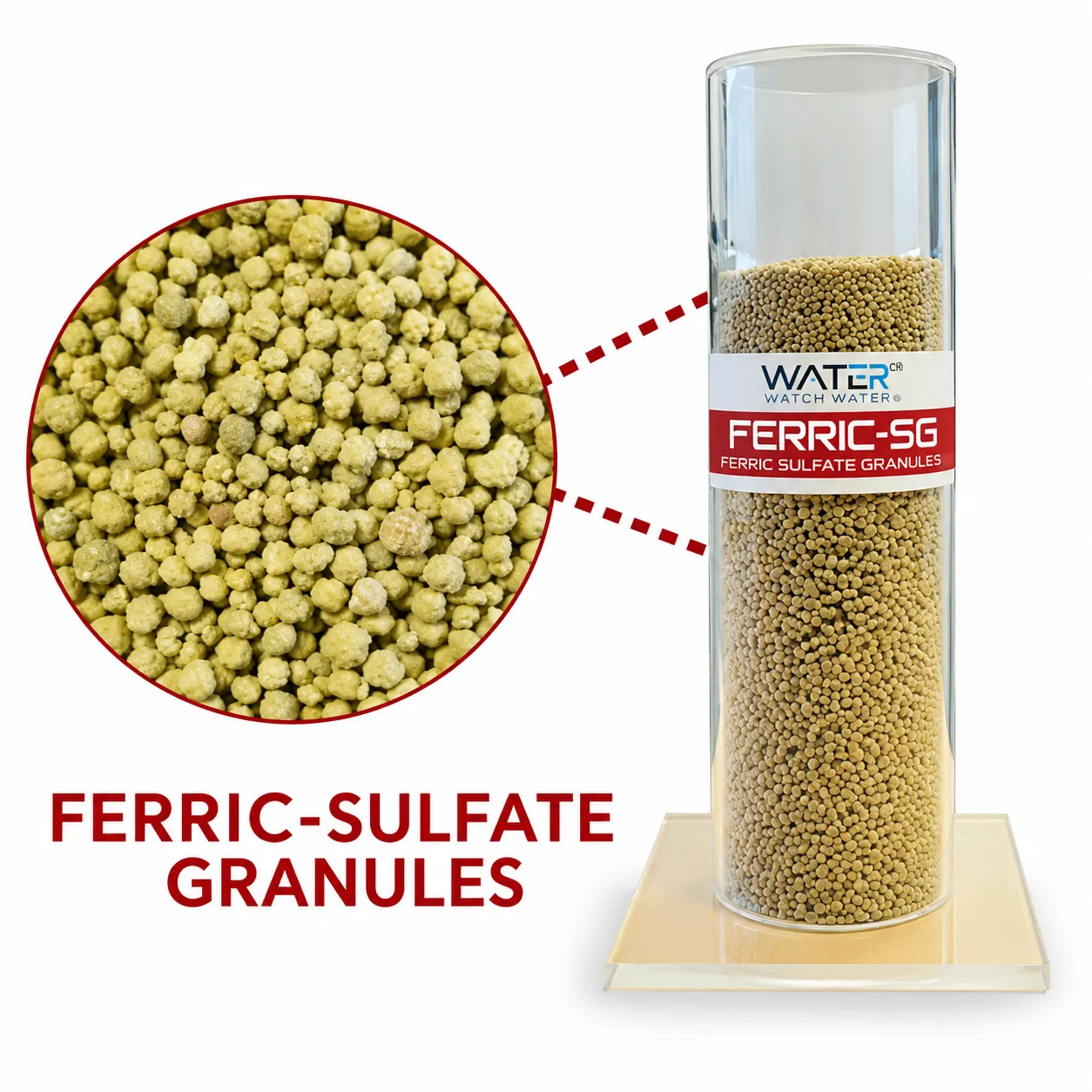
One granulated coagulant.
Multiple treatment objectives.
FERRIC-SG can be introduced into conventional coagulation–flocculation processes after controlled dissolution. It can support clarification, filtration, precipitation and sludge-conditioning systems across municipal and industrial applications.
Raw Water Clarification
Supports the removal of turbidity, clay, suspended solids, natural organic matter and other coagulable contaminants before filtration or downstream treatment.
Wastewater Treatment
Improves solids separation and can reduce the particulate and coagulable fractions of COD, BOD and TOC.
Phosphorus & Nutrient Control
Ferric iron reacts with phosphate to form low-solubility compounds that can be separated with the generated sludge.
Hydrogen Sulphide & Odour Control
Supports sulphide fixation and odour management in wastewater, sludge lines, pumping stations and sewer applications.
Arsenic & Heavy-Metal Separation
Ferric-hydroxide flocs can adsorb or co-precipitate selected metals and arsenic species under properly controlled conditions.
Industrial Solids & Colour Removal
Applicable to oily wastewater pretreatment, colour reduction, sludge conditioning and suspended-solids separation following laboratory validation.
Four treatment functions / Delivered by one ferric coagulant
Rapid Particle Destabilisation (COAGULATION)
Ferric ions reduce the stability of suspended and colloidal particles, allowing them to combine into removable aggregates.
Chemical Phosphorus Precipitation (PHOSPHATE-CAPTURE)
Ferric iron reacts with dissolved phosphate and incorporates phosphorus into precipitated solids for downstream separation.
Odour and Corrosion-Risk Management (SULPHIDE-CONTROL)
Proper ferric dosing can reduce dissolved sulphide and hydrogen-sulphide emissions, helping manage odour and sulphide-related corrosion risks.
Dense Floc and Improved Settling (SOLIDS-SEPARATION)
Iron-hydroxide precipitates capture fine particles and form heavier flocs that can improve settling, flotation and filtration performance.
Science & Technology
FERRIC-SG uses ferric-ion hydrolysis, sweep flocculation, adsorption and chemical precipitation to convert difficult-to-remove contaminants into separable solids.
- Ferric-Ion Release – After dissolution, ferric sulphate releases $Fe^{3+}$ ions into the water ($Fe_2(SO_4)_3 \rightarrow 2Fe^{3+} + 3SO_4^{2-}$). Effective chemistry depends on concentration, water composition, pH and mixing.
- Iron-Hydroxide Floc Formation – Ferric ions hydrolyse and form amorphous iron-hydroxide solids ($Fe^{3+} + 3H_2O \rightarrow Fe(OH)_3(s) + 3H^+$), providing a large surface area for adsorption while consuming alkalinity.
- Phosphate Precipitation – Ferric ions react with phosphate to form low-solubility ferric-phosphate phases (removal depends on pH, competing ions, Fe:P ratio and separation).
- Contaminant Capture – Iron-hydroxide flocs adsorb or co-precipitate selected arsenic species, metals, natural organic matter and fine particles into the sludge.
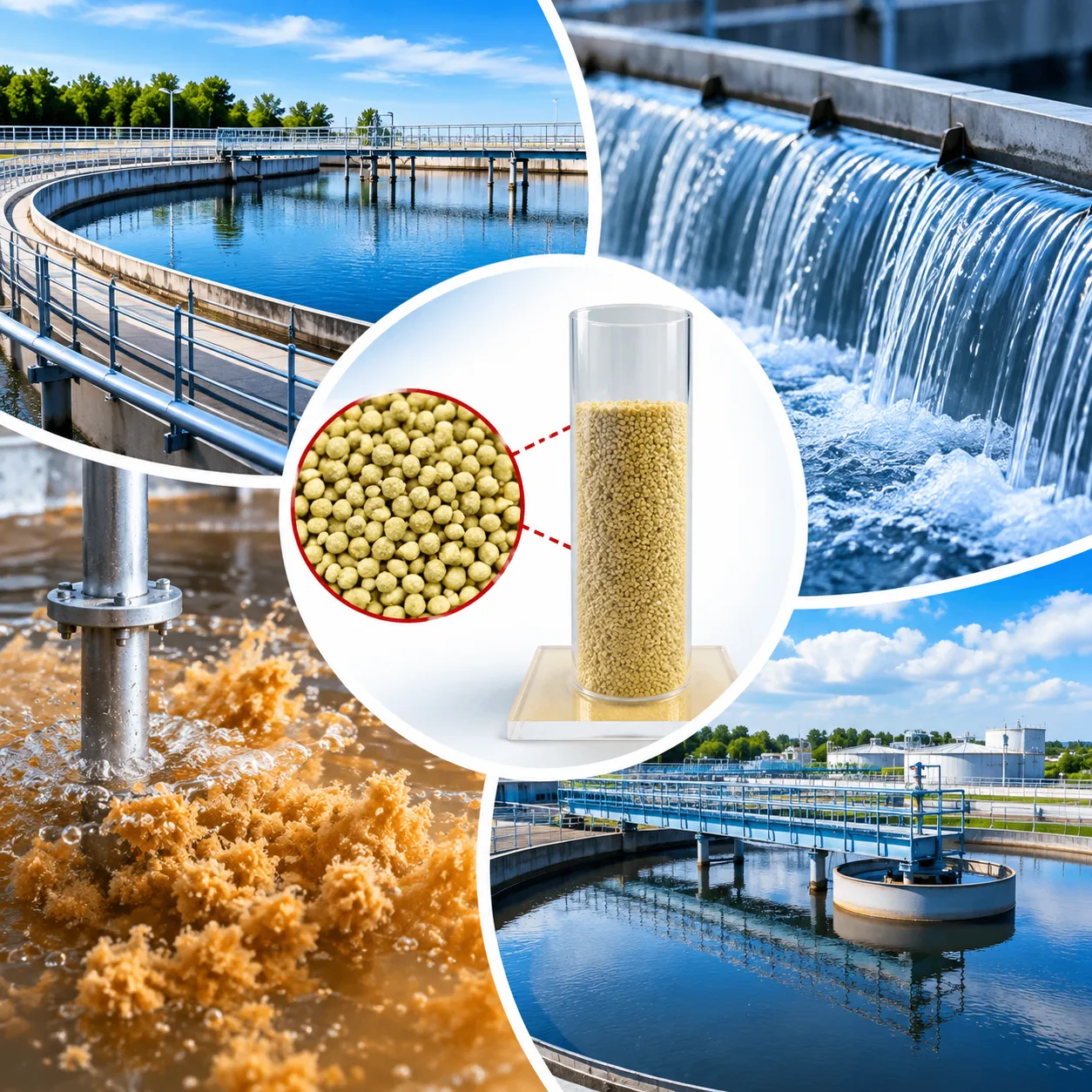
Published Technical Data
Physical characteristics, chemical composition, and packaging configurations for FERRIC-SG.
Published Product Specifications
| Parameter | Brochure Value |
|---|---|
| Appearance | Yellow-greyish granules |
| Bulk density | 1,050–1,290 kg/m³ |
| Total iron | 21–23% |
| Ferric iron, Fe³⁺ | 19.5–22% |
| Ferrous iron, Fe²⁺ | Approximately 1% |
| Particle size distribution | >4.0 mm: <2% | <1.5 mm: ~50% | <0.2 mm: <1% |
| Standard packaging & Pallet | 30 kg bag (40 bags per pallet = 1,200 kg net weight) | 1,000 kg Big-bag option |
Download Our Latest Documents
Explore the FERRIC-SG
Poster Library


Frequently
Asked Questions
Technical answers covering product preparation, treatment performance, safe handling and process control.
Contact SupportGet a water clarification solution
It all starts with water analysis and jar testing.
Send us your water characterization data, turbidity, phosphorus levels, flow rates and clarification objectives. Our specialists will help evaluate FERRIC-SG for your treatment process.
