Two radical pathways / One advanced oxidation process
SMART PO₂® is a solid wastewater-treatment formulation designed to generate sulfate and hydroxyl radical pathways for the oxidation of difficult organic and inorganic pollutants.
Developed by Watch Water® Germany for demanding industrial and landfill wastewater, SMART PO₂® is intended to activate powerful oxidation reactions directly in contaminated water. The process targets pollutants such as VOCs, COD-forming organics, phenols, humic substances and sulfides. Depending on water chemistry and treatment conditions, oxidation may transform complex pollutants into smaller intermediates and, where sufficient oxidant demand and reaction conditions are achieved, continue toward mineralization. Site-specific treatability testing is required to determine dosage, contact time, residual oxidant, by-products and the necessary polishing stages.
Sulfate radicals plus hydroxyl radicals / Activated inside water
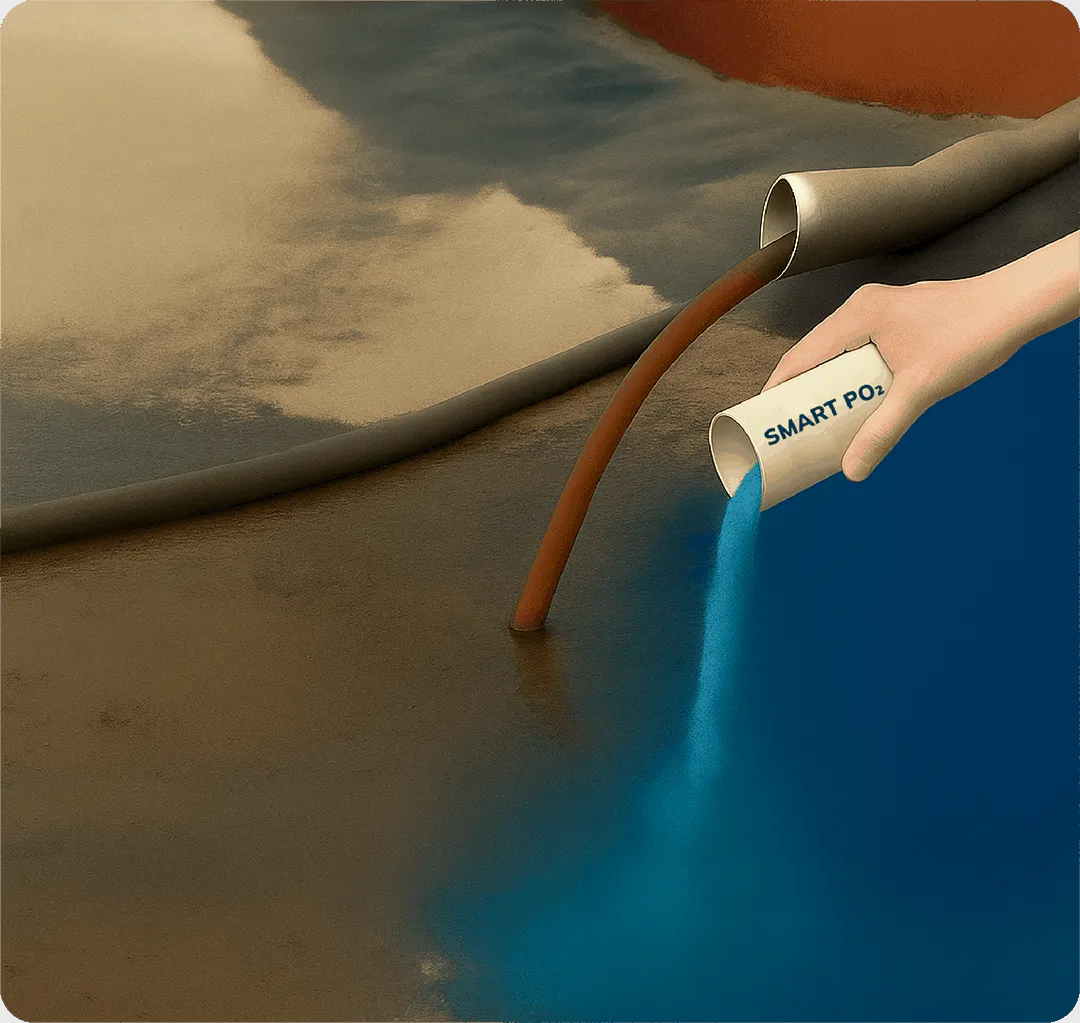
Advanced oxidation.
For challenging wastewater streams.
Designed for professionally engineered treatment systems where conventional biological, physical or single-oxidant processes cannot independently meet the required water-quality objectives.
Landfill Leachate
Oxidation support for leachate and solid-waste effluent containing refractory organic compounds.
Industrial Wastewater
Treatment of chemical, refinery and textile wastewater following laboratory treatability testing.
Contaminated Groundwater
In-situ or ex-situ oxidation applications for groundwater and contaminated aquifers under controlled conditions.
Water Reuse and ZLD
Oxidation pretreatment or polishing within water-reuse and zero-liquid-discharge treatment trains.
High-COD Wastewater
Reduction of oxidizable organic loading before biological or physical polishing stages.
Odour and Sulfide Control
Oxidation of sulfide-related compounds and associated odour under validated treatment conditions.
Four reaction functions / Engineered into one formulation
Selective Radical Oxidation (SULFATE-RADICAL)
SMART PO₂® is promoted as generating sulfate-radical chemistry capable of reacting with a range of persistent organic pollutants.
Broad-Spectrum Oxidation (HYDROXYL-RADICAL)
Hydroxyl-radical pathways provide highly reactive, relatively non-selective oxidation of susceptible organic compounds.
Extended Pollutant Breakdown (MINERALIZATION-DRIVE)
Properly designed oxidation can continue beyond initial transformation toward lower-molecular-weight intermediates and, where demonstrated, carbon dioxide and water.
Multi-Stage Treatment Compatibility (INTEGRATION-READY)
The product page positions SMART PO₂® for integration with CRYSTOLITE®, Katalox-Light® and Catalytic Carbon® filtration or polishing stages.
Science behind SMART PO₂ double oxidation
SMART PO₂® is intended to establish multiple reactive-oxygen pathways in water. Treatment performance depends on oxidant demand, pH, temperature, catalyst availability and competing water constituents.
- Sulfate-Radical Formation – Activation of the formulation produces sulfate radicals ($SO_4^{\bullet-}$), which can oxidize electron-rich organic compounds.
- Hydroxyl-Radical Pathway – Sulfate-radical reactions and aqueous conditions generate hydroxyl radicals ($\bullet OH$), expanding the range of susceptible contaminants.
- Pollutant Transformation – Radical attack breaks chemical bonds and transforms complex molecules into smaller oxidation products (intermediates must be identified where environmental or reuse requirements apply).
- Treatment-Train Polishing – Filtration, adsorption, biological treatment or neutralization may be required after oxidation to remove precipitated material, residual oxidant and remaining reaction products.
Safety & Handling Information
Hazard classifications, personal protection requirements, storage guidelines, and emergency protocols for SMART PO₂®.
Hazard Classification (EC No. 1272/2008)
- H302: Harmful if swallowed
- H314: Causes severe skin burns and eye damage
- H412: Harmful to aquatic life with long-lasting effects
Required Personal Protection
- Chemical-resistant protective gloves
- Protective clothing
- Safety goggles with side protection & face shield
- P2 or FFP2 particulate respiratory protection
- Local exhaust ventilation
- Immediate access to emergency eyewash and safety shower
Handling & Storage Requirements
- Do not breathe dust, mist or spray; avoid all contact with skin and eyes.
- Never add water directly into concentrated product containers.
- Store in a dry, well-ventilated location in original sealed containers.
- Protect against moisture, direct sunlight, and elevated temperatures.
- Store separately from incompatible chemicals and away from drains.
Typical Treatment Parameters
| Parameter | Published Information |
|---|---|
| Typical starting dosage | Approximately 30 g/m³ |
| Typical contact time | Approximately 30 minutes |
| Product form & appearance | Solid powder mixture / Light reddish |
| Solution pH | 2.0–2.5 at 1% concentration |
| Bulk density & solubility | ~1,200–1,400 kg/m³ | 280–340 g/L |
| External aeration | Not required |
Download our latest documents
Explore our SMART PO₂ poster library


Frequently
Asked Questions
Essential information about SMART PO₂® chemistry, applications, dosage, safety and treatment limitations.
Contact SupportCalculate SMART PO₂® Chemical Demand
Estimate the required product quantity per batch or per hour based on wastewater volume and starting dosage.
Chemical Demand Estimation
Build an advanced oxidation solution
It all starts with wastewater characterization and treatability testing.
Send us your wastewater parameters (COD, BOD, TOC, pH, sulfides, flow rates) and oxidation objectives. Our specialists will help evaluate SMART PO₂® advanced oxidation for your industrial effluent.
