Restore reactive surfaces. Raise oxidation potential. Extend media performance.
INSTANT OXYDES®-P is a highly soluble acidic oxidising granulate developed for catalytic-media cleaning, oxidation support and selected water-treatment applications.
INSTANT OXYDES®-P is designed for periodic application during backwash, batch cleaning and controlled oxidation processes. The product is intended to increase oxidation-reduction potential, remove deposits from catalytic surfaces and restore the activity of compatible activated carbon, Katalyst-Light® and other filtration media. The brochure also describes activation with sodium chloride for generating reactive oxidising species. Because the current brochure and webpage give conflicting descriptions of the active chemistry—chlorine generation in one source and hydroxyl-radical generation in another—the exact reaction mechanism must be confirmed before publishing definitive chemical claims.
Media-surface cleaning / Controlled oxidation support
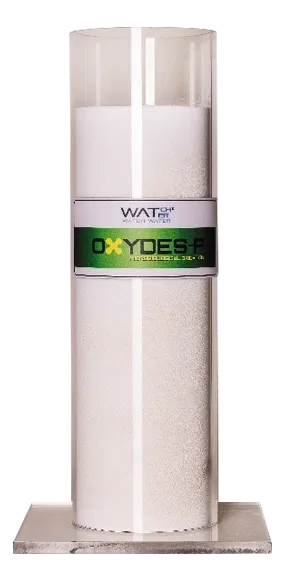
One concentrated oxidiser.
Multiple regeneration and treatment applications.
INSTANT OXYDES®-P can be applied during media backwash, batch cleaning or controlled water treatment where increased oxidation potential and surface cleaning are required.
Catalytic Carbon Regeneration
Cleaning and reactivating accessible catalytic sites during controlled backwash cycles.
Katalyst-Light® Cleaning
Restoring oxidising conditions and removing accumulated deposits from filtration media.
Iron and Manganese Oxidation
Converting soluble contaminants into species suitable for downstream filtration.
Hydrogen Sulfide Control
Oxidising sulfide to control rotten-egg odour and support downstream removal.
Cooling-Tower Shock Treatment
Controlled oxidation for compatible open recirculating water systems.
Pool and Spa Treatment
Periodic oxidising shock treatment for recreational water systems.
Four treatment functions / Inside one concentrated granulate
Catalytic-surface cleaning (SURFACE-RESET)
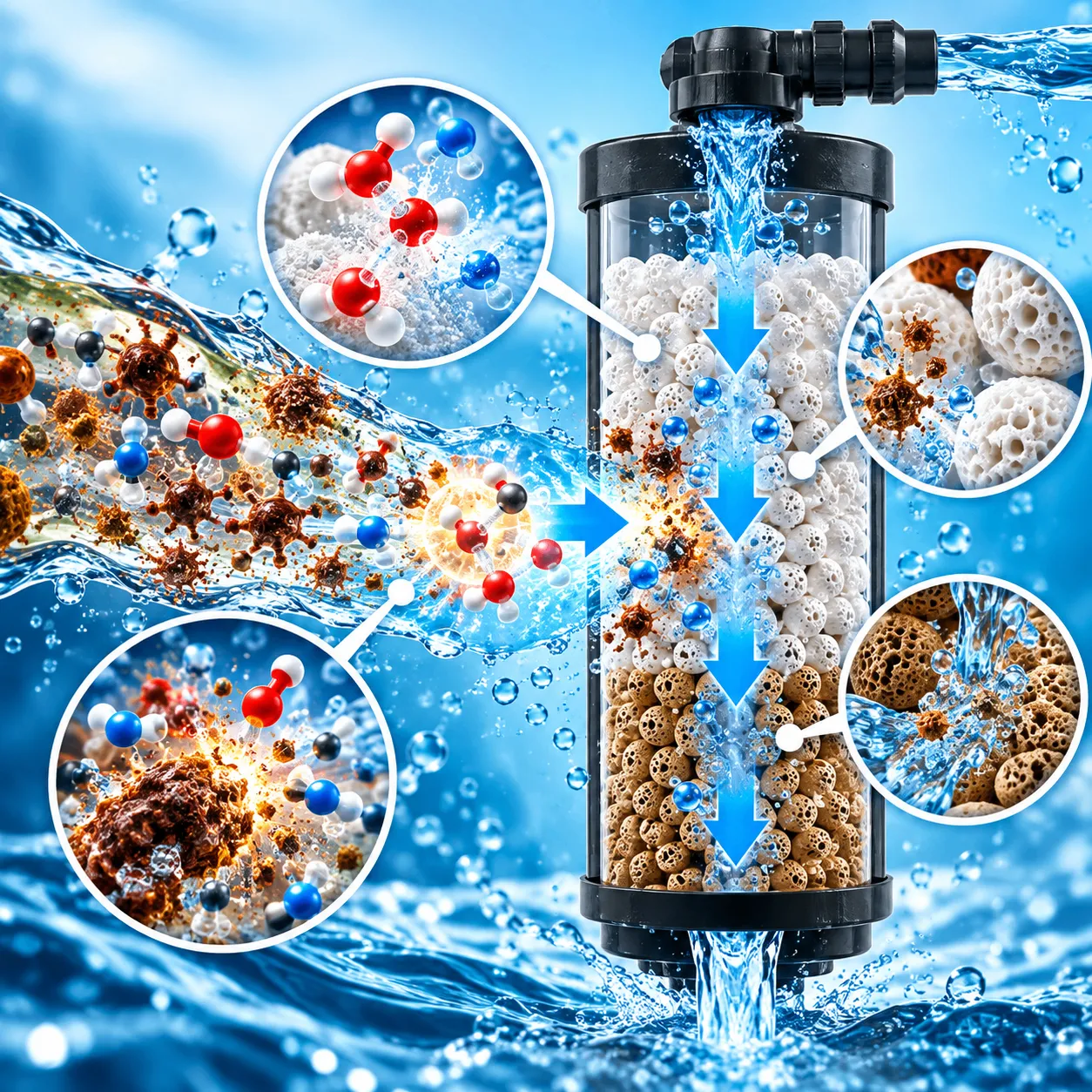
The oxidising solution helps remove compatible organic and reducing deposits that can block active sites on catalytic media.
Oxidation-potential restoration (ORP-BOOST)
Controlled application increases system ORP, helping restore conditions needed for oxidation before or within a catalytic filter.
Salt-activated oxidation process (SALT-ACTIVE)
The brochure describes reaction with sodium chloride to generate additional oxidising species. The identity and concentration of those species require analytical confirmation.
Media-performance maintenance (MEDIA-LIFE)
Periodic cleaning can help preserve hydraulic and catalytic performance where decline is caused by removable surface fouling rather than permanent media exhaustion.
Reactive chemistry for cleaning and oxidation
INSTANT OXYDES®-P is an acidic oxidising formulation. Its treatment effect depends on the active ingredient, solution concentration, chloride content, pH, ORP and contact time.
- Solution Activation – Solid granulate dissolves rapidly in water to produce an acidic working solution ($INSTANT~OXYDES\text{-}P_{(s)} + H_2O \rightarrow active~oxidising~solution$).
- Chloride and Active Chlorine – Reacts with sodium chloride to create chlorine ($Cl_2 + H_2O \rightleftharpoons HOCl + H^+ + Cl^-$ and $HOCl \rightleftharpoons H^+ + OCl^-$ depending on pH).
- Radical Oxidation Claim – Generates hydroxyl radicals ($Oxidant + activation~energy \rightarrow \bullet OH + other~species$), though formation must be demonstrated using probe/scavenger testing.
- Media-Surface Cleaning – Oxidising species react with accumulated organic matter and reduced inorganic deposits ($Surface~contaminant + oxidant \rightarrow oxidised~products$), requiring thorough backwashing and rinsing.
Download INSTANT OXYDES®-P documents
Explore INSTANT OXYDES®-P Posters


Frequently
Asked Questions
Essential information about INSTANT OXYDES®-P activation, media cleaning, oxidation and safe operation.
Contact SupportGet a media-regeneration and oxidation solution
Effective surface restoration starts with verified treatment chemistry.
Send us your media type (activated carbon, Katalyst-Light®), fouling characteristics, and regeneration objectives. Our specialists will help evaluate INSTANT OXYDES®-P for your facility.
