Activate powerful water treatment with the energy of sunlight
SolarOxy-3C™ combines a photocatalyst, oxidizing chemistry and adsorption to target difficult organic pollutants and selected inorganic contaminants.
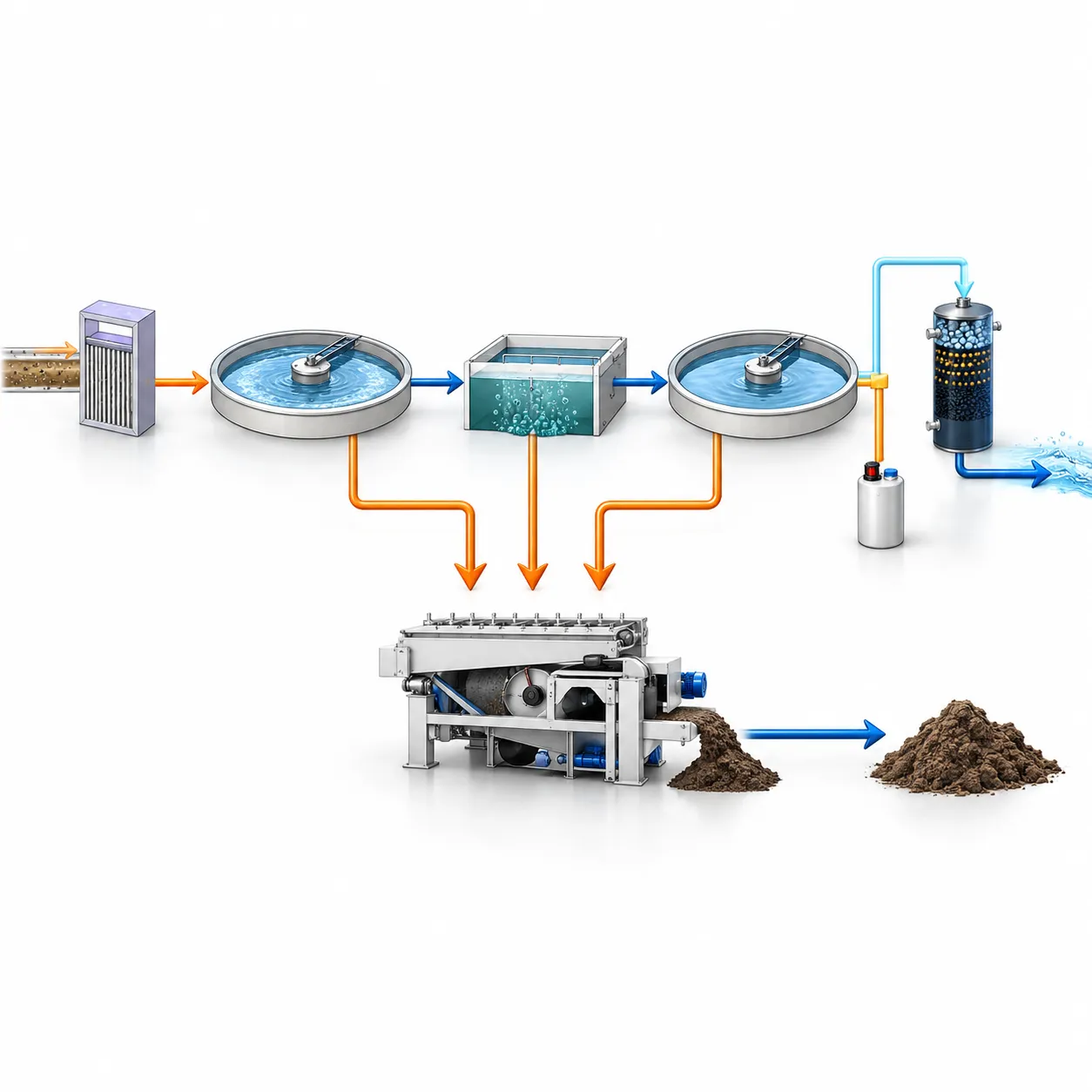
SolarOxy-3C™ is a solar-activated advanced oxidation formulation based on crystalline Watch-TiO₂ and OXYDES-P™ oxidizing chemistry. Under suitable irradiation, the photocatalyst generates electron–hole pairs that promote the formation of reactive species, including hydroxyl and sulfate radicals. These species attack susceptible organic contaminants, while the mineral surface can adsorb selected metals and oxyanions. Following treatment, catalyst-containing solids must be separated through clarification or filtration before discharge or reuse. Performance depends on light intensity, water transparency, catalyst concentration, oxidant demand, pH and contact time.
Solar activation / Radical oxidation / Adsorptive polishing

Solar-powered treatment across diverse water challenges
SolarOxy-3C™ can be evaluated as a pretreatment, advanced oxidation or polishing step for contaminated water, wastewater and environmental-remediation applications.
Municipal & Industrial Wastewater
Targets selected refractory organics, colour, pharmaceuticals, pesticides and micropollutants before discharge or reuse.
Lakes, Ponds & Reservoirs
Supports professionally managed treatment of algae-related pollution, odour, organic contaminants and selected cyanotoxins.
Landfill Leachate
Can be evaluated for oxidation of difficult organic fractions and adsorption of selected metals before downstream treatment.
Pharmaceutical & Hospital Effluent
Targets selected pharmaceutical residues, antibiotics, metabolites and other biologically active micropollutants.
Agricultural & Aquaculture Water
Supports treatment of selected pesticides, organic loading, odour and nutrient-related pollution after ecological validation.
Soil & Groundwater Remediation
May be used in controlled ex-situ or engineered in-situ remediation where sufficient activation and catalyst recovery can be achieved.
Four technologies / Integrated into one solar-activated platform
Light-Driven Energy Input (SOLAR-ACTIVATION)
Solar irradiation activates the photocatalytic material, reducing dependence on artificial UV lamps where sufficient natural light is available.
Photocatalytic Electron–Hole Generation (TiO₂-CATALYSIS)
Irradiated titanium dioxide generates conduction-band electrons and valence-band holes that initiate oxidation and reduction reactions.
Hydroxyl and Sulfate Radicals (RADICAL-OXIDATION)
Activated OXYDES-P™ chemistry promotes reactive species capable of transforming selected persistent organic molecules.
Contaminant Capture and Catalyst Separation (ADSORPTION-RECOVERY)
Mineral surfaces adsorb selected metals and oxyanions before catalyst-containing solids are removed through clarification or filtration.
Science & Technology
SolarOxy-3C™ combines photocatalysis, oxidant activation and adsorption to create a multimechanism treatment process.
- Photoexcitation – When titanium dioxide absorbs light of sufficient energy, electrons move from the valence band to the conduction band ($TiO_2 + h\nu \rightarrow e^- + h^+$).
- Hydroxyl-Radical Formation – Photogenerated holes react with water or hydroxide ions to form hydroxyl radicals ($h^+ + H_2O \rightarrow \bullet OH + H^+$) near the catalyst surface.
- Sulfate-Radical Formation – Activation of a persulfate-type oxidizer generates sulfate radicals ($S_2O_8^{2-} + e^- \rightarrow SO_4^{\bullet-} + SO_4^{2-}$).
- Adsorption and Separation – Titanium-based mineral surfaces adsorb selected metals and oxyanions, which remain associated with the recovered solid phase for residuals management.
Explore the SolarOxy-3C™
Poster Library


Frequently
Asked Questions
Technical answers covering SolarOxy-3C™ photocatalysis, pollutant treatment, solar activation and catalyst recovery.
Contact SupportGet a solar-activated oxidation solution
It all starts with light, water and contaminant analysis.
Send us your water characteristics, solar irradiation data, flow rates and treatment objectives. Our specialists will help evaluate SolarOxy-3C™ for your project.
