Transform reactive silica. Capture fine particles. Protect critical equipment.
SilicaTrapp® is a two-stage treatment process combining TrappSorb® reactive mineral media with Crystolite® fine filtration for the reduction of reactive and colloidal silica.
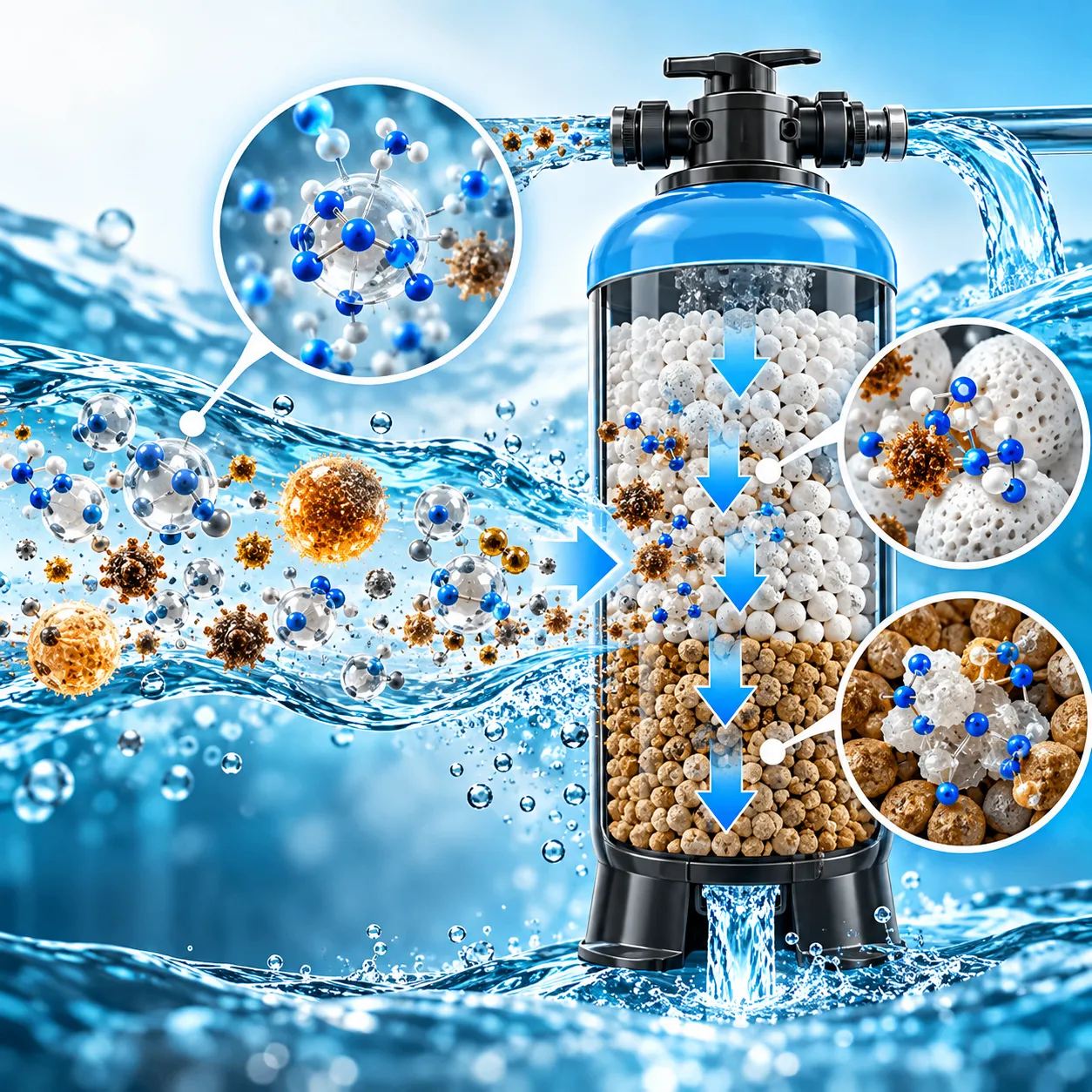
Elevated silica can limit reverse-osmosis recovery, reduce cooling-tower concentration cycles and produce hard, difficult-to-remove deposits in boilers and heat-transfer equipment. SilicaTrapp® first conditions the water using porous TrappSorb® beads containing high-purity magnesium and calcium oxides. The media increases pH and releases magnesium, creating conditions intended to convert part of the reactive silica into magnesium-containing silicate particles. A second Crystolite® filtration vessel then retains these reaction products, colloidal silica and other suspended solids. The brochure reports silica reduction of up to 70%, hardness reduction of up to 60% and turbidity reduction above 96%, depending on the water chemistry and operating conditions.
Reactive silica conversion / Submicron particle filtration
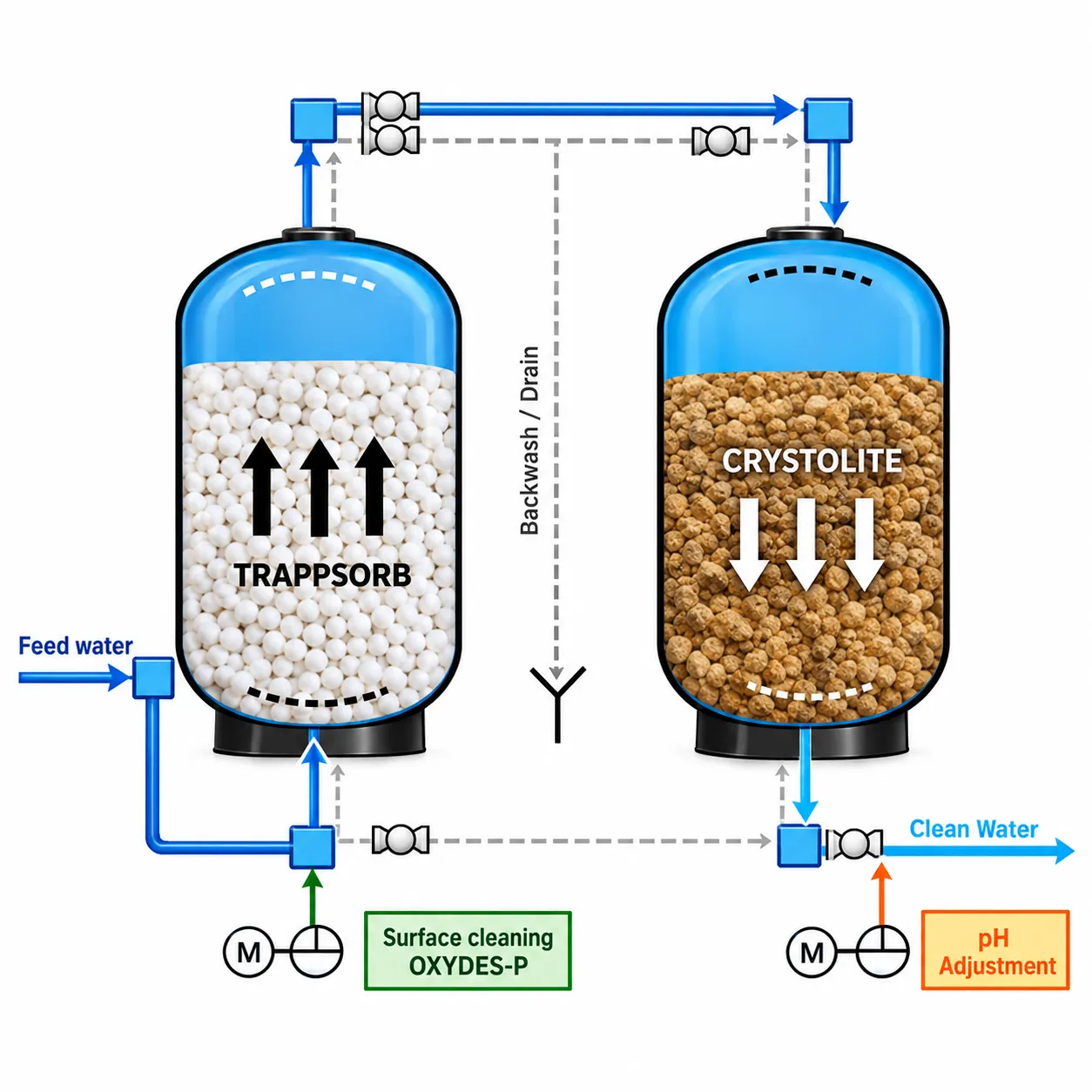
One silica-control process.
Multiple high-demand applications.
SilicaTrapp® can be integrated into industrial pretreatment systems where silica limits water recovery, heat transfer or equipment reliability.
Reverse-Osmosis Pretreatment
Upstream silica and hardness reduction to prevent membrane scaling and allow higher water recovery.
Cooling-Tower Treatment
Increasing cooling-tower concentration cycles while preventing hard silica deposition on heat exchangers.
Steam and Process Boilers
Protecting high-pressure boiler tubes and steam-generating surfaces from tenacious silica scale.
Industrial Water Reuse
Conditioning reclaimed process streams to eliminate silica-related scaling in closed-loop systems.
Groundwater Treatment
Managing naturally high reactive and colloidal silica in deep well supplies and aquifers.
High-Purity Process Water
Reliable pretreatment for semiconductor, power generation and high-purity utilities.
Four treatment functions / Engineered into one process
Reactive silica conditioning (SILICA-REACT)
TrappSorb® modifies pH and mineral chemistry to promote the transformation or adsorption of selected dissolved-silica species.
Magnesium-silicate formation (MG-SILICATE)
Magnesium released by the reactive stage may combine with silica under suitable conditions to form less-soluble or particle-associated silicate phases.
Fine-particle filtration (CRYSTO-FINE)
Crystolite® retains reaction-generated particles, colloidal silica and turbidity in a backwashable granular media bed.
Downstream equipment protection (RO-PROTECT)
Reducing silica and suspended solids can help limit membrane fouling, hard deposits and silica-related operating restrictions.
Understanding silica speciation and removal
Silica exists in dissolved, polymerised, colloidal and particulate forms. Each form behaves differently, making complete water characterisation essential before treatment.
- Dissolved Silica Speciation – At neutral pH, dissolved silica exists mainly as weakly ionised silicic acid ($Si(OH)_4 \rightleftharpoons H^+ + H_3SiO_4^-$); ionisation increases as pH rises.
- Mineral-Media Hydration – TrappSorb® magnesium oxide reacts with water ($MgO + H_2O \rightarrow Mg(OH)_2$), increasing pH and contributing dissolved or surface magnesium.
- Magnesium–Silica Interaction – Under suitable pH, concentration and contact time, magnesium and silicate species form adsorbed complexes or magnesium-silicate solids.
- Solids Separation – Converted silica and colloidal particles are removed from the water via downstream Crystolite® filtration and periodic backwashing.
Download SilicaTrapp® documents
Explore SilicaTrapp® science and applications


Frequently
Asked Questions
Essential information about SilicaTrapp® design, operation and silica-removal performance.
Contact SupportGet a silica-removal solution
Reliable silica control begins with complete water speciation.
Send us your water characteristics (reactive and colloidal silica, hardness, pH, flow rates) and system objectives. Our specialists will help evaluate SilicaTrapp® for your industrial pretreatment or RO application.
