Capture dissolved barium before it becomes a treatment problem.
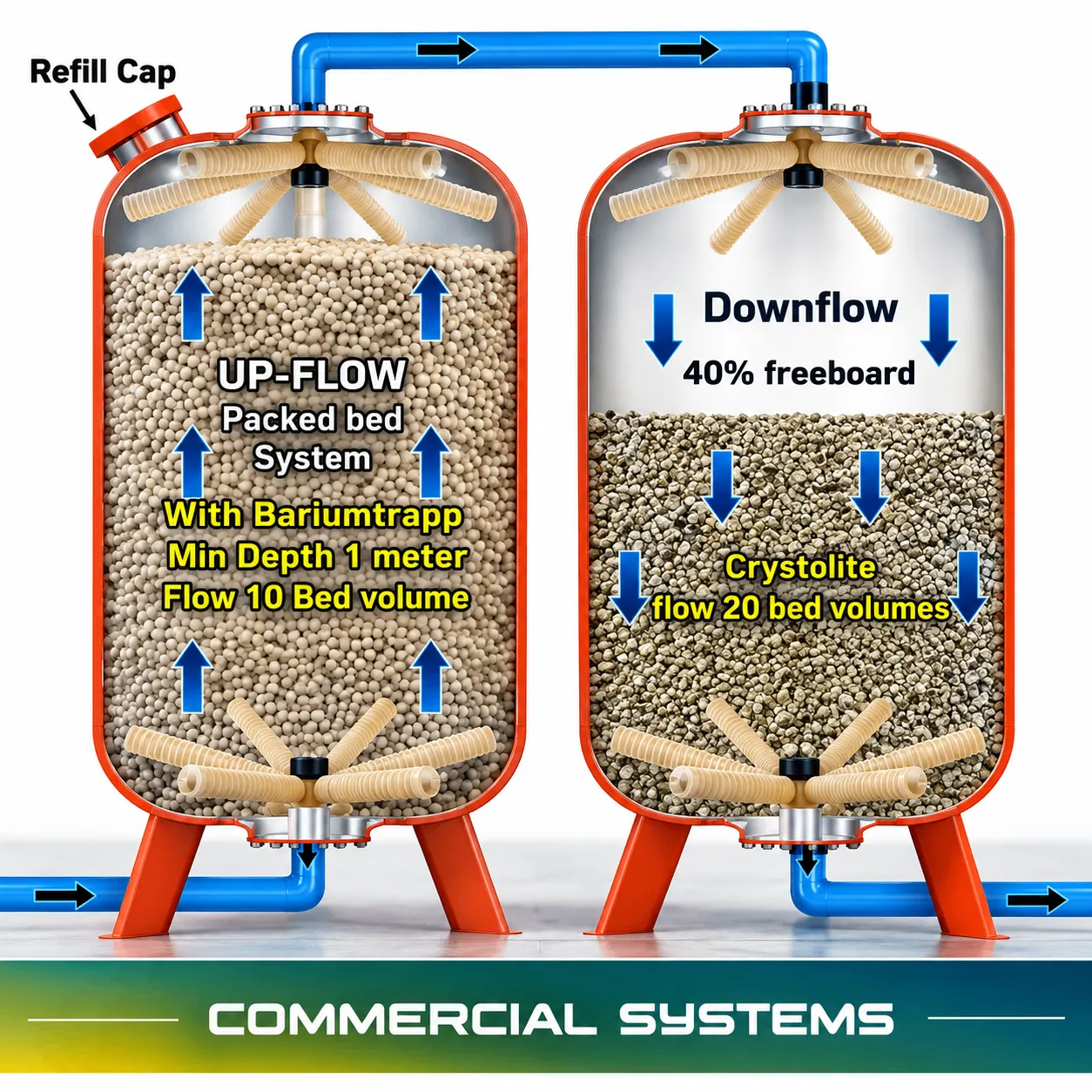
BariumTrapp® is a magnesium-based treatment media developed to reduce dissolved barium from contaminated water through a combined adsorption, mineral-reaction and downstream filtration process.
Dissolved barium can occur naturally in groundwater or enter industrial water streams through mining, drilling and manufacturing activities. It can also react with sulfate, carbonate, phosphate or silica-containing species to form deposits that restrict pipes and foul reverse-osmosis membranes. BariumTrapp® uses hydrous magnesium oxide media in an upflow contact bed to condition the water and promote the capture of barium-containing species. A downstream Crystolite® filtration stage is recommended in the brochure to retain precipitated or media-bound particles. The complete process must be designed using laboratory testing because performance depends strongly on pH, barium speciation, alkalinity and competing ions.
Chemical-free media operation / No brine regeneration
Targeted barium control.
Across challenging water sources.
BariumTrapp® can be integrated into groundwater, industrial wastewater and membrane pretreatment systems where dissolved barium or barium-scale formation creates a health, discharge or operational concern.
Groundwater and Well Water
Treatment of naturally occurring dissolved barium in well supplies and regional aquifers.
Drinking-Water Treatment
Municipal or commercial drinking-water conditioning to meet regional barium compliance limits.
Reverse-Osmosis Pretreatment
Upstream barium removal to prevent catastrophic barium sulfate scaling on high-recovery RO membranes.
Mining and Acid-Mine Water
Buffering and selective metal capture for mining drainage and process effluents.
Oil and Gas Produced Water
Managing barium-rich produced water to protect downstream separation and reinjection infrastructure.
Industrial Wastewater
Specialised treatment for manufacturing, drilling and chemical processing effluent containing dissolved barium.
Four treatment functions / Integrated into one process
Dissolved barium reduction (BA-CAPTURE)
Hydrous magnesium oxide provides reactive mineral surfaces intended to capture dissolved barium under controlled water-chemistry conditions.
Reaction-condition optimisation (PH-CONTROL)
The magnesium-based media influences pH and hydroxide availability, creating conditions intended to support surface adsorption and mineral precipitation.
Downstream particulate retention (SOLIDS-TRAPP)
A polishing filter containing appropriately selected filtration media, such as Crystolite®, can retain particles created or released during treatment.
Barium-scale risk reduction (RO-PROTECT)
Reducing dissolved barium upstream can help lower the risk of barium sulfate, carbonate or phosphate deposits forming on reverse-osmosis membranes.
Understanding barium capture
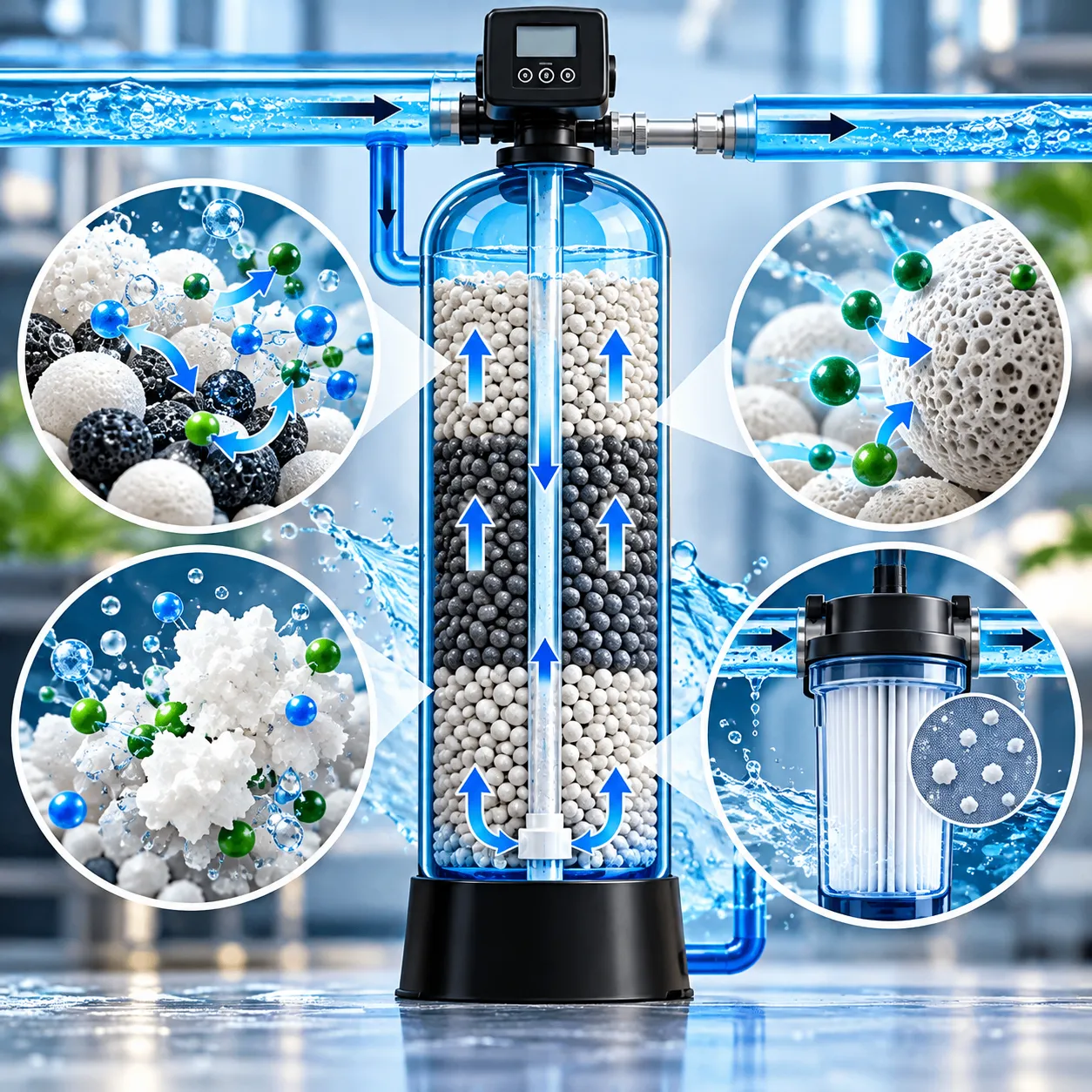
BariumTrapp® uses hydrous magnesium oxide surfaces, pH adjustment and downstream filtration. Its mechanism should be presented as a combination of adsorption and possible mineral precipitation—not as conventional sodium-cycle ion exchange.
- Hydrous Magnesium Oxide Formation – Magnesium oxide hydrates when exposed to water and forms magnesium hydroxide ($MgO + H_2O \rightarrow Mg(OH)_2$).
- Surface Adsorption – Dissolved barium ions interact with reactive hydroxylated mineral surfaces ($\equiv Mg–OH + Ba^{2+} \rightleftharpoons \equiv Mg–O–Ba^+ + H^+$).
- Barium Precipitation – When counter-ions are present, dissolved barium forms sparingly soluble minerals ($Ba^{2+} + SO_4^{2-} \rightarrow BaSO_4(s)$ and $Ba^{2+} + CO_3^{2-} \rightarrow BaCO_3(s)$).
- Filtration and Separation – Adsorbed or precipitated barium-containing solids must be separated using a downstream Crystolite® filtration stage.
Download BariumTrapp® documents
Explore barium removal science and applications


Frequently
Asked Questions
Important information about BariumTrapp® selection, operation, performance and maintenance.
Contact SupportGet a barium-removal solution
Reliable treatment starts with complete water analysis.
Send us your water characteristics (barium levels, pH, sulfate, alkalinity, flow rates) and treatment objectives. Our specialists will help evaluate BariumTrapp® for your filtration and RO protection requirements.