Capture arsenic / Protect drinking-water quality
TITANSORB® is a high-capacity granular titanium dioxide adsorber developed for reducing arsenic and selected heavy metals from drinking water, groundwater and industrial water.
TITANSORB® uses a hydrophilic, porous titanium dioxide surface to adsorb dissolved arsenic and selected metal species. Its large pore structure promotes rapid intraparticle transport, allowing contaminants to reach active adsorption sites quickly. The media can capture both arsenite, As(III), and arsenate, As(V). However, oxidizing As(III) to As(V) before treatment generally improves adsorption capacity and extends media life. TITANSORB® is designed as a non-regenerable, single-use adsorber. Once contaminant breakthrough reaches the defined replacement limit, the exhausted media is removed, characterized and replaced. This simplifies system operation by eliminating onsite chemical regeneration.
High-capacity adsorption / No onsite regeneration
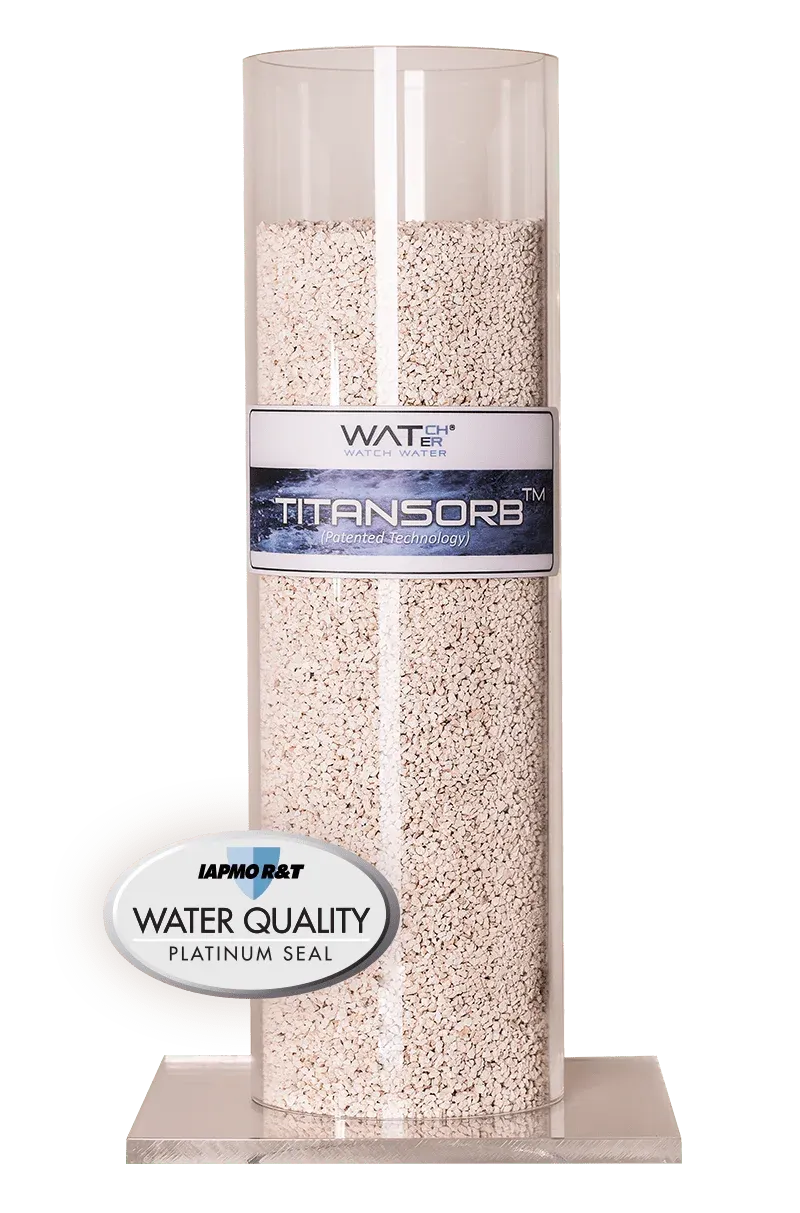
One titanium adsorber.
Multiple heavy-metal applications.
TITANSORB® can be used in cartridge filters, pressure vessels and fixed-bed adsorption systems. Performance must be verified using the actual water chemistry, target contaminant and required treated-water limit.
Point-of-Use Drinking Water
Compact cartridges for under-sink and individual-outlet arsenic treatment.
Point-of-Entry Systems
Whole-building pressure-vessel systems for arsenic-contaminated groundwater.
Municipal Water Treatment
Fixed-bed arsenic and metal adsorption for community drinking-water supplies.
Industrial Wastewater Treatment
Treatment of selected dissolved metals in industrial and remediation streams.
Bottled and Mineral Water
Arsenic polishing where permitted by applicable bottled-water regulations.
Food and Beverage Water
Pretreatment of ingredient and process water containing arsenic or selected metals.
Four performance advantages engineered into one media
Titanium dioxide adsorption
Titanium dioxide provides hydroxylated surface sites that can bind arsenic and selected metal species through surface-complexation reactions.
Dual-species arsenic capture
TITANSORB® can adsorb both As(III) and As(V), with the highest published capacity associated with As(V) under favorable laboratory conditions.
Fast intraparticle transport
The porous granular structure supports rapid diffusion of dissolved contaminants toward active adsorption sites, enabling comparatively short contact times.
Regeneration-free operation
The exhausted media is replaced rather than chemically regenerated onsite, simplifying equipment and avoiding a liquid regeneration-waste stream.
Titanium dioxide surface chemistry for arsenic capture
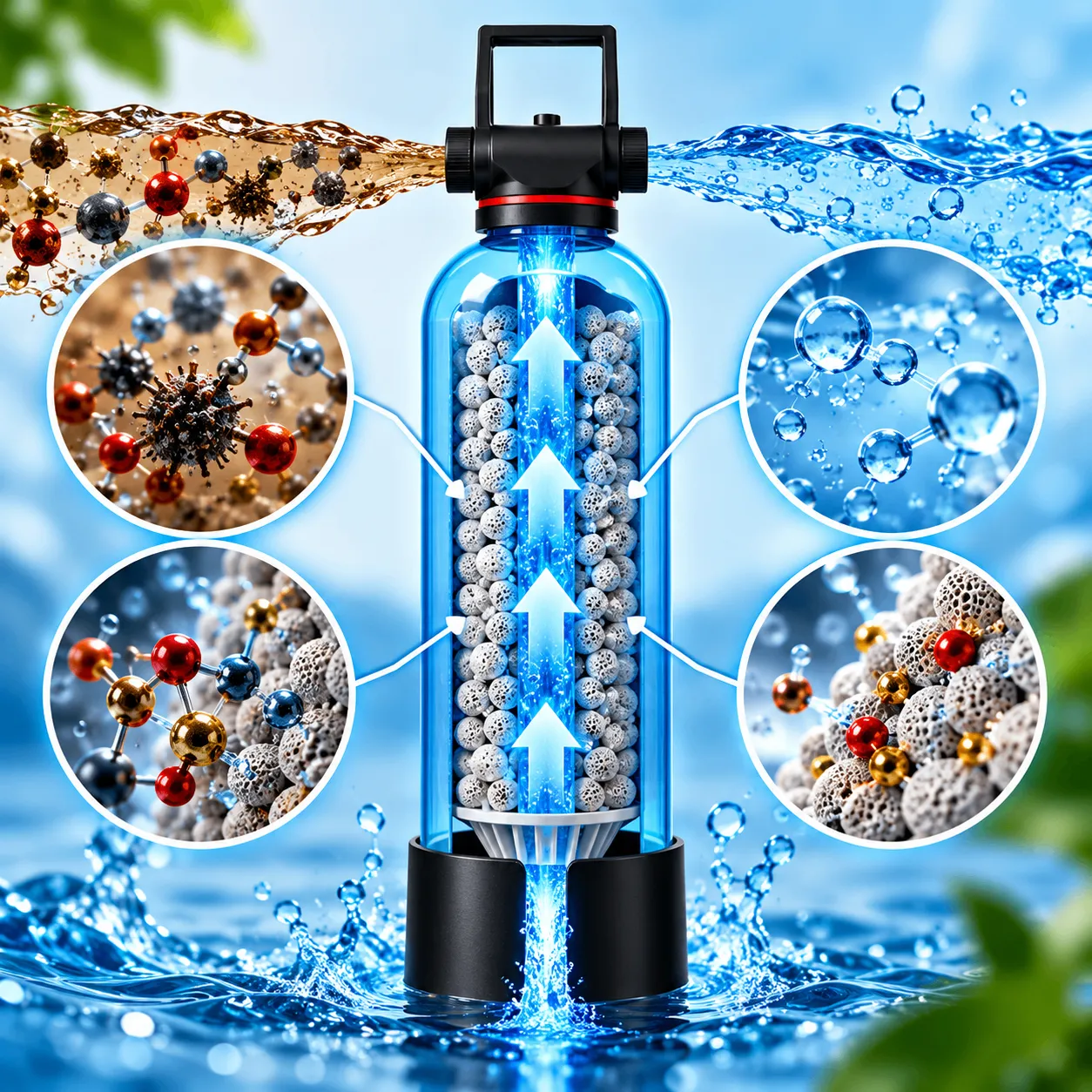
TITANSORB® removes arsenic and selected metals by binding dissolved species to hydroxylated titanium dioxide surface sites.
- Hydrophilic Surface – The titanium dioxide surface readily contacts water, allowing dissolved arsenic species to approach active adsorption sites.
- Surface Complexation – Arsenic oxyanions and selected metal species bind to titanium-associated hydroxyl groups through ligand exchange and surface-complex formation.
- Fast Mass Transfer – The large-pore granular structure shortens the diffusion path between the water phase and internal adsorption sites.
- Selective Fixed-Bed Operation – Target contaminants accumulate inside the media until adsorption sites approach exhaustion and breakthrough occurs.
Download our latest TITANSORB® documents
Explore the TITANSORB®
technology library


Frequently
Asked Questions
Learn about TITANSORB® arsenic adsorption, pretreatment, operation, replacement and disposal.
Contact SupportCalculate Your TITANSORB® Adsorption System
Determine the required media volume and empty-bed contact time (EBCT) based on your flow rate.
Sizing Recommendation
Get an arsenic and heavy-metal solution
It all starts with complete water analysis and arsenic speciation.
Send us your As(III), As(V), total arsenic, pH, phosphate, silica, sulfate, alkalinity, iron and flow information. Our specialists will evaluate whether TITANSORB® is appropriate and recommend the required pilot testing and treatment arrangement.