Reactive boron capture. Precision filtration. One integrated process.
BoronTrapp® combines high-purity TrappSorb® magnesium oxide beads with Crystolite® microfiltration media to reduce boron and reaction-generated particles from water.
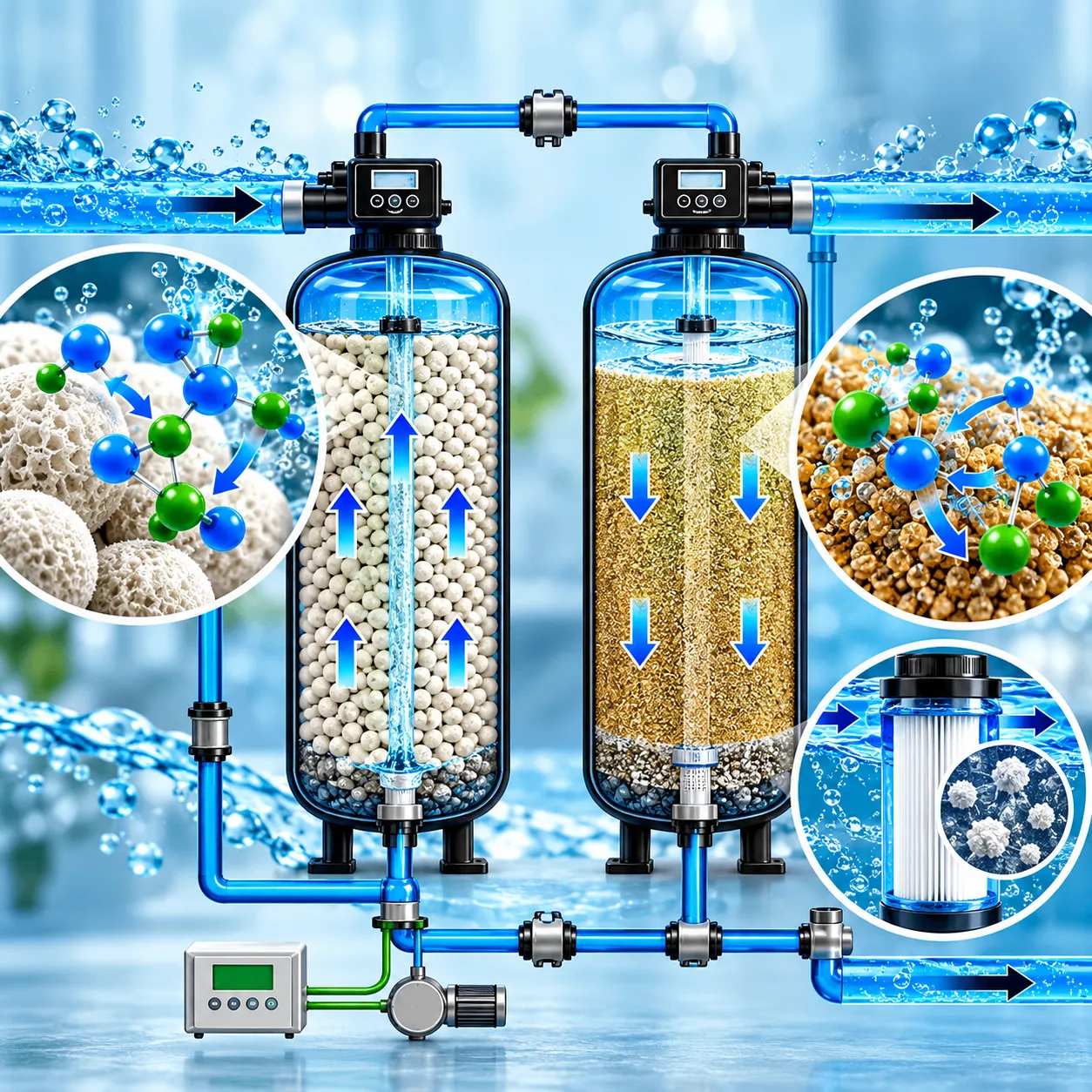
Boron occurs naturally in groundwater and surface water through geological processes and may also enter water resources through wastewater, detergents, fertilisers and industrial discharges. Although boron is an essential plant micronutrient at low concentrations, excessive levels can affect sensitive crops, restrict irrigation-water reuse and cause drinking-water compliance concerns. The BoronTrapp® process uses porous TrappSorb® magnesium oxide beads as its reactive first stage, followed by a backwashable Crystolite® filtration bed. The magnesium-based stage is intended to adsorb or transform boron-containing species, while the second stage retains the resulting particles and suspended solids.
Reactive magnesium treatment / Filtration down to 0.5 micron
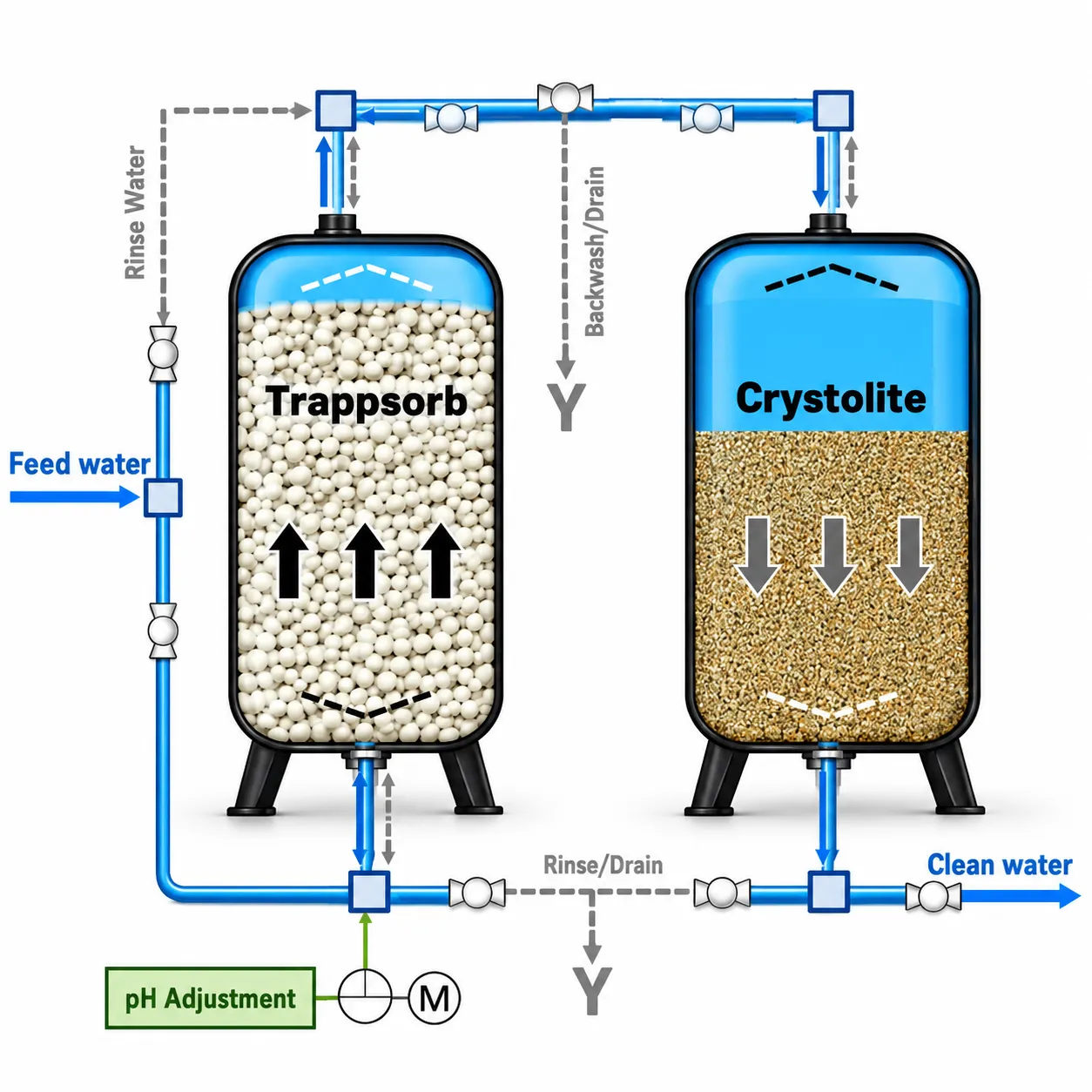
One integrated process.
Multiple boron-control applications.
BoronTrapp® can be applied where boron limits drinking-water use, industrial reuse, membrane operation or irrigation of boron-sensitive crops.
Drinking-Water Treatment
Municipal or commercial drinking-water conditioning to meet regional boron compliance limits.
Groundwater and Wells
Treatment of naturally occurring dissolved boron in well supplies and regional aquifers.
Agricultural Irrigation
Protecting sensitive crops from excessive boron in groundwater and reclaimed irrigation water.
Industrial Wastewater
Specialised treatment for manufacturing, drilling and chemical processing effluent containing dissolved boron.
Reverse-Osmosis Polishing
Post-treatment options for reducing residual boron after desalination or high-recovery RO.
Water Reuse Systems
Conditioning treated wastewater to allow safe agricultural or industrial reuse without boron toxicity.
Four treatment functions / Engineered into one process
Reactive boron adsorption (B-CAPTURE)
Porous magnesium oxide beads provide hydroxylated mineral surfaces that can interact with dissolved boron species under controlled water-chemistry conditions.
Magnesium-based conditioning (MG-REACT)
TrappSorb® hydrates when exposed to water and modifies the local surface chemistry, supporting adsorption or mineral-reaction pathways.
High-efficiency solids retention (MICRO-TRAPP)
Crystolite® captures suspended particles and reaction-generated solids, producing a clarified water stream after the reactive treatment stage.
Backwashable continuous operation (REUSE-FLOW)
The Crystolite® filtration stage can be periodically backwashed, while consumed TrappSorb® media can be replenished according to bed-volume loss and treatment performance.
Understanding boron chemistry and removal
In water, boron occurs mainly as boric acid or borate, depending on pH. Effective treatment requires control of this chemical equilibrium and adequate separation of any generated solids.
- Boron Speciation – Boric acid is dominant in neutral waters ($B(OH)_3 + H_2O \rightleftharpoons B(OH)_4^- + H^+$); higher pH converts a portion to borate.
- Magnesium Oxide Hydration – TrappSorb® magnesium oxide reacts with water to form magnesium hydroxide ($MgO + H_2O \rightarrow Mg(OH)_2$).
- Surface Interaction – Boric acid and borate interact with hydroxyl groups on the hydrated magnesium surface ($\equiv Mg–OH + B(OH)_3 \rightleftharpoons \equiv Mg–O–B(OH)_2 + H_2O$).
- Filtration and Separation – Crystolite® provides downstream filtration needed to separate boron-containing reaction products and fine particles from treated water.
Download BoronTrapp® documents
Explore boron removal science and applications


Frequently
Asked Questions
Essential information about BoronTrapp® chemistry, system operation and performance monitoring.
Contact SupportGet a boron-removal solution
Effective treatment starts with boron speciation and complete water analysis.
Send us your water characteristics (boron levels, pH, flow rates, target compliance limit) and application requirements. Our specialists will help evaluate BoronTrapp® for your two-stage treatment system.