Neutralise acidic water through controlled mineral chemistry.
AcidTrapp® is a high-purity magnesium oxide bead media developed for pH correction, acidity neutralisation and selected dissolved-metal treatment applications.
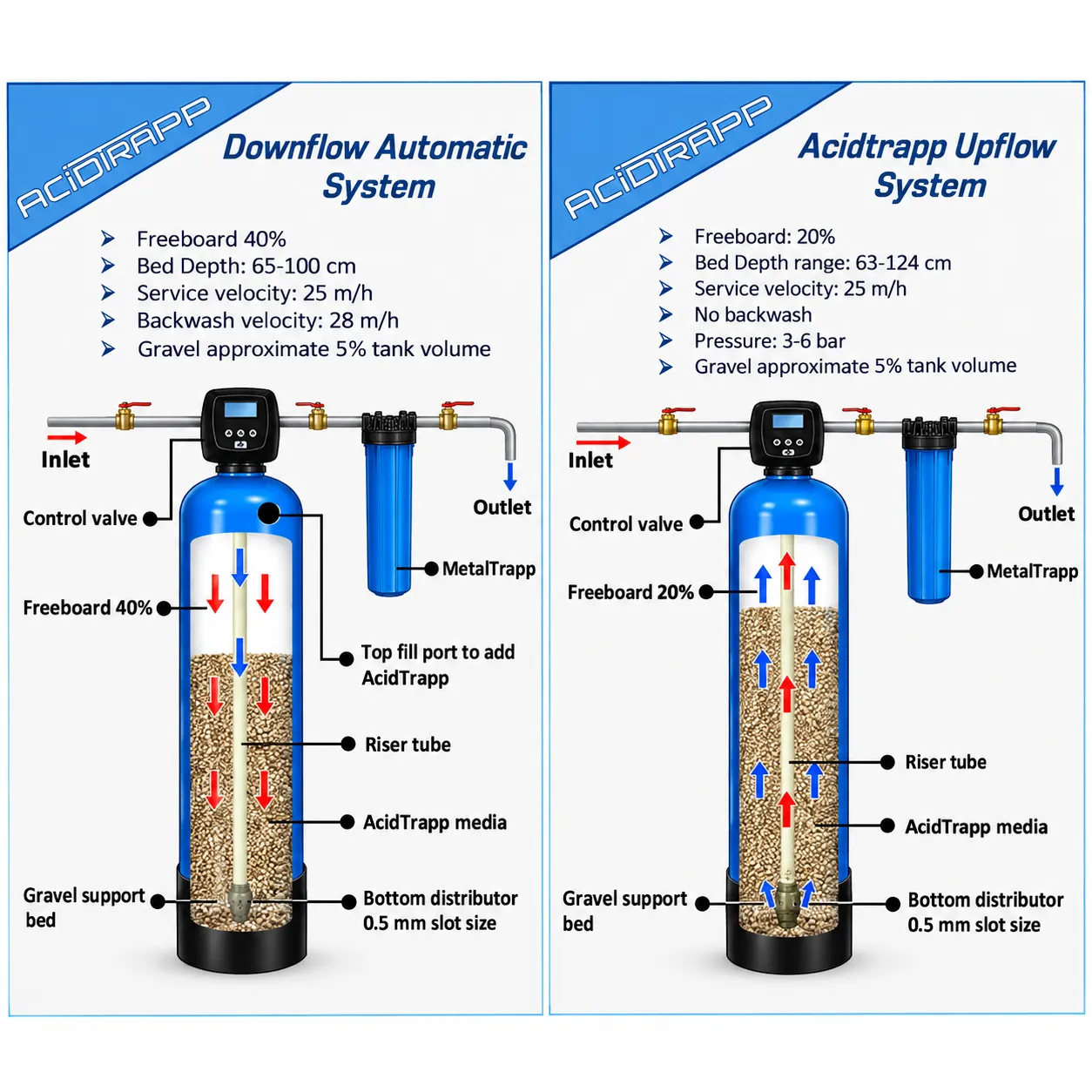
Acidic water can damage distribution pipelines, mobilise metals and create challenging industrial discharge conditions. AcidTrapp® uses slowly reacting magnesium oxide beads to consume acidity and generate magnesium alkalinity. Unlike rapidly dosed liquid caustic, the solid-media process allows neutralisation to occur progressively inside a contact vessel. This controlled reaction may promote the formation of larger, more filterable metal-hydroxide particles while reducing the risk of sudden chemical overdosing. AcidTrapp® can be installed in upflow or downflow vessels and may be followed by Crystolite®, MetalTrapp® or another suitable filtration stage where precipitated metals or suspended solids must be removed.
Controlled pH correction / Solid-media simplicity
One reactive media.
Multiple acid-neutralisation applications.
AcidTrapp® can be integrated into potable, industrial and environmental treatment processes requiring gradual pH correction or neutralisation of acidic components.
Acidic Well Water
Neutralising aggressive, low-pH groundwater supplies to protect residential and commercial plumbing.
Industrial Acidic Effluent
Conditioning and neutralising acidic wastewater streams before discharge or further treatment.
Acid-Mine Drainage
Buffering highly acidic mine water and supporting the precipitation of dissolved heavy metals.
Metal-Finishing Rinse Water
pH correction and controlled neutralisation for manufacturing rinse and process waters.
Corrosion-Risk Reduction
Stabilising water chemistry to prevent infrastructure degradation and metal leaching.
Tertiary Metals Polishing
Supporting metal hydroxide precipitation and subsequent solid-liquid separation.
Four treatment functions / Engineered into one mineral media
Controlled acidity neutralisation (ACID-CONTROL)
Solid magnesium oxide beads react progressively with acidic water, helping reduce the risk of rapid pH overshoot associated with concentrated liquid-caustic dosing.
Magnesium alkalinity generation (MG-BUFFER)
Hydration and dissolution of the media release magnesium and acid-neutralising capacity, helping improve the buffering characteristics of treated water.
Metal precipitation support (METAL-PRECIP)
Increasing pH can convert selected dissolved metal ions into less-soluble hydroxide phases that may then be separated by clarification or filtration.
Gradual pH correction (PH-STABLE)
Limited media solubility provides a slower neutralisation response than freely soluble hydroxides, although the final pH remains dependent on water chemistry and system design.
The chemistry behind AcidTrapp®
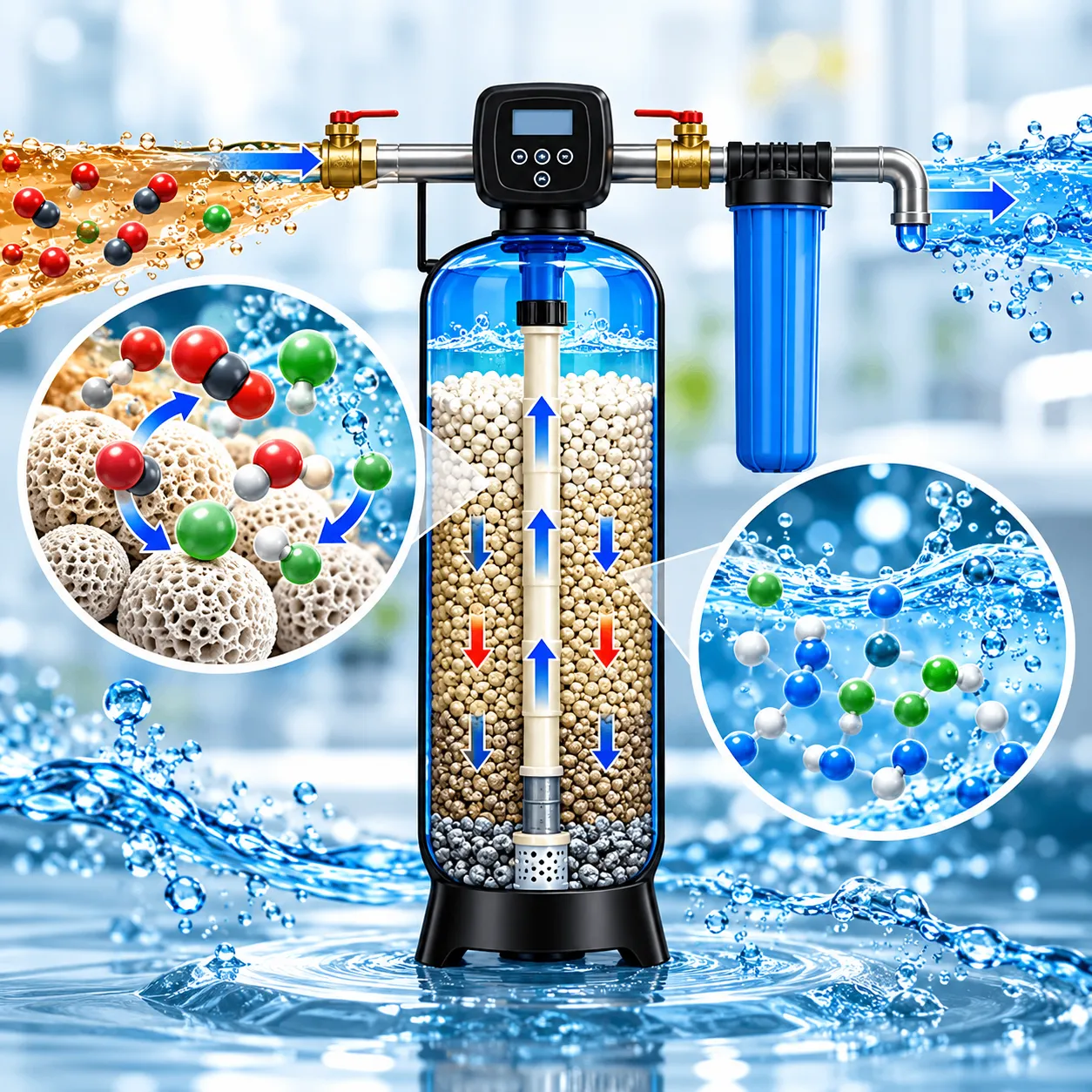
AcidTrapp® converts acidic components into water and dissolved magnesium salts while supporting the formation of filterable metal-hydroxide solids where suitable metals are present.
- Magnesium Oxide Hydration – Magnesium oxide hydrates to form magnesium hydroxide ($MgO + H_2O \rightarrow Mg(OH)_2$).
- Acid Neutralisation – Magnesium hydroxide consumes hydrogen ions ($Mg(OH)_2 + 2H^+ \rightarrow Mg^{2+} + 2H_2O$); overall reaction: $MgO + 2H^+ \rightarrow Mg^{2+} + H_2O$.
- Carbonic Acidity – Carbon dioxide dissolved in water participates in carbonate equilibria ($CO_2 + H_2O \rightleftharpoons H_2CO_3 \rightleftharpoons H^+ + HCO_3^-$); AcidTrapp® consumes acidity but does not necessarily remove all dissolved $CO_2$.
- Metal-Hydroxide Formation – Increasing pH may precipitate certain dissolved metals ($M^{2+} + 2OH^- \rightarrow M(OH)_2(s)$), requiring downstream solids separation.
Download AcidTrapp® documents
Explore AcidTrapp® chemistry and applications


Frequently
Asked Questions
Essential information about AcidTrapp® selection, operation, safety and performance.
Contact SupportGet an acidity-neutralisation solution
Stable water chemistry starts with complete analysis.
Send us your water characteristics (pH, acidity, dissolved metals, flow rates) and neutralisation objectives. Our specialists will help evaluate AcidTrapp® for your filtration vessel design.