Oxidise odour at its source—not simply cover it
Deodor-Oxy™ is a water-soluble, three-component powder developed for the treatment of odour-producing waste, sludge and organic material.
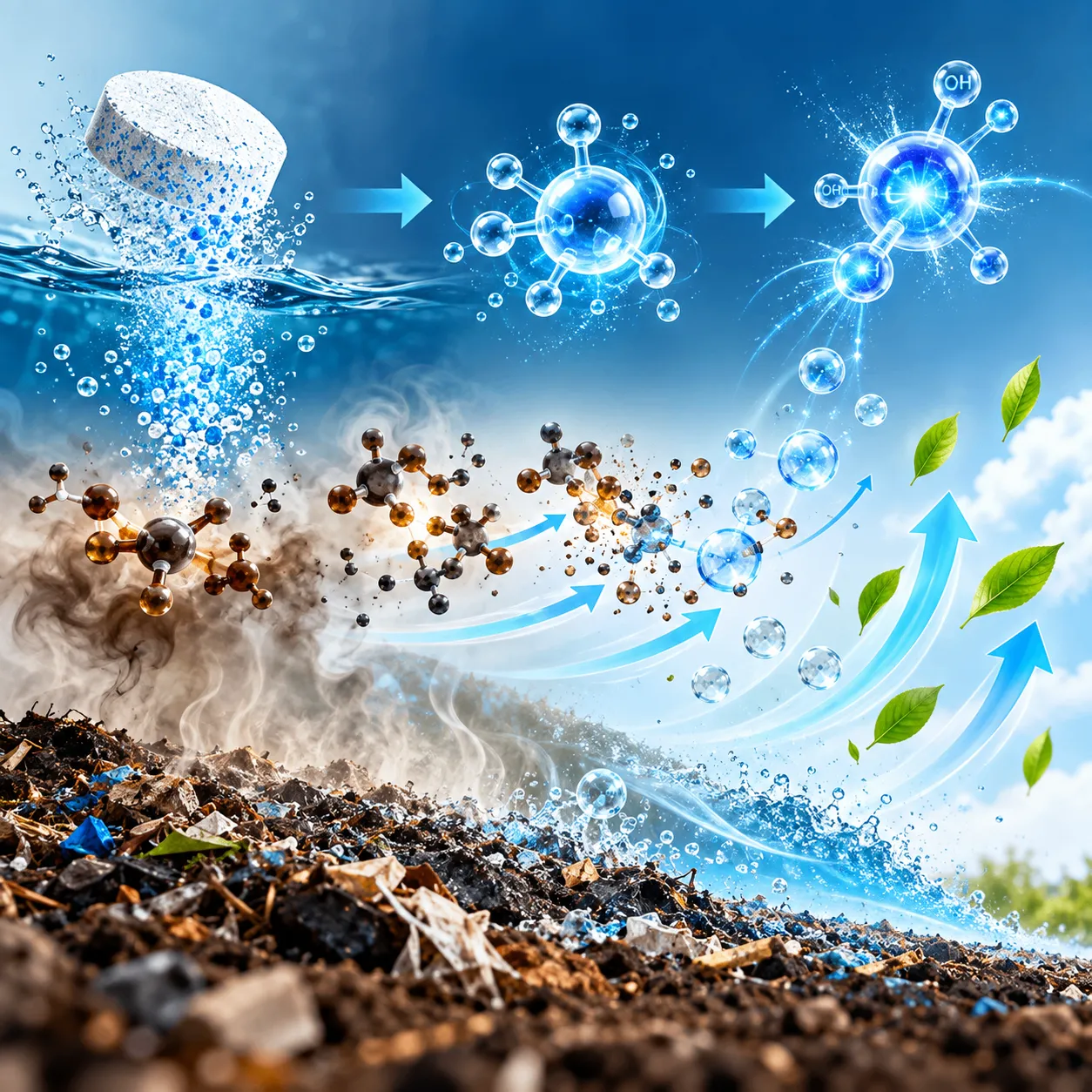
Deodor-Oxy™ is prepared as a fresh aqueous solution and sprayed directly onto the odour-producing material. Its built-in catalytic oxidation system is designed to generate reactive oxygen species, including hydroxyl radicals, that interact with susceptible odour molecules, volatile organic compounds and hydrocarbons. Unlike fragrance-based products that temporarily mask odour, Deodor-Oxy™ is intended to chemically transform selected compounds at the source. The required concentration, application volume and treatment frequency must be established according to waste type, moisture, temperature and measured emissions.
No perfume masking / Direct source oxidation

One odour-control technology.
Multiple waste environments.
Deodor-Oxy™ can be applied to suitable solid and semi-solid waste streams using controlled spraying equipment and an application programme developed from site testing.
Landfills & Waste Disposal Sites
Applied directly to exposed waste surfaces to control selected odorous compounds and VOC emissions.
Waste Containers & Collection Areas
Suitable for dumpsters, collection points, storage areas and waste-transfer facilities.
Composting & MBT Facilities
Supports odour management around composting plants and mechanical-biological treatment operations.
Wastewater, Sewage & Sludge
Targets selected sulphur-containing and organic odours from sewage-treatment areas, sludge and related waste.
Food & Animal-Feed Processing
Supports source-level odour treatment in industries handling food residues, pet food, fish, poultry and animal-feed materials.
Commercial & Municipal Facilities
Applicable to markets, commercial waste areas, municipal collection zones and professionally managed smart-city programmes.
Four functions / Engineered into one premixed product
Built-In Catalytic Activation (OXY-ACTIVATION)
A proprietary catalyst activates the oxidizing component after solution preparation, eliminating the need for a separately dosed activator.
Reactive Oxygen Species (ROS-GENERATION)
Activated chemistry is designed to produce reactive oxygen species that attack susceptible organic odour compounds.
Molecular Transformation (ODOUR-OXIDATION)
Selected sulphur compounds, VOCs and hydrocarbons are oxidised into less odorous or more manageable transformation products.
Direct Waste-Surface Treatment (SOURCE-CONTACT)
A freshly prepared solution is sprayed evenly over the waste so the active chemistry reaches the odour-producing material.
Science & Technology
Deodor-Oxy™ uses catalytic oxidation to transform selected odour molecules directly at their source.
- Solution Activation – Dry powder is dissolved in clean water immediately before use, activating the oxidizing and catalytic components upon water contact.
- Reactive Oxygen Formation – Generates reactive oxygen species, including hydroxyl radicals ($\bullet OH$) and potentially superoxide ($O_2^{\bullet-}$) or peroxide species.
- Odour-Molecule Oxidation – Reactive species attack susceptible molecular bonds in sulphides, reduced organic compounds and selected VOCs.
- Source-Level Contact – Requires direct and uniform contact between the prepared solution and odour-generating waste (airborne odour already left the source requires off-gas treatment).
Download Our Latest Documents
Explore the Deodor-Oxy™
Poster Library


Frequently
Asked Questions
Technical information about Deodor-Oxy™ preparation, odour oxidation, spraying, monitoring and safety.
Contact SupportGet an advanced odour-control solution
It all starts with identifying the odour source.
Send us your waste type, emission characteristics (hydrogen sulphide, VOCs, municipal or industrial waste) and odour control objectives. Our specialists will help evaluate Deodor-Oxy™ for your facility.
