
twomit.com

FILTERSORB® CT

Combined Treatment for Temporary and Permanent Hardness

Combined Scale Prevention

One media for temporary and permanent hardness

FILTERSORB® CT is a factory-prepared combined scale-prevention media designed to address carbonate scale together with more difficult sulfate-, silicate- and phosphate-related deposits.

Developed by Watch Water® Germany, FILTERSORB® CT combines FILTERSORB® SP3 and FILTERSORB® SPA in a 50:50 media blend[cite: 3]. The SP3 component applies Nucleation Assisted Crystallization to transform calcium- and magnesium-related carbonate hardness into stable microcrystals[cite: 3]. The SPA component is designed to control scale involving negatively charged species such as sulfates, silicates and phosphates[cite: 3]. Together, the two media provide broader protection for residential, commercial, municipal and industrial water systems without salt regeneration, chemical dosing or brine wastewater[cite: 3].

Dual-action scale prevention without salt or regeneration[cite: 3].

50% SP3 for carbonate hardness. 50% SPA for permanent-hardness scale[cite: 3].
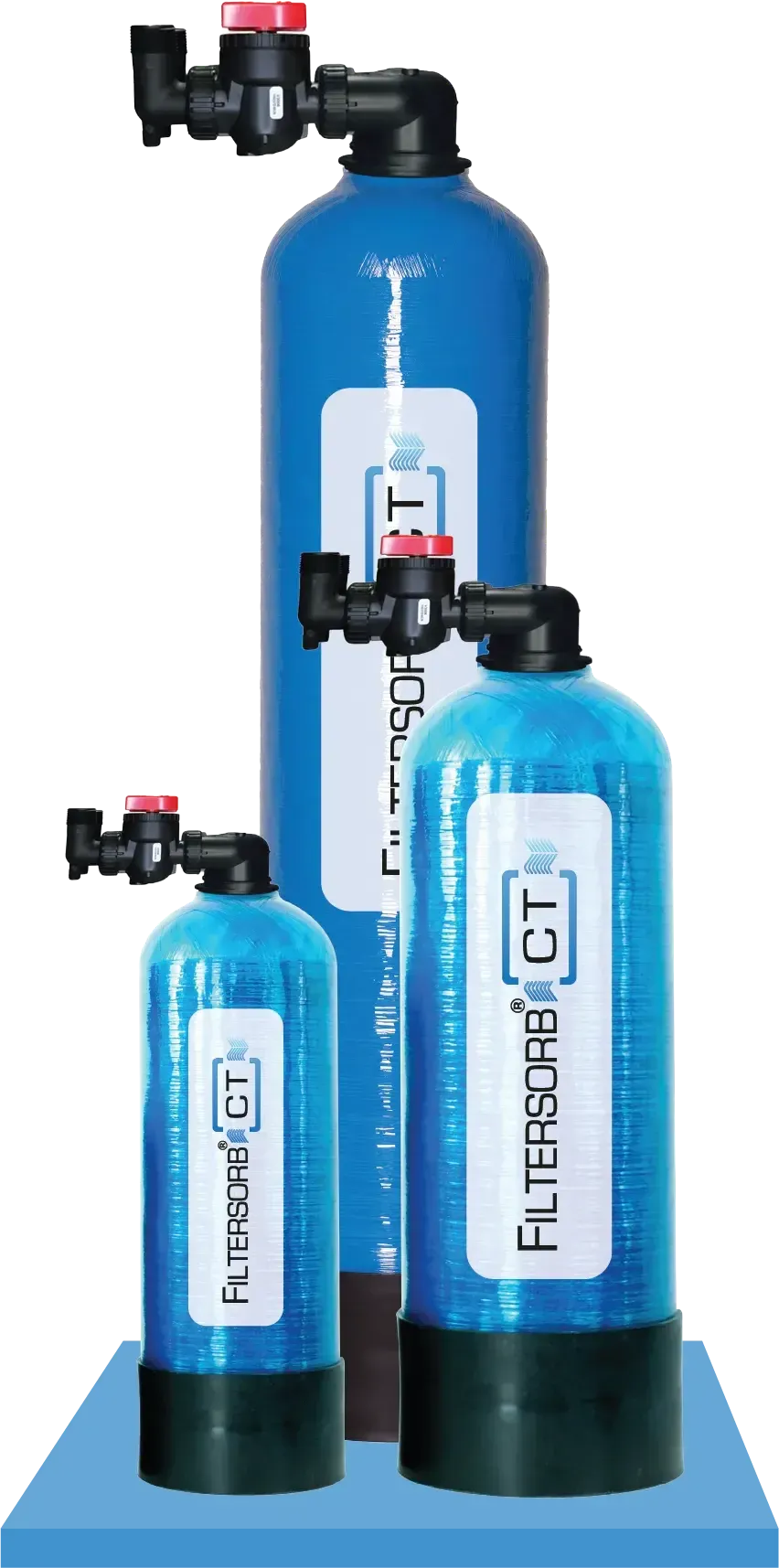
FILTERSORB CT Introduction

Comprehensive scale protection
across water systems

FILTERSORB® CT is intended for applications where both carbonate hardness and non-carbonate scale-forming species are present[cite: 3]. It can be configured for point-of-use, point-of-entry and larger commercial or industrial treatment systems.

Residential and Whole-House Systems

Protects household plumbing, water heaters, shower systems, appliances and point-of-entry installations.

Hotels, Restaurants and Food Service

Suitable for hotels, commercial kitchens, coffee and tea equipment, ice machines and catering systems.

Commercial and Institutional Buildings

Supports scale prevention in offices, hospitals, schools, public facilities and commercial hot-water systems.

Boilers and Heating Equipment

Helps protect boilers, hot-water generators, heating elements and heat-transfer surfaces from complex mineral deposits.

Cooling and Industrial Process Water

Suitable for cooling equipment, manufacturing, process-water systems and applications affected by sulfate and silicate scale.

Food, Beverage and Specialty Water

Preserves the natural mineral profile used for coffee, tea and beverage preparation while supporting broader scale control.

Four advantages engineered into one combined media

Carbonate Hardness Transformation

The SP3 component provides catalytic nucleation sites that transform calcium- and magnesium-related carbonate hardness into suspended calcium-carbonate microcrystals

Protection Against Difficult Permanent-Hardness Scale

The SPA component provides positively charged active surfaces intended to interfere with scale formation involving sulfates, silicates and phosphates.

Scale Prevention Without Sodium Exchange

FILTERSORB® CT is not a conventional ion-exchange softener. It does not intentionally replace calcium and magnesium with sodium.

No Regeneration, Brine or Electrical Valve

The recommended continuous-upflow configuration requires no salt regeneration, chemical feed, routine regeneration backwashing or electrical control valve.

Science &
Technology

FILTERSORB® CT combines two different media surfaces to address the two major categories of scale-forming water chemistry: temporary carbonate hardness and permanent non-carbonate hardness[cite: 3].

  • NAC Treatment with SP3 – FILTERSORB® SP3 initiates calcium-carbonate nucleation. Dissolved calcium bicarbonate is transformed into calcium-carbonate microcrystals that are intended to remain suspended rather than forming hard surface deposits.
  • Anion-Scale Control with SPA – FILTERSORB® SPA uses positively charged active surfaces designed to interact with negatively charged scale-forming species, including sulfate, silicate and phosphate.
  • 50:50 Combined Media Configuration – FILTERSORB® CT is supplied as an equal mixture of SP3 and SPA[cite: 3]. The SP3 fraction addresses temporary carbonate hardness, while the SPA fraction targets permanent-hardness scale.
  • Continuous Upflow Fluidization – The media is designed for upflow operation with sufficient freeboard and water distribution to support media movement, contact and controlled pressure drop.
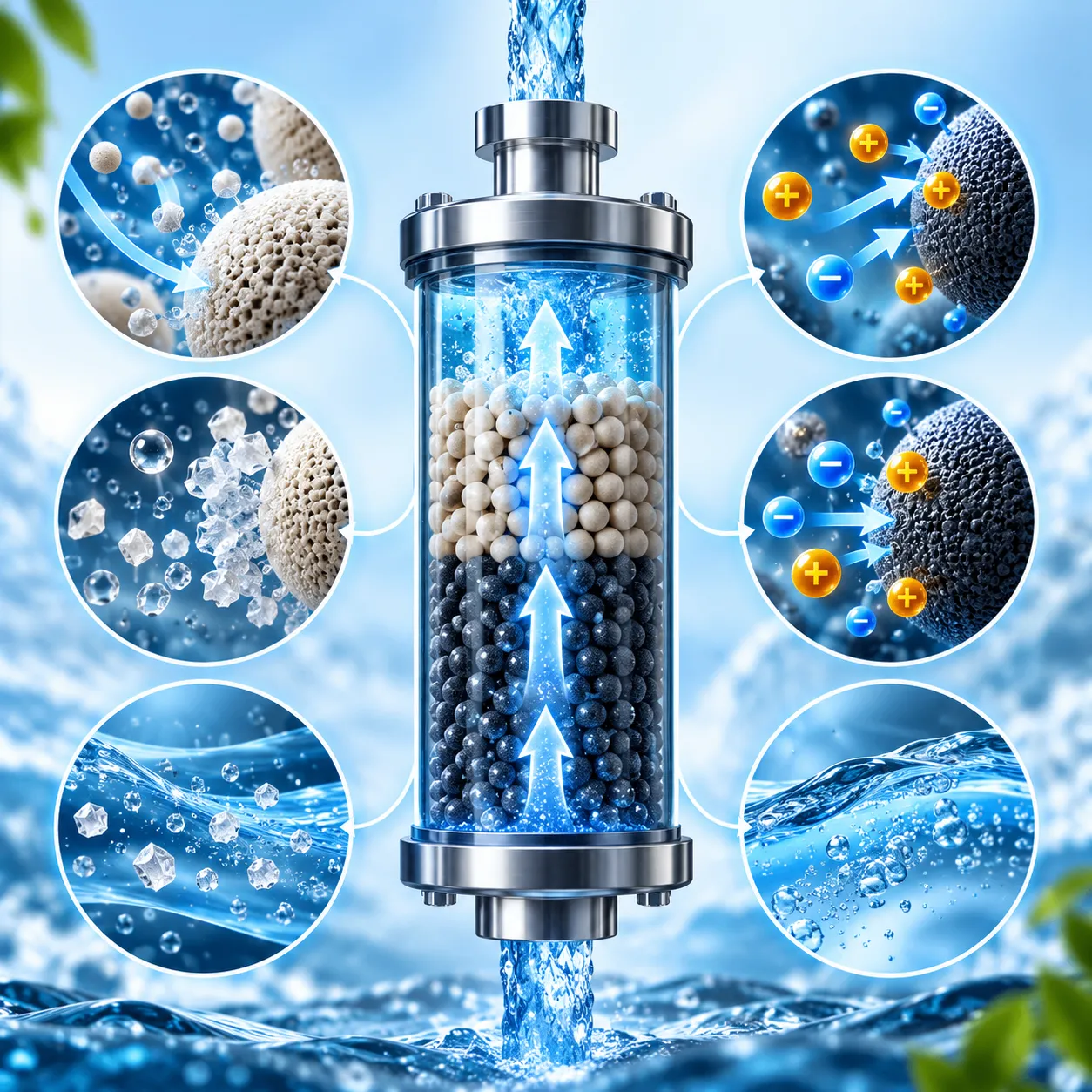
FILTERSORB CT Science and Technology

Explore the FILTERSORB® CT
Poster Library

Loading Poster Library…
Combined Scale Prevention
2026

Combined Scale Prevention

One media blend for temporary and permanent-hardness scale.

SP3 + SPA Technology
2026

SP3 + SPA Technology

See how two complementary media surfaces provide broader scale protection.

Temporary vs. Permanent Hardness
2026

Temporary vs. Permanent Hardness

Understand carbonate, sulfate, silicate and phosphate-related scale.

Salt-Free Total Hardness Control
2026

Salt-Free Total Hardness Control

Scale protection without sodium exchange, regeneration or brine discharge.

Difficult Industrial Scale
2026

Difficult Industrial Scale

Protection for systems affected by sulfate-, silicate- and phosphate-containing deposits.

Continuous Upflow Design
2026

Continuous Upflow Design

Learn how vessel geometry, freeboard and media fluidization affect system performance.

Residential and Commercial Protection
2026

Residential and Commercial Protection

Combined scale prevention for whole-house, hospitality and food-service systems.

SORBEX Media Cleaning
2026

SORBEX™ Media Cleaning

Preventive maintenance guidance for organically or inorganically fouled media.

Frequently
Asked Questions

Find answers about FILTERSORB® CT, combined scale prevention, installation, maintenance and system sizing[cite: 3].

Contact Support
What is FILTERSORB® CT?
FILTERSORB® CT is a combined scale-prevention media consisting of a 50:50 mixture of FILTERSORB® SP3 and FILTERSORB® SPA[cite: 3].
What does “CT” mean?
CT means Combined Treatment[cite: 3]. It refers to combined treatment of temporary carbonate hardness and permanent non-carbonate hardness[cite: 3].
How is it different from FILTERSORB® SP3?
SP3 primarily addresses carbonate hardness involving calcium and magnesium[cite: 3]. CT adds the SPA component for broader control of sulfate-, silicate- and phosphate-related scale[cite: 3].
What is temporary hardness?
Temporary hardness is mainly associated with dissolved calcium and magnesium bicarbonates that can form carbonate scale when water is heated or concentrated[cite: 3].
What is permanent hardness?
Permanent hardness generally refers to calcium and magnesium associated with non-carbonate anions, including sulfates and chlorides[cite: 3]. Silica and phosphate may create additional deposit risks[cite: 3].
What types of scale does FILTERSORB® CT target?
It is designed for carbonate scale and deposits involving sulfates, silicates and phosphates[cite: 3].
How does FILTERSORB® CT work?
The SP3 fraction initiates carbonate nucleation, while the SPA fraction provides active surfaces intended to interfere with scale involving negatively charged species[cite: 3].
Is FILTERSORB® CT a conventional water softener?
No[cite: 3]. It is a scale-prevention and conditioning technology[cite: 3]. It does not remove all hardness ions or produce zero-hardness water[cite: 3].
Does it remove calcium and magnesium?
No[cite: 3]. Conventional ion exchange does not occur[cite: 3]. Calcium and magnesium are retained while their tendency to form scale is modified[cite: 3].
Does it add sodium?
No[cite: 3]. FILTERSORB® CT does not intentionally replace hardness ions with sodium[cite: 3].
Does it require salt or regeneration?
No salt regeneration or chemical-regeneration cycle is required[cite: 3].
Does it produce wastewater?
It does not produce ion-exchange regeneration brine[cite: 3]. Cleaning or pretreatment stages may generate wastewater[cite: 3].
Does it require electricity?
A basic continuous-upflow CT vessel does not require an electrical regeneration valve[cite: 3]. Pumps or monitoring systems may require power[cite: 3].
Can SP3 and SPA be purchased separately?
The existing page states that SPA is supplied only as part of FILTERSORB® CT and is not offered separately[cite: 3].
What is the recommended media ratio?
The standard CT configuration is 50% FILTERSORB® SP3 and 50% FILTERSORB® SPA[cite: 3].
When should CT be selected instead of SP3?
CT should be considered when permanent-hardness scale, sulfate, silicate or phosphate contributes significantly to the overall deposit risk[cite: 3].
Is FILTERSORB® CT effective against permanent hardness?
It is specifically positioned for broader scale prevention where permanent-hardness constituents are present[cite: 3]. Application-specific performance should be confirmed through testing[cite: 3].
What applications are suitable?
Applications include residential, commercial, municipal, hospitality, food and beverage, boiler, cooling and industrial process-water systems[cite: 3].
Can it be used for point-of-use systems?
Yes[cite: 3]. It can be used in point-of-use applications when properly sized[cite: 3].
Can it be used for point-of-entry systems?
Yes[cite: 3]. Whole-house and building-entry systems are among its intended applications[cite: 3].
What vessel configuration is recommended?
The existing brochure recommends a tall, relatively narrow FRP or stainless-steel pressure vessel operated in upflow[cite: 3].
Is support gravel required?
The brochure recommends avoiding sand and support gravel in the CT media bed[cite: 3]. The final distributor design must still follow current engineering instructions[cite: 3].
What is the recommended maximum pressure drop?
The existing brochure recommends limiting media-bed pressure drop to approximately 0.5 bar or 7 psi[cite: 3].
How long does the media last?
The existing page states that service life can exceed five years in many applications[cite: 3]. Actual life depends on water chemistry, flow, fouling and system design[cite: 3].
Does the media require maintenance?
It is low maintenance, but not maintenance-free[cite: 3]. Water quality, differential pressure and media condition should be inspected periodically[cite: 3].
How is fouled FILTERSORB® CT cleaned?
The existing instructions recommend SORBEX™ at 200 g per litre of CT media, followed by the specified contact and flushing procedure[cite: 3].
Should catalytic carbon be installed before CT?
Catalytic carbon may be recommended when organic compounds or disinfectant residuals could foul or damage the CT media[cite: 3].
Can FILTERSORB® CT disinfect water?
No disinfection claim should be made for the CT media[cite: 3]. Microbiologically unsafe or unknown-quality water requires suitable disinfection[cite: 3].
Is FILTERSORB® CT certified for drinking-water use?
The existing page and Non-Objection Certificate reference NSF/ANSI/CAN 61[cite: 3]. The current listing and applicable product model should be verified before displaying certification marks[cite: 3].
Who manufactures FILTERSORB® CT?
FILTERSORB® CT is manufactured by Watch-Water® GmbH in Mannheim, Germany[cite: 3].
System Sizing Tool

Calculate Your FILTERSORB® CT System

Determine the estimated media volume using the formula: Required Throughput (L) ÷ 250.

Sizing Recommendation

Get a Combined Scale-Prevention Solution

It all starts with complete water chemistry.

Send us your water analysis, flow requirements and equipment details. Our technical team can evaluate temporary hardness, permanent hardness, sulfate, silica and phosphate to determine whether FILTERSORB® CT is appropriate[cite: 3].

Protecting Water Systems Against Temporary and Permanent Hardness

Water treatment facility overview